Kamil Kubik (1930-2011)

Biography

Czech-American pastelist Kamil Kubik was born in 1930 in Olomouc, Czechoslovakia, and grew up during the Nazi occupation of the country during World War II. In 1948, as the communist party came to power in Czechoslovakia, Kubik defected to West Germany, where he spent several years in a refugee camp, often spending his time painting murals of Czech history on the walls of his unit. He was eventually sent to Australia where he worked as a cowboy in the Outback before enrolling in art school in Sydney.  There, he met and married his wife, Joanna Bowers, an accomplished ballerina whose work with different ballet companies took them around the world. Kamil often designed costumes and painted backdrops for local theater and ballet productions, continuing to find various jobs wherever they lived that drew on his artistic talents. Kamil and Bowers lived in San Francisco, London, and Germany before returning to the United States and eventually settling in New York City in 1965. 

Throughout their travels, Kubik refined his Impressionist artistic style, painting in plein air (in open air) with oil paints and pastels in and around the cities and countries he and his wife lived in. He once said, “The most valuable thing I do by being an artist is that I meet many incredible people,” and he enjoyed interacting with individuals who passed by and stopped to watch him paint different cityscapes, landscape, and street scenes. His popularity even allowed him to return to visit family in Czechoslovakia despite his previous defection, and to meet with the Prime Minister of the time while he and his wife lived in Europe. 

Upon returning to the United States and settling in New York in1965, Kubik’s impressionist style did not match up with the obsession with American abstract art of the time. With modernism on the rise,  the art scene in the twentieth century trended towards avant-garde, modernism, abstract expressionism, and surrealism, yet Kubik maintained the resilient lineage of Impressionism and Lumière style of many emigrant artists. Unable to find a gallery that would display his art, he opened the St. James Gallery on Madison Avenue in New York City, where he sold his work and continued his practice of painting landscapes on the streets of the city, and around the United States. His gallery’s proximity to wealthy clientele caused him to gain notoriety; he quickly became well known for his vibrant and kinetic cityscapes and floral designs. Kubik’s popularity and artistic notability continued to spread during his time as the Official White House Artist under the presidency of George H. W. Bush, as well as creating works for the cover of the 1972 Reader’s Digest, stamps for the 1994 World Cup tournament, and being the official artist for the US Open tennis and golf championships. It was in 1992 that he made his U.S. citizenship official after living in the United State around 30 years. 

His work should not only be seen as decorative pieces; they serve as a visual manifestation of the artist’s embrace of Western liberty, offering a deliberate rebuttal of the Communist and Nazi regimes from his youth.

“You constantly have to think when you create art. Art is science. If it is not science, it is a game or play. And art is not play. When you see a championship golfer hit a ball, it looks like play, but there are years of dedication, work and struggle that go into his swing. It's the same with art.”

Kamil Kubik
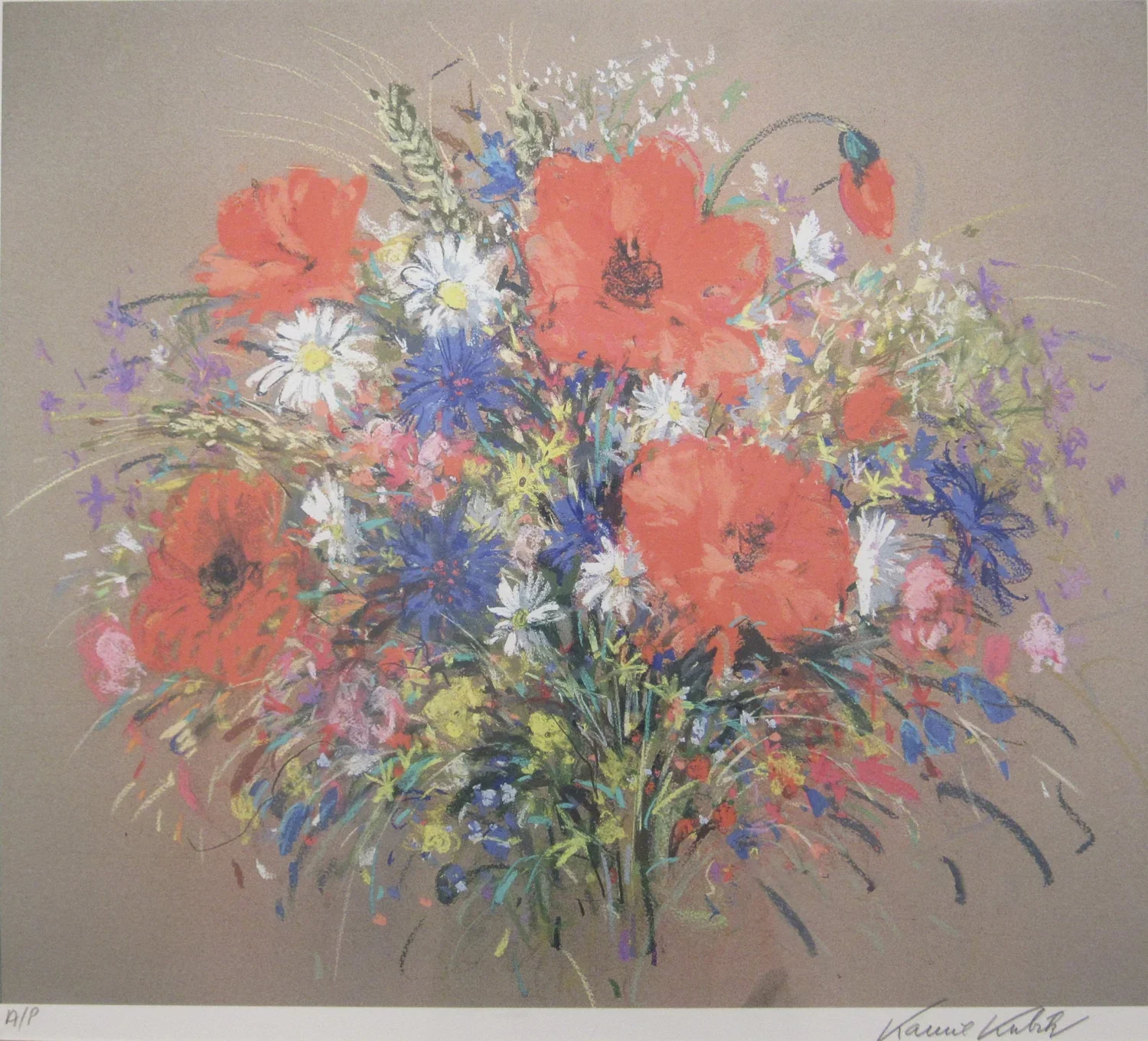

Poppies have long been grown in the Czech Republic, with the seeds being used in many traditional Czech recipes. Apart from his landscapes and architectural depictions, Kubik was known for his floral pieces, so it is not surprising that poppies would have caught his attention and focus in some of his floral works. In particular, the inclusion of not just red poppies, but also blue and white wildflowers was a choice most likely done with the national colors of the Czech Republic in mind.

ARTIST
Kamil Kubik

TITLE
Poppies- Czechoslovakian Wild Flowers

MEDIUM
Pastel on paper 

DIMENSIONS
Width 31.5 in x Height 28.5 in

CURRENT LOCATION
Collections

ACCESSION NUMBER
2005.11.1

CLASSIFICATION
Print, signed by artist

PROVENANCE
The piece was acquired by the Czech Center Museum Houston from Marta P. Latsch in April, 2005.

Red, white, and blue shine against a tonal background where a grouping of native wild flowers become a symbol of national identity. The soft, yet briskness to the strokes bring the fragility and resilience of Central Eastern Europe to mind.


Paul Revere Monument
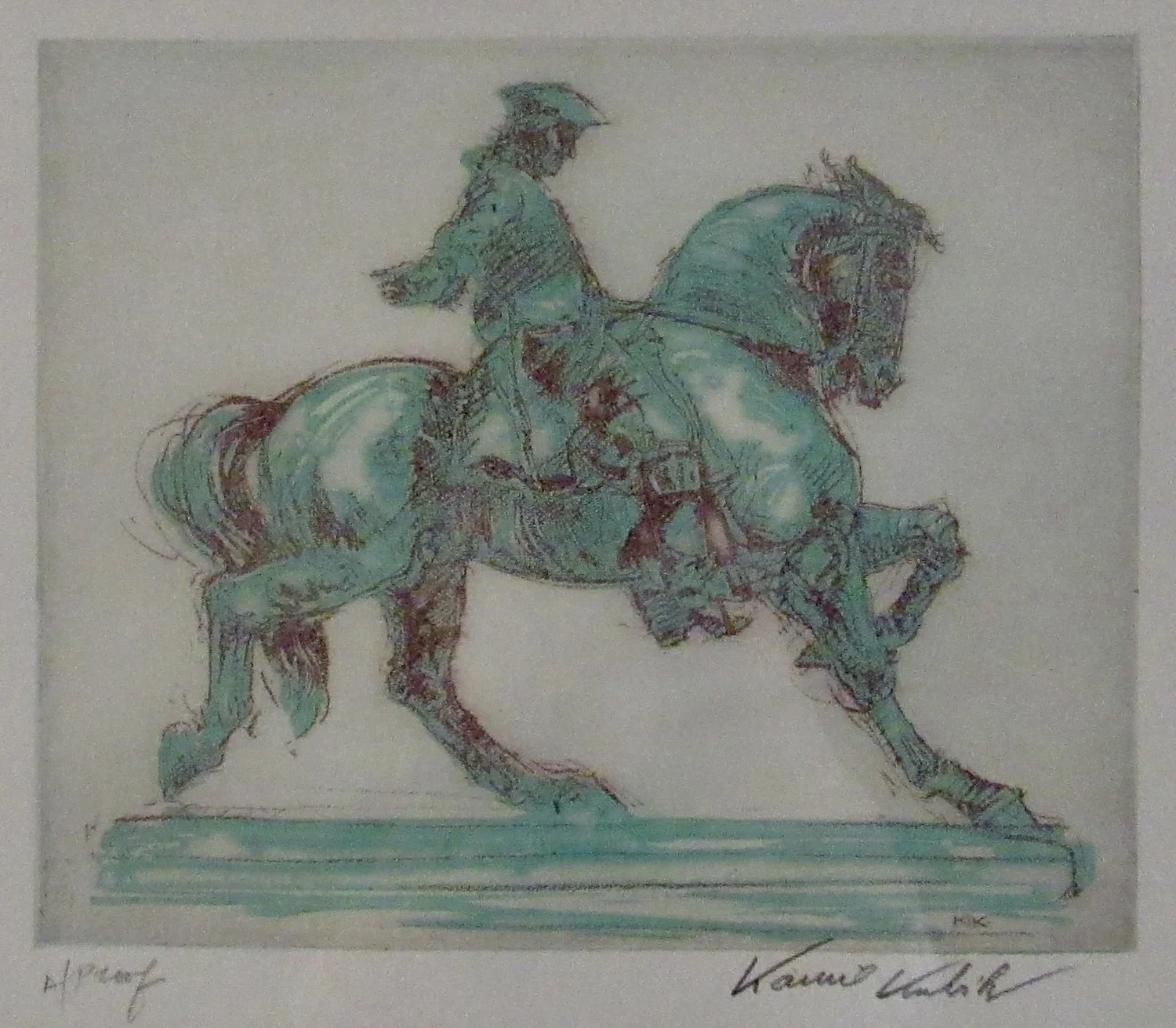
Easily identifiable, Paul Revere became famous for his midnight ride to alert the local colonial militia that the British forces were on their way, thus allowing John Adams and John Hancock time to raise the minutemen to defend against the British. Undoubtedly, Kamil Kubik must have viewed this finished statue as a symbol of courage and the fight against imperial rule.  

His monochromatic sketch allows audiences to fully understand and appreciate the attention to form. The gestural detail of the monument enables viewers to easily identify this patriotic and national figure.

ARTIST
Kamil Kubik

TITLE
Paul Revere Monument

MEDIUM
Pastel on paper, original, signed by artist

DIMENSIONS
34cm x 30cm

CURRENT LOCATION
Collections

ACCESSION NUMBER
PU17

CLASSIFICATION
Original, signed by the artist

PROVENANCE
The piece was acquired by the Czech Center Museum Houston from an unknown donation.


Saint Patrick’s Cathedral
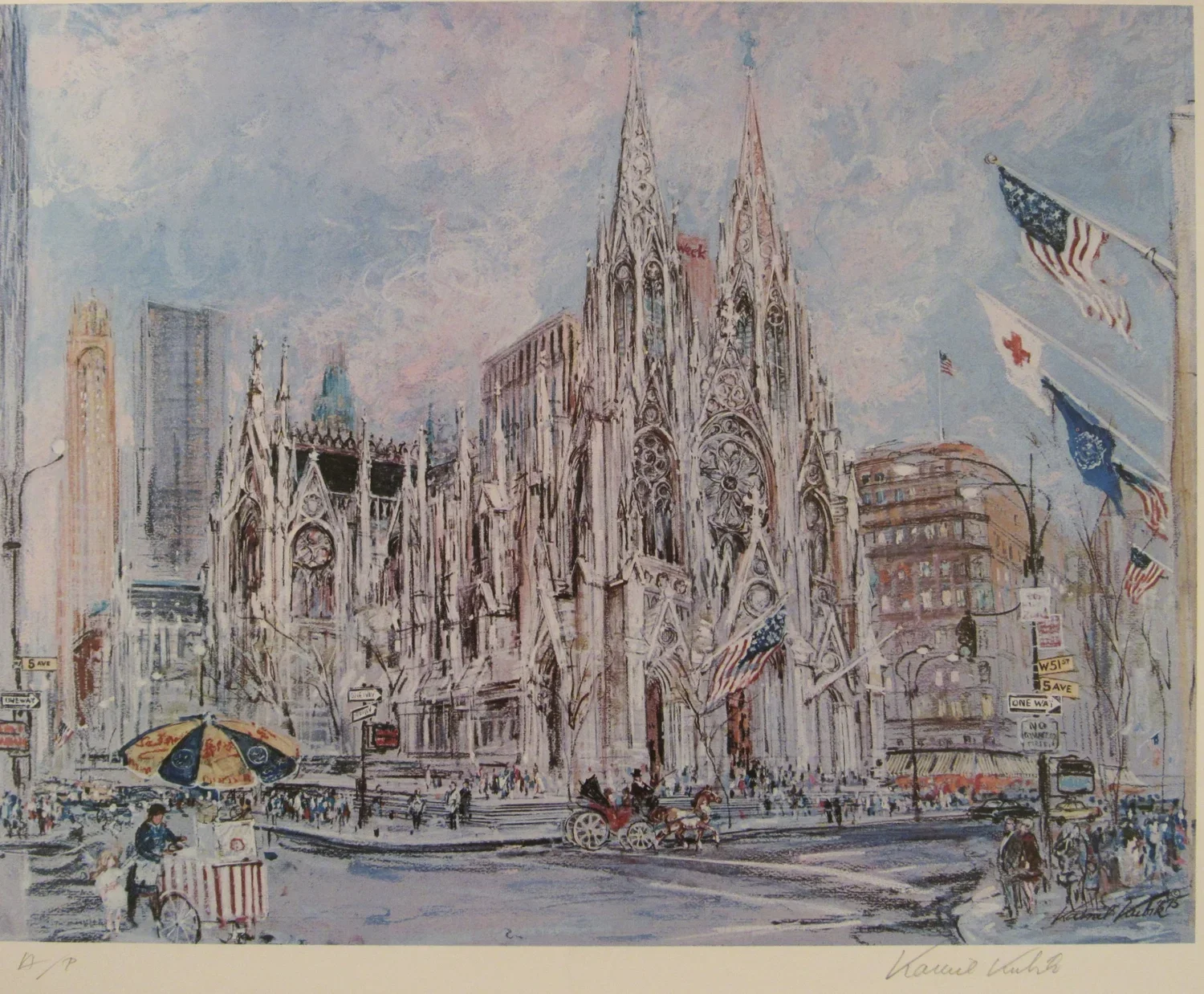
While living in New York, Kubik often painted depictions of famous and popular landmarks around the city. The St. Patrick’s Cathedral in New York City opened in 1879 to help accommodate the growing Catholic community in the city. The Cathedral remains the largest Gothic style cathedral in the New World and has become a central part of New York City’s unique architectural heritage.

The use of cool tones and sharp vertical lines helps to accentuate the Gothic architecture of the cathedral. Rather than exclusively focusing on the building, Kubik’s commonly used composition is employed; the surrounding streets and buildings incorporate a sense of busy city life in the movement of the painting.

ARTIST
Kamil Kubik

TITLE
Saint Patrick’s Cathedral, New York City

MEDIUM
Pastel on Paper  

DIMENSIONS
45cm x 35cm

CURRENT LOCATION
Collections

ACCESSION NUMBER
PRos5

CLASSIFICATION
Print, signed by artist

PROVENANCE
The piece was acquired by the Czech Center Museum Houston from Effie & Bill Rosene in March 2012.


Return to Czechoslovakia

After defecting from Czechoslovakia in 1948, Kamil Kubik was allowed to return in the 1960s, once to visit family and friends and again a few months later to attend the funeral of his father. It is likely that during these short return trips home, he would have taken to the streets to paint in areas of Prague and around Czechoslovakia, as he was known to do whenever he traveled. The following are several pieces from the Czech Center Museum Houston collection that most likely would have been completed during these trips back to Czechoslovakia.


Jan Hus Statue in Prague
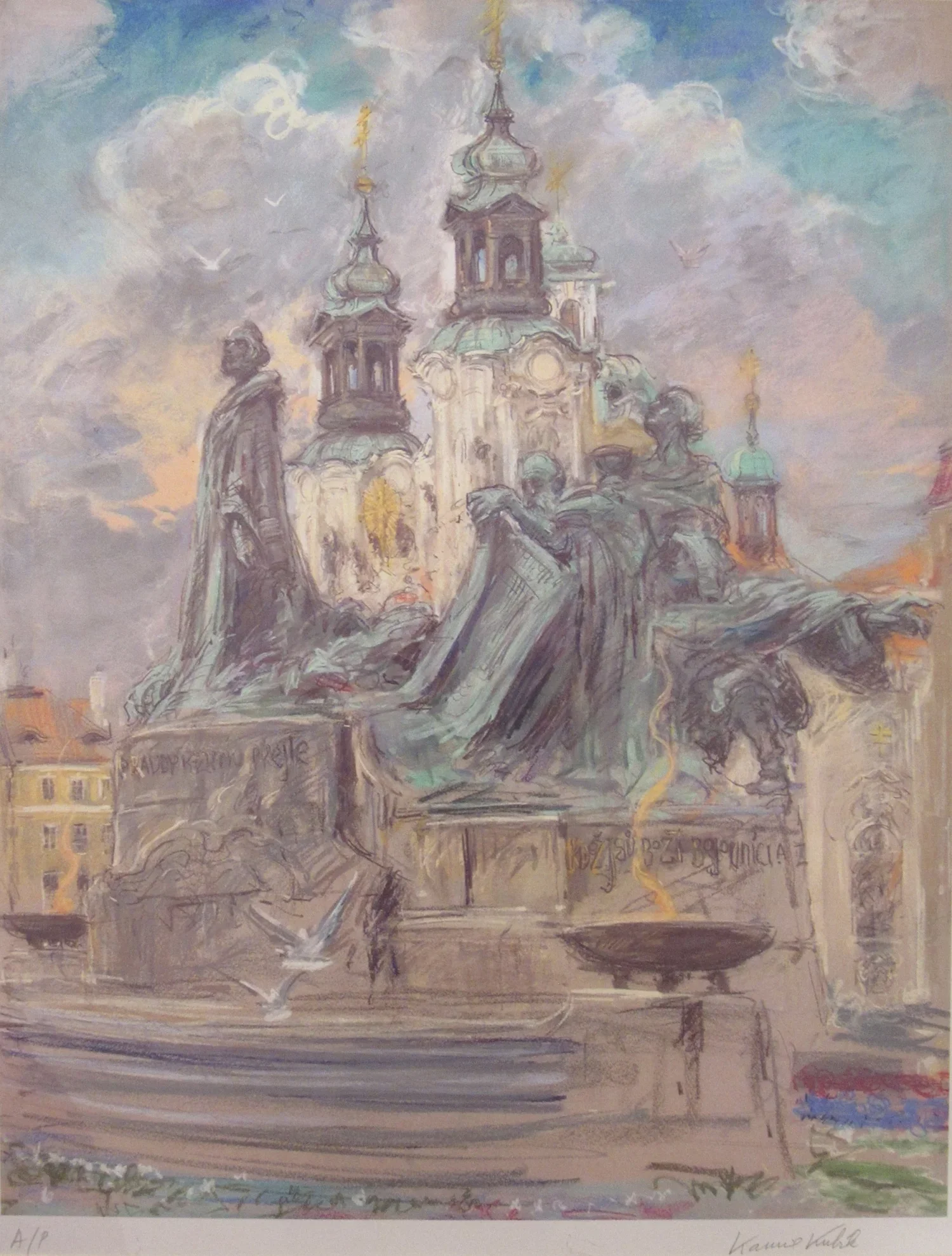
Born in 1369, Jan Hus was a religious thinker, philosopher, and reformer who spoke out openly against the Catholic church before he was burned at the stake in 1415. The monument in his memory was completed in 1915 and quickly became a symbol of dissidence and strength against oppressive regimes. During the communist rule in Czechoslovakia, sitting at the feet of the memorial became a way to silently express opposition to communist rule, a symbol that would probably have resonated deeply with Kubik after his defection from the country following the communist coup.

ARTIST
Kamil Kubik

TITLE
Jan Hus statue in Prague

MEDIUM
Pastel on paper

DIMENSIONS
Width 28 in x Height 34.25 in

CREDIT LINE
Gift of Laverne Huml Nash

CURRENT LOCATION
Collections

ACCESSION NUMBER
2005.12.1

CLASSIFICATION
Print, signed by artist

PROVENANCE
The piece was acquired by the Czech Center Museum Houston from Laverne Huml Nash on April 13, 2005.

From a street perspective, Kubik’s view of the Jan Hus statue is monumental. The turquoise and greens of the statue are echoed in the roof and sky. Although the statue is not rendered in high detail, we understand the visual language of the piece through his characteristic strokes which carve out a sense of form.


Prague Castle- Hradčany
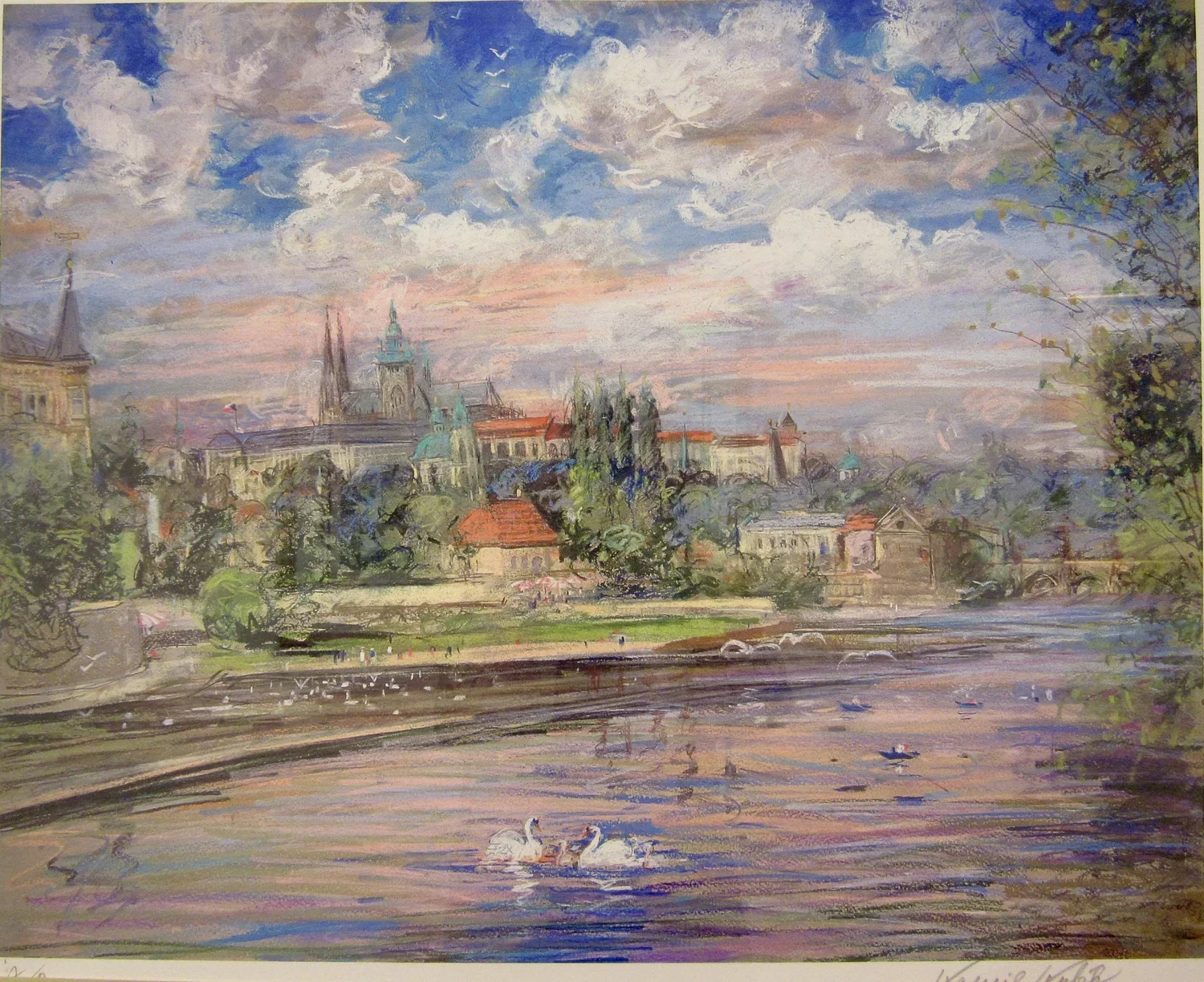
One of the most iconic landmarks, Prague Castle’s history began in 880 C.E., with strong connections to both the head of state and the Catholic church. Throughout its history, the castle has gone through periods of neglect followed by renovations and is considered an important cultural and historical monument, as well as the world’s largest ancient castle complex.

ARTIST
Kamil Kubik

TITLE
Prague Castle- Hradčany

MEDIUM
Pastel on paper

DIMENSIONS
Width 33.75 in x Height 28.75 in

CURRENT LOCATION
Collections

ACCESSION NUMBER
1000.99.12

CLASSIFICATION
Print, signed by artist

PROVENANCE
The piece was acquired by the Czech Center Museum Houston from an unknown donation.

The Prague Castle overlooks the Vltava River, famous for its sweeping views and local wildlife, which Kubik was careful to include in his depiction. The colors of the sky are expertly echoed in the surface of the river, which creates a soft and luminous quality, a hallmark of the pastel medium. The ability of pastels to glow on paper makes this medium naturally adept for the Lumière style, which focuses on the light within the piece.


Market in Prague
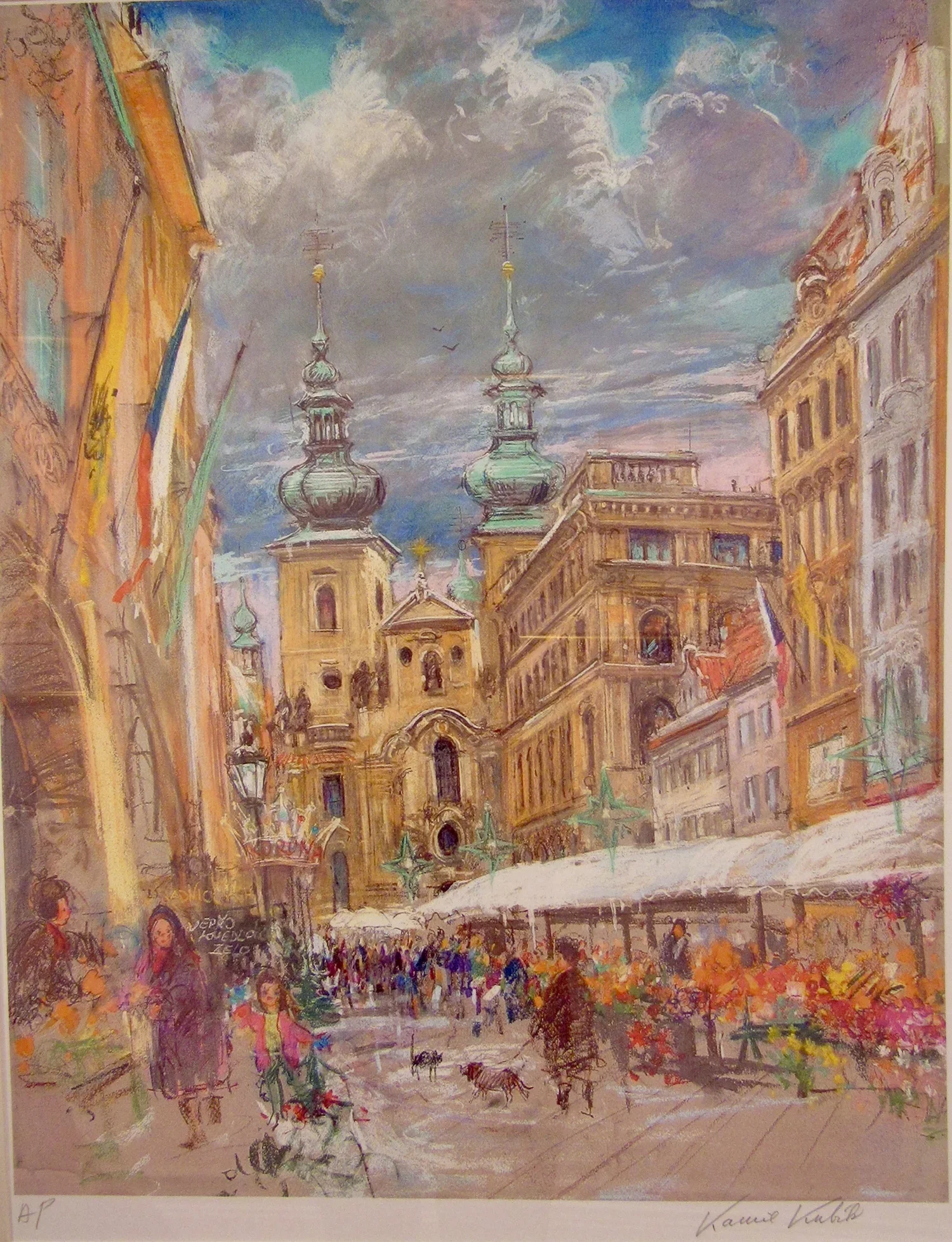
Havel Market is located in the heart of Prague, in one of the oldest parts of the city. The market dates back to the 13th century, and continues to be one of the most notable landmarks in Prague. The Church of St. Havel, established by Wenceslas I in 1232, rises in the background of this popular attraction, which is well known by tourists for its transformation into a Christmas market during the holiday season.

ARTIST
Kamil Kubik

TITLE
Market in Prague

MEDIUM
Pastel on paper

DIMENSIONS
Width 34.75 in x Height 38 in

CREDIT LINE
Gift of Fr. Paul Chovanec

CURRENT LOCATION
Collections

ACCESSION NUMBER
2005.3.1

CLASSIFICATION
Print, signed by artist

PROVENANCE
The piece was acquired by the Czech Center Museum Houston from Fr. Paul Chovanec in April 2005.

The composition of the market scene emphasizes the hustle and bustle of everyday life, while the Church of St. Havel rises above the surrounding buildings. The verdigris hue from the roof is carried throughout the piece, providing a sense of unity to the kaleidoscope of color seen in the market.


Wildflowers on Yellow BackGround
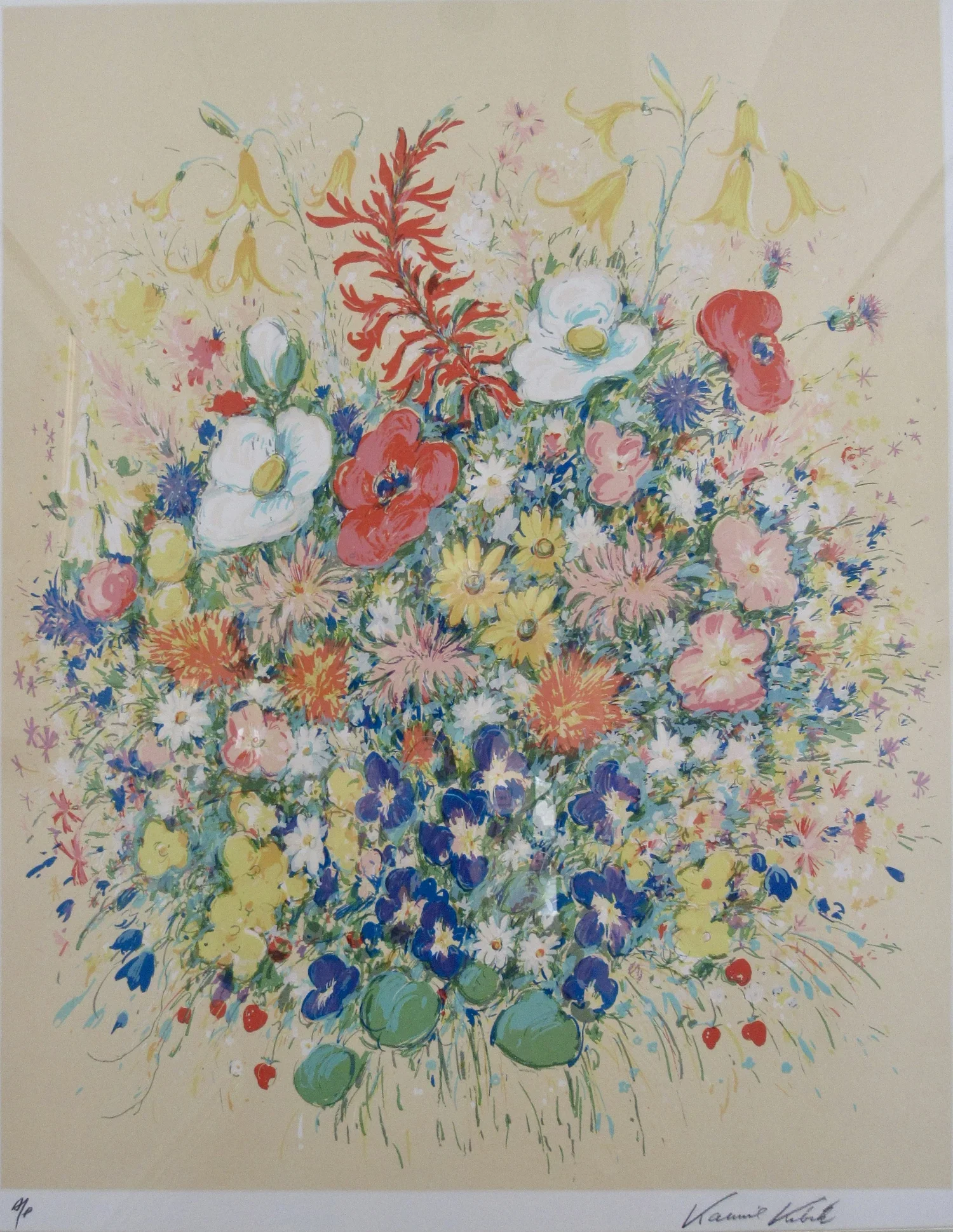
ARTIST
Kamil Kubik

TITLE
Wildflowers on Yellow Background

MEDIUM
Pastel on paper

DIMENSIONS
Width 29 in x Height 34 in

CURRENT LOCATION
Collections

ACCESSION NUMBER
1000.99.13

CLASSIFICATION
Print, signed by artist

PROVENANCE
The piece was acquired by the Czech Center Museum Houston from an unknown donation.

Although he enjoyed painting landscapes, Kubik’s floral pieces are no less impressive, and were often quite popular with those visiting the St. James gallery. According to Kubik, he first met and formed an acquaintance with Former First Lady Barbara Bush when one of his floral designs caught her attention from the window of the gallery and she came in to inquire about the piece. This meeting would grow into a correspondence between the two that lasted over the course of many years.

The vibrant yellow background with native wildflowers draws in even the most discerning of clientele. Sparkes of vibrant colors allow viewers a cheery and energetic display, where the pastel medium shines best.


St. Michael’s Gate, Bratislava, Slovakia
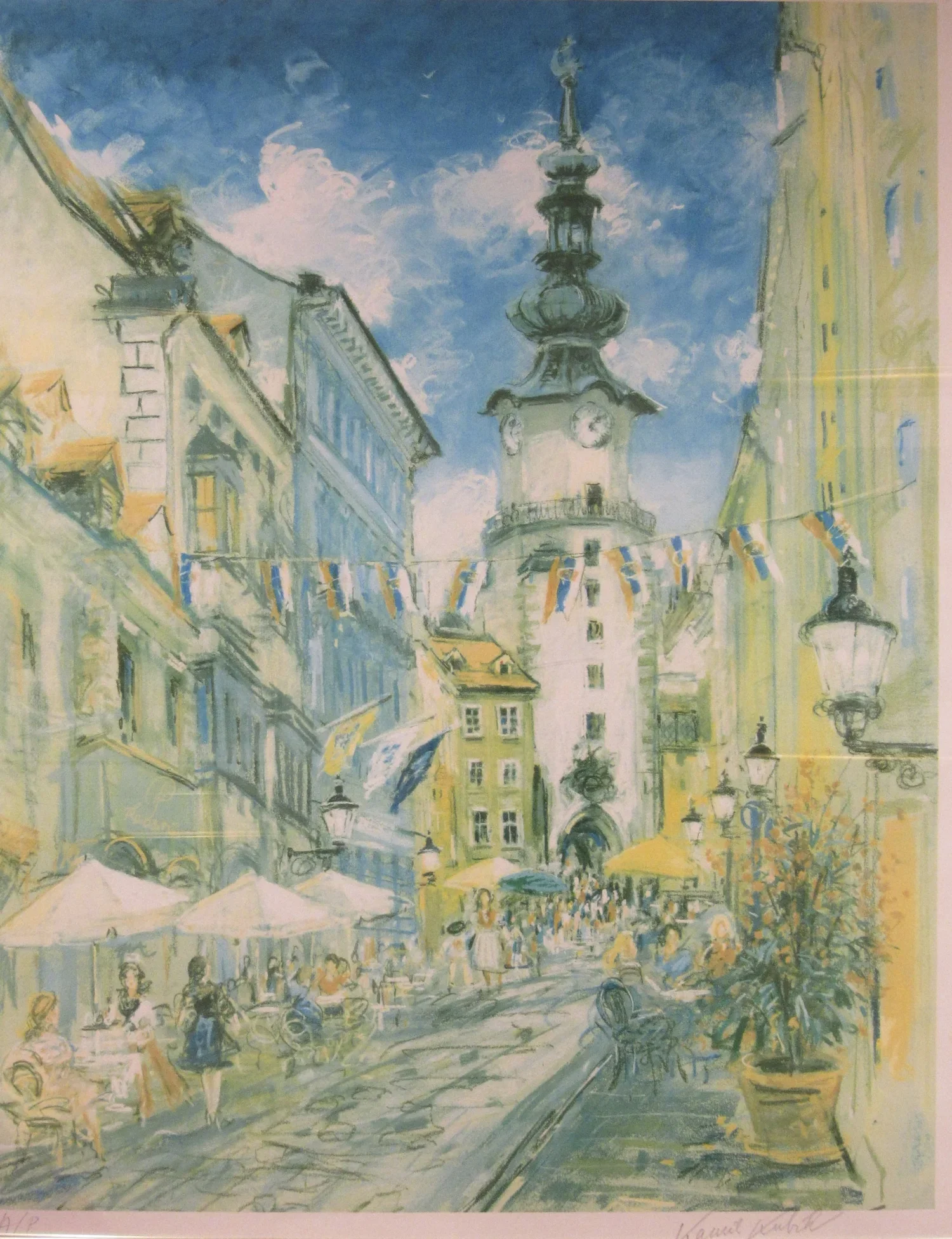
ARTIST
Kamil Kubik

TITLE
St. Michael’s Gate, Bratislava, Slovakia

MEDIUM
Pastel on paper

DIMENSIONS
Width 32 in x Height 38.25 in

CURRENT LOCATION
Collections

ACCESSION NUMBER
1000.99.10

CLASSIFICATION
Print, signed by artist

PROVENANCE
The piece was acquired by the Czech Center Museum Houston from an unknown donation.

Named after the Archangel Michael, St. Michael’s gate is the only one remaining of the four original gates that guarded entry to the city of Bratislava. Built in the 14th century as part of the medieval fortifications to the city, the gate has become one of the most well known landmarks in Bratislava, with renovations and restorations taking place to preserve its history. 

Kubik’s interpretation of this iconic street scene with one of Bratislava’s historic buildings harkens back to his scenic urban landscapes. His soft and muted color palette draws attention to the architecture and renders a subtle atmospheric setting from a pedestrian's perspective.


Slovak National Theater, Bratislava, Slovakia
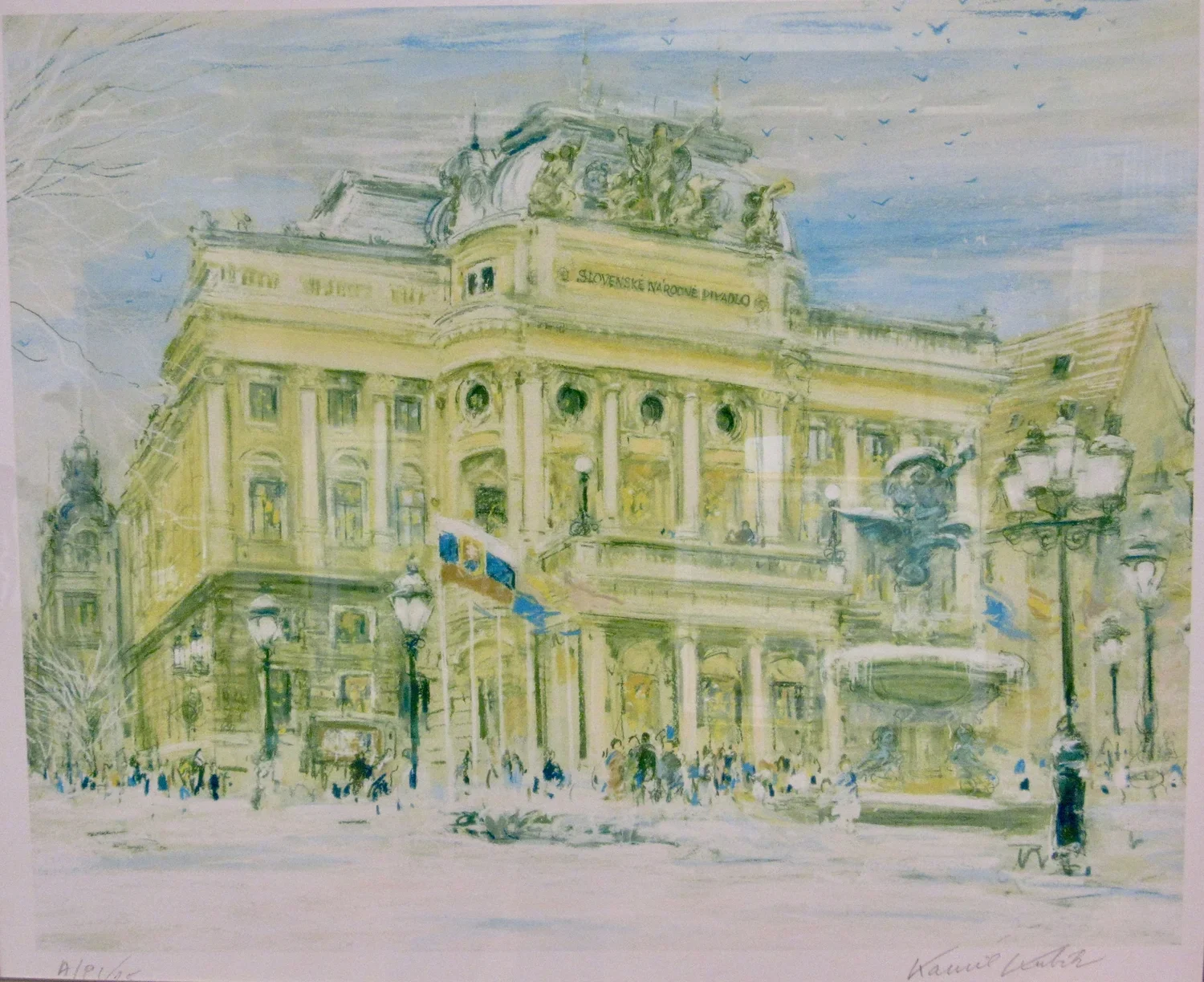
The Slovak National Theater stands where the former city theatre was established in 1776. Built by Austrian architects in 1886, the National Theater features its memorable neo-renaissance look, the preferred style for many cultural institutions of the time. Beginning in the 1920s, it housed the Slovak National Theater and eventually opera and ballet companies. The building is currently under reconstruction to upgrade its infrastructure and improve the acoustics while preserving the history of the building. 

ARTIST
Kamil Kubik

TITLE
Slovak National Theater, Bratislava, Slovakia

MEDIUM
Pastel on paper

DIMENSIONS
30 in x 35 in

CURRENT LOCATION
Collections

ACCESSION NUMBER
1000.99.9

CLASSIFICATION
Print, signed by artist

PROVENANCE
The piece was acquired by the Czech Center Museum Houston from an unknown donation.

Standing boldly in the center of the scene, the prominent architecture captures the imagination. The symmetrical face of the building with the horizontal stone banding is a quintessential hallmark of Renaissance revival architecture, which was popularized in the Austro-Hungarian Empire. This strong rendering of a historical building emphasizes its cultural significance of the time.


Prague’s Charles Bridge under the Snow
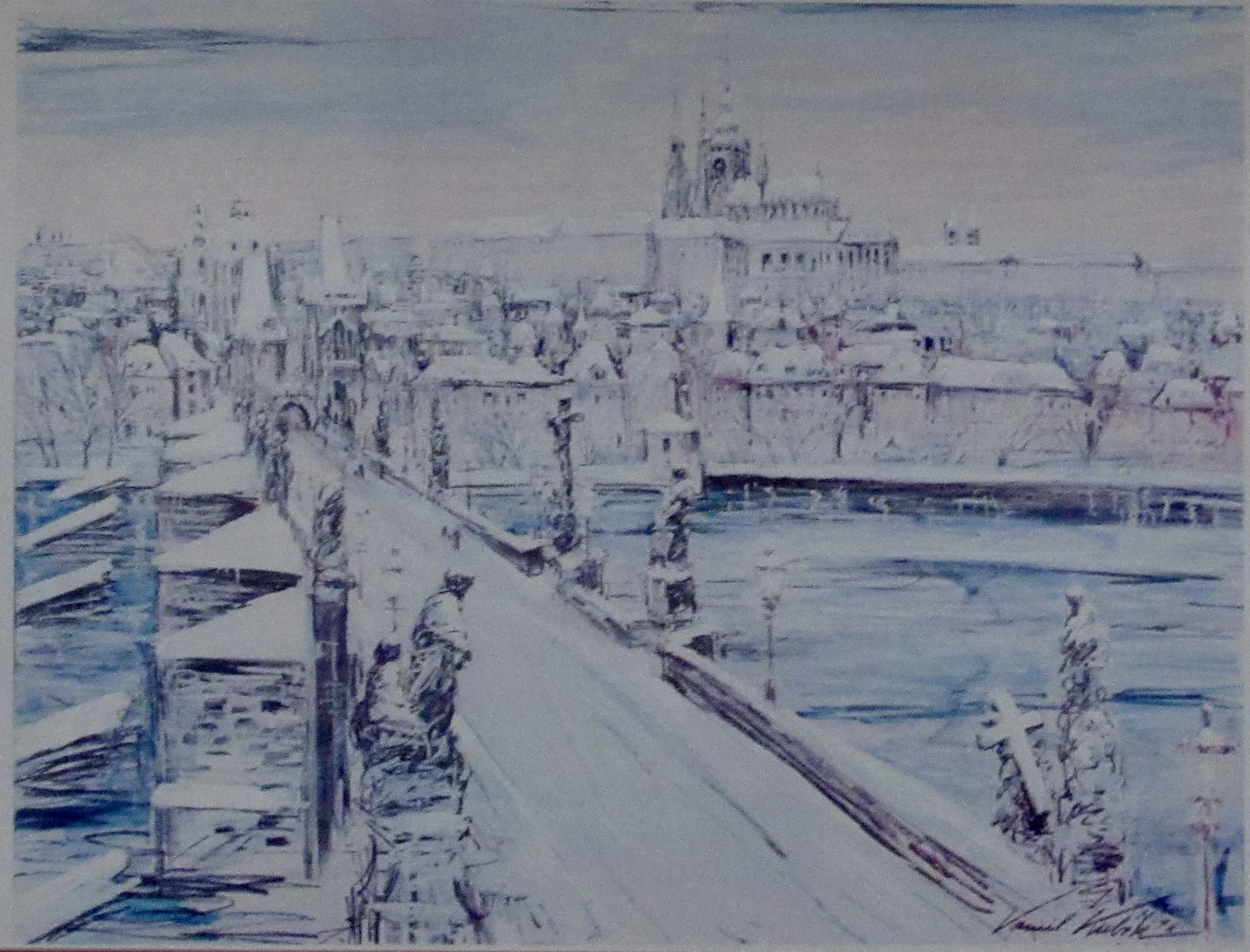
The Charles Bridge is the oldest preserved Prague bridge, and one that is often photographed by those visiting the city. Construction began on July 9th, 1357 after the original bridge was destroyed in a flood. Timing of the bridge started at exactly 5:31 am in order to create a palindromic number: 1 3 5 7 (year) 9 (day) 7 (month) and 5 3 1 (time). From the 14th century until 1928, sculptures of 30 different saints have been placed along the bridge on both sides, often being replaced by contemporary copies of the originals when they were destroyed or damaged by weather or flooding.

ARTIST
Kamil Kubik

TITLE
Prague’s Charles Bridge in the Snow

MEDIUM
Pastel on paper

DIMENSIONS
Width 20.75 in x Height 17.75 in

CURRENT LOCATION
Collections

ACCESSION NUMBER
2007.12.1

CLASSIFICATION
Print

PROVENANCE
The piece was acquired by the Czech Center Museum Houston from Laverne Huml Nash in April, 2007.

The shift of pinks, blues, and grays used strategically within the piece lend a feeling of the bridge and city under snow. The subtle use of a limited color palette allows us to focus on form, structure and atmosphere rather than details, reinforcing the quiet mood of the scene.


Prague Municipal Building
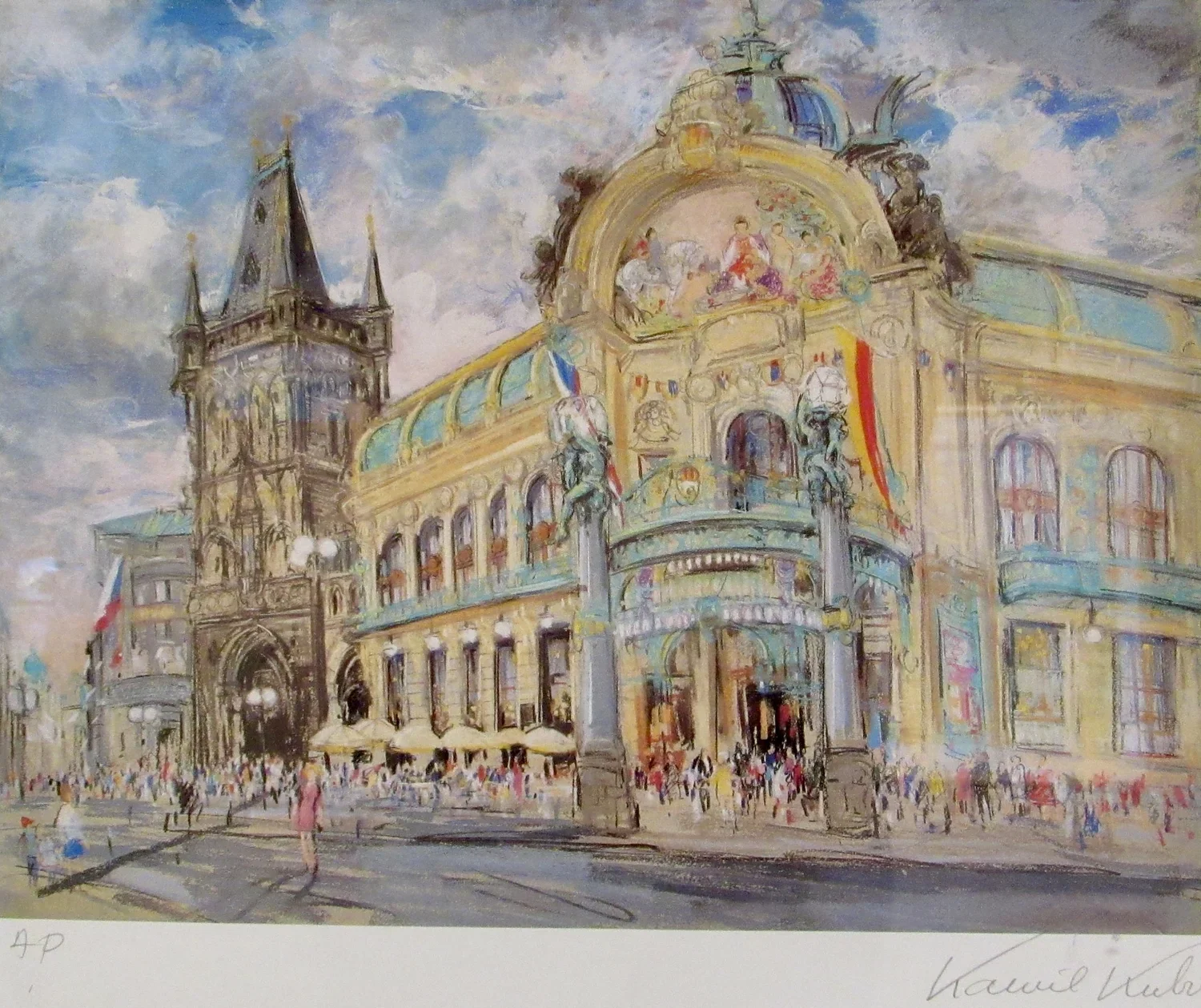
The Municipal House stands on a site long associated with different governing buildings. It was originally the site of the royal King’s Court and eventually became the location of a military cadet school. The modern building was finished in 1911, housing several significant events in the independence of Czechoslovakia, including the signing of the Three Kings Declaration, calling for the creation of independent Czechoslovakia. The first National Committee assembled and issued the first law of the new republic in the building as well. Kubik, along with other Czechs would have surely seen the building as a representation of a free and independent Czechoslovakia.

ARTIST
Kamil Kubik

TITLE
Prague Municipal Building

MEDIUM
Pastel on paper

DIMENSIONS
Width 19.75 in x Height 17.25 in

CURRENT LOCATION
Collections

ACCESSION NUMBER
1000.99.15

CLASSIFICATION
Print, signed by artist

PROVENANCE
The piece was acquired by the Czech Center Museum Houston from an unknown donation.

The two-point perspective draws the viewer’s eyes straight to the entrance of the Municipal Building, the focal point of the piece. Strong vertical lines and curves accentuates the building’s solid stone façade, emphasizing its civic importance. Kubik’s use of vibrant color adds to the lively feel of this street scene, while pedestrians and vehicles crowd the streets, reinforcing the sense of movement and urban life.


Infant Jesus over Prague
ARTIST
Kamil Kubik

TITLE
Infant Jesus over Prague

MEDIUM
Pastel on paper

DIMENSIONS
Width 28 in x Height 35 in

CURRENT LOCATION
Collections

ACCESSION NUMBER
1000.99.11

CLASSIFICATION
Print, signed by artist

PROVENANCE
The piece was acquired by the Czech Center Museum Houston from an unknown donation.

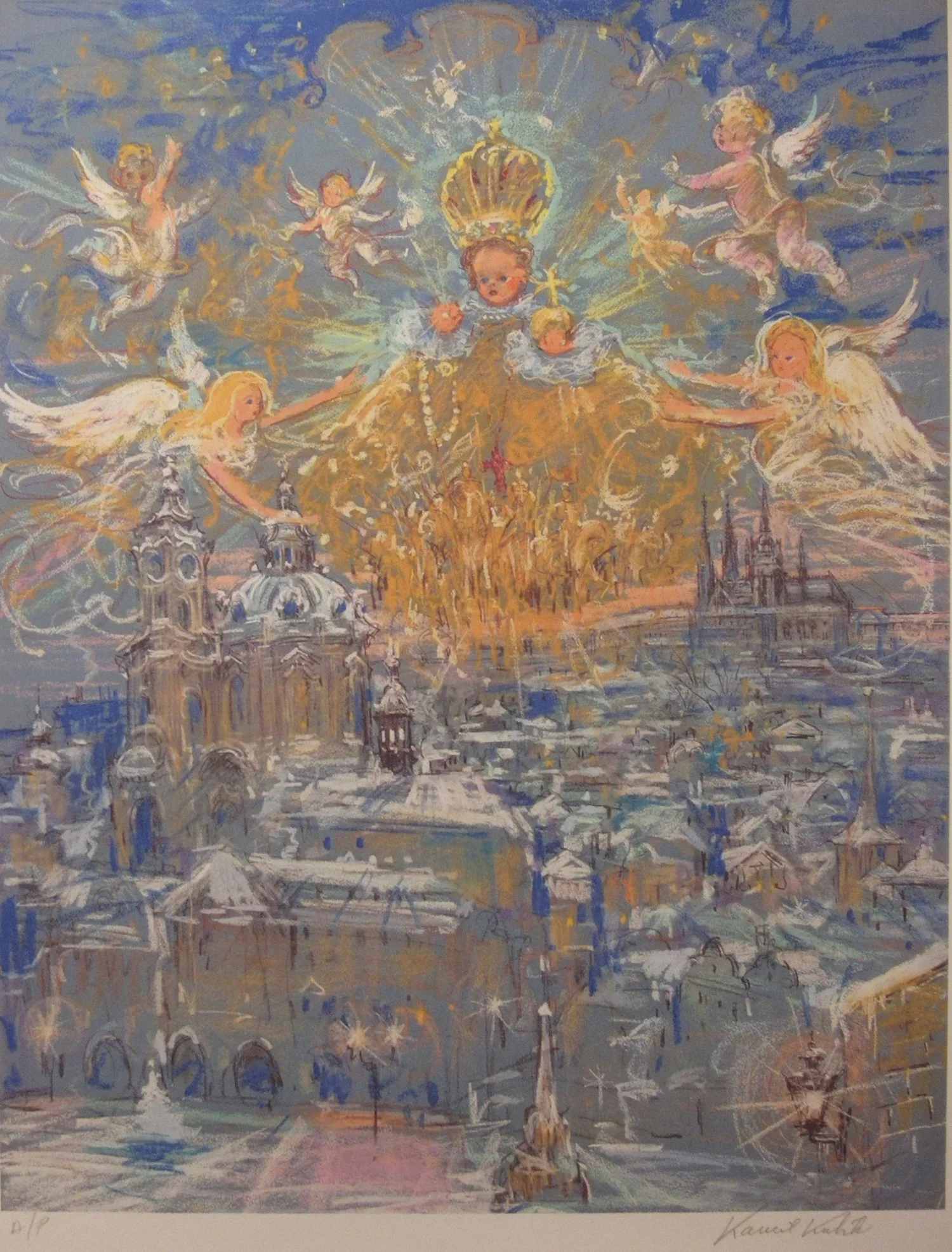
The depiction of the baby Jesus over the city of Prague is a direct reference to the Infant Jesus of Prague statue, currently housed in the Church of Our Lady Victorious. The statue dates to the 16th century, when it was given as a gift from the Spanish Duchess Marie Manriquez de Lara to the Discalced Carmelite friars upon her marriage to a Czech nobleman. The statue has been credited with miraculous healings, particularly of children, and remains a popular pilgrimage site and one Kubik would have been familiar with.

The Infant Jesus’ depiction harkens back to the Eastern European Baroque movement that spread rapidly after the victory of the Catholic Church during the Thirty Years’ War in the 1600s. Baroque style can be characterized by its highly ornate and decorative styling, as seen in the explosion of ornate details, and dramatic entrance of the infant Jesus accompanied by his fanfare of trumpeting angels. The Christ Child holds a globus cruciger (cross-bearing orb) which has been a Christian symbol of spiritual authority since the Middle Ages. Kubik seamlessly ties the piece together with his use of a complementary color palette, creating an expressive, radiant winter scene. 


Return to the United States

Kamil and his wife Joanna both felt the pull to move back to the United States in 1965 after spending several year living and traveling around Europe for Joanna’s ballet career. Kamil’s impressionist style was often at odds with art dealers in New York who were focused on catering to demands for American abstract art. Kamil’s unique style for the time certainty set him apart, earning him many patrons from the wealthy and political elite who often stopped to look at the displays of his artwork through the gallery window. Not content to only paint New York scenes, Kamil travelled across the United States, much like he did during their time in Europe, painting along the way.


Polo Match
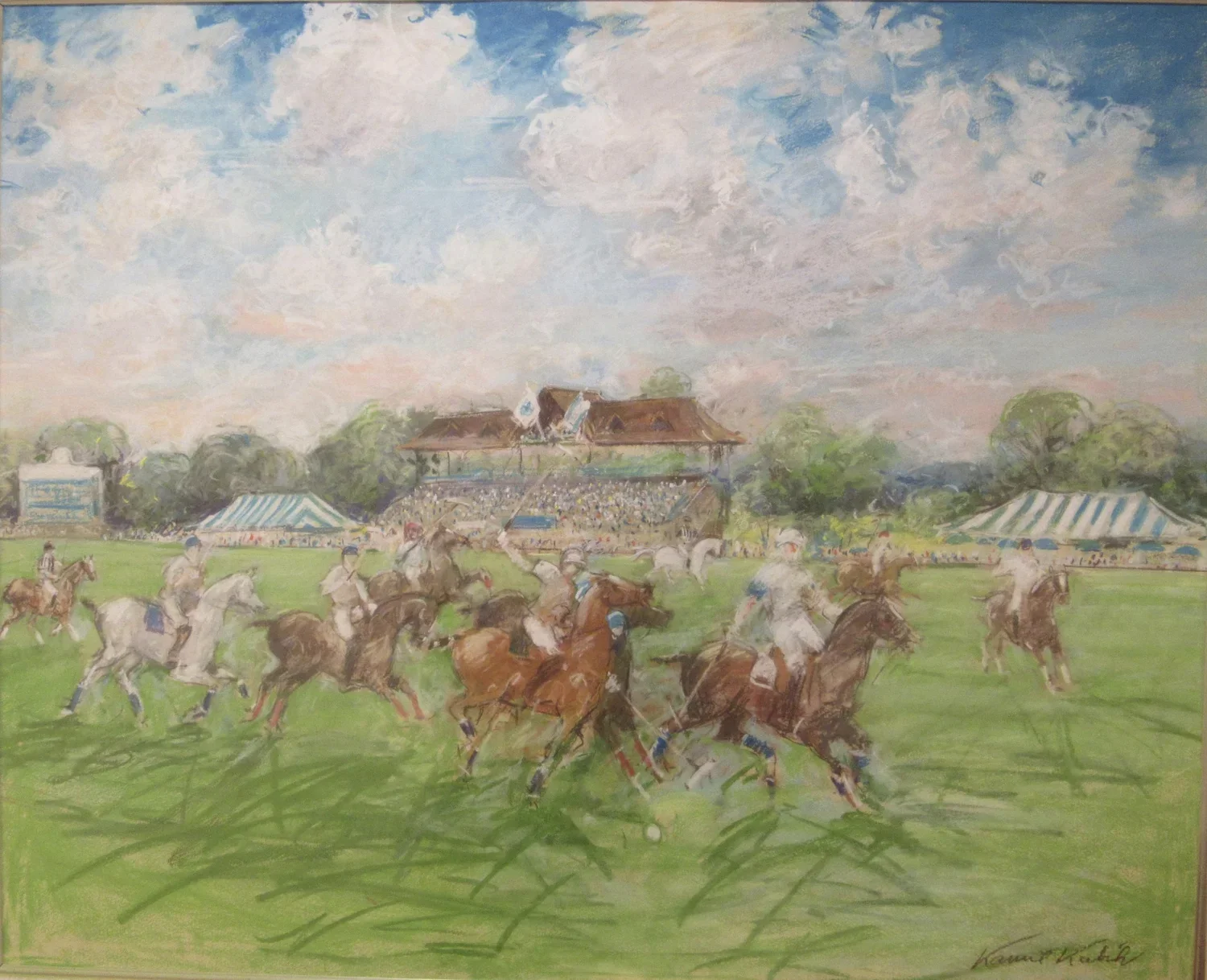
Along with cityscapes, monuments and floral paintings, Kubik also became well known for his depictions of different sporting events. He was the official artist for the US open tennis and golf championships in the 1980s, and created depictions of the 1994 World Cup hosted by the United States. With polo being a prestigious sport both in the United States and across Europe, it is unsurprising that it was depicted by Kublik along with other major sporting events. 

ARTIST
Kamil Kubik

TITLE
Polo Match

MEDIUM
Pastel on paper

DIMENSIONS
Width 38.8 in x Height 32 in

CURRENT LOCATION
Collections

ACCESSION NUMBER
1000.99.14

CLASSIFICATION
Original, signed by artist

PROVENANCE
The piece was acquired by the Czech Center Museum Houston from an unknown donation.

Kubik’s energetic color palette showcases the liveliness of the match. Quick strokes with the pastel create a sense of shadow on the field without sacrificing the sense of movement.


San Antonio River Walk
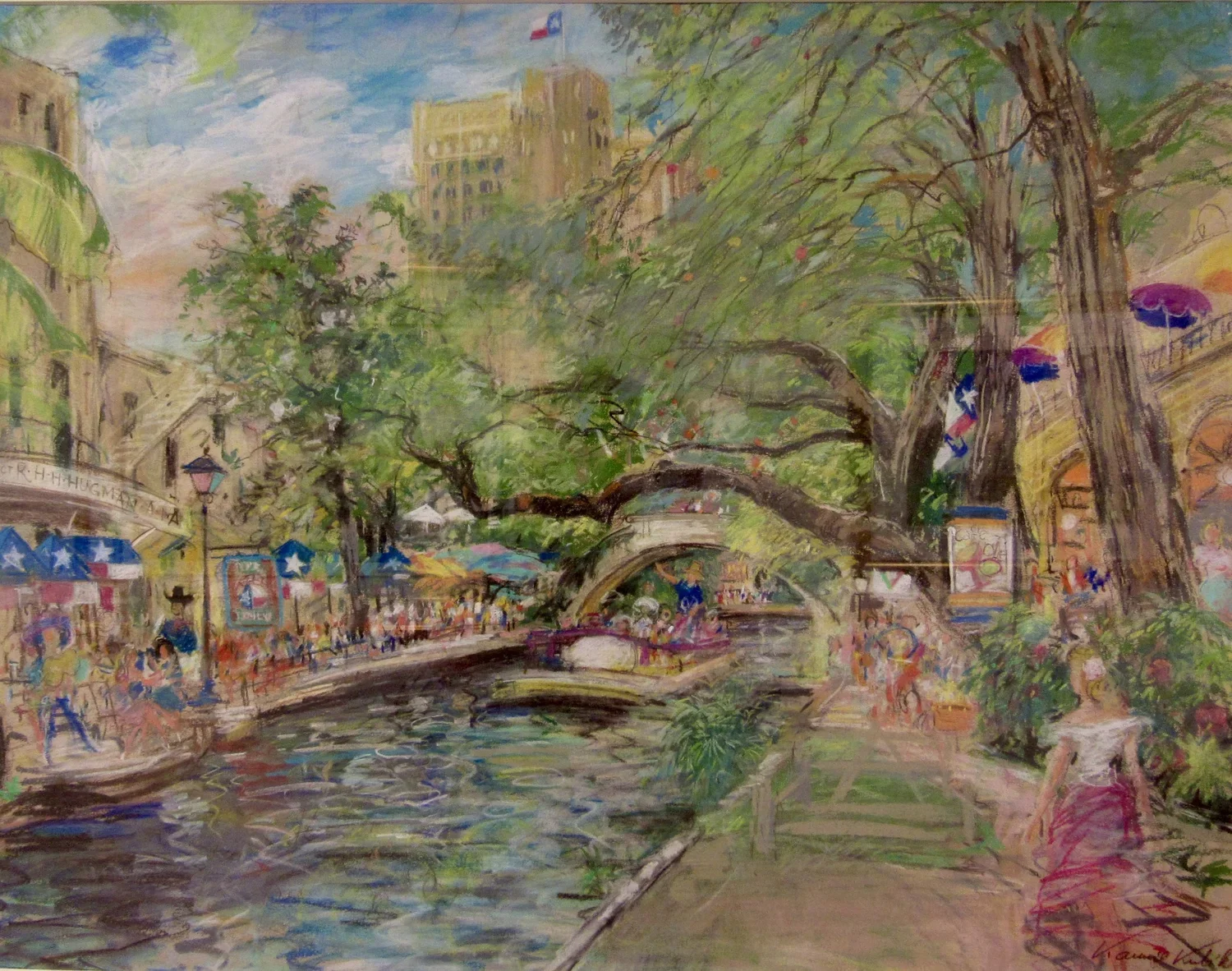
In addition to his works done in New York and Washington D.C., Kubik traveled to different parts of the United States to paint, often stating that he had created works to represent each of the 50 states. The San Antonio Riverwalk, which began as a flood control project after the 1921 flood, has quickly become one of the most iconic sites in Texas, drawing visitors from across the country and around the world.

Kubik’s work captures this vibrant life within his interpretation of the Riverwalk, focusing on expressive strokes to create a sense of movement within the piece.

ARTIST
Kamil Kubik

TITLE
San Antonio River Walk

MEDIUM
Pastel on paper

DIMENSIONS
Width 33.25 in x Height 28 in

CURRENT LOCATION
Collections

ACCESSION NUMBER
1000.99.4

CLASSIFICATION
Original, signed by artist

PROVENANCE
The piece was acquired by the Czech Center Museum Houston from an unknown donation.


University of Texas- Clocktower
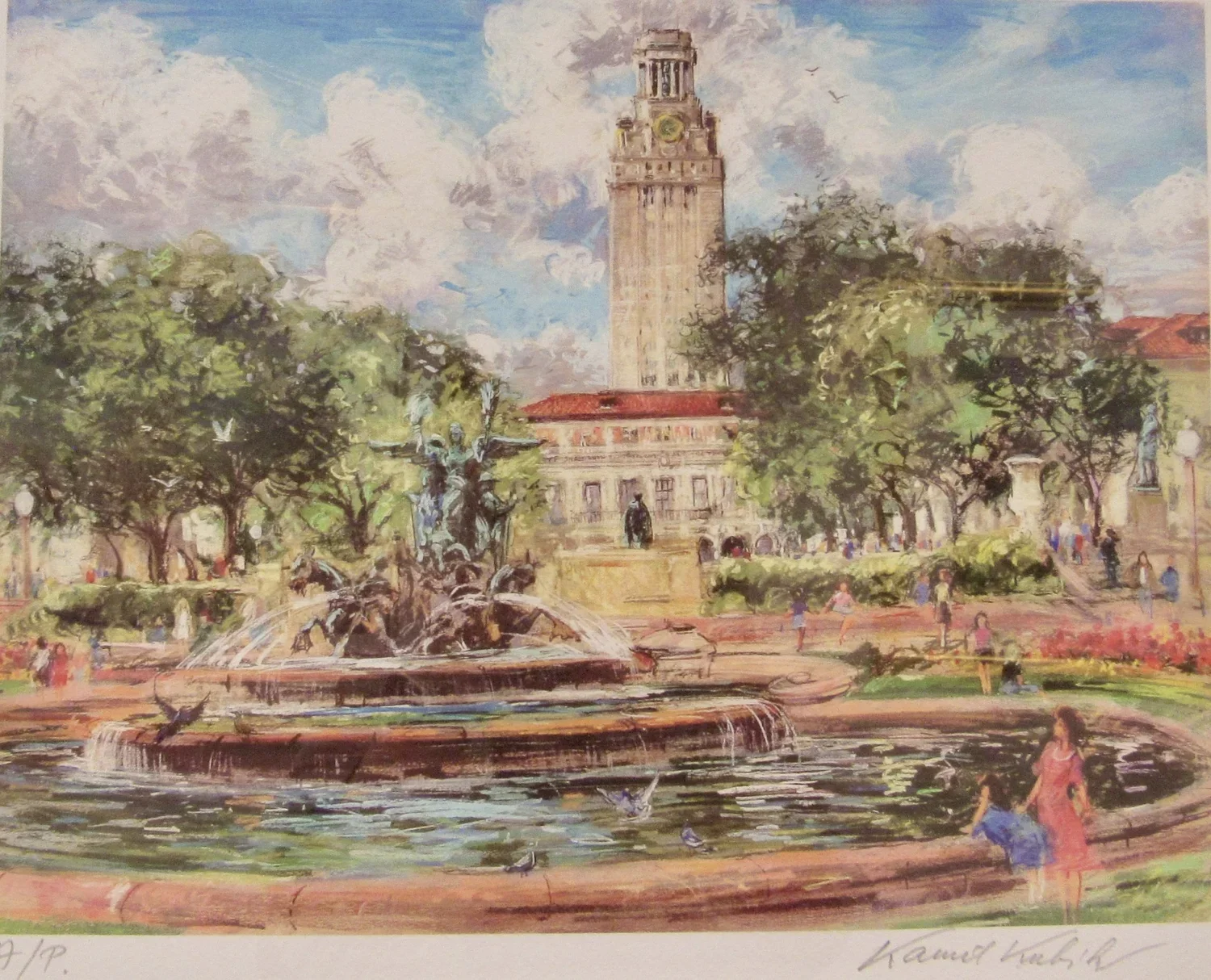
The Clocktower at the University of Texas, Austin, is the most defining building on campus. Completed in 1937, the tower is often lit to commemorate sports victories and academic honors and has become synonymous with school pride. Rendered in pastel, the familiar clock tower rises above the surrounding landscape. 

Favoring atmosphere over precision, Kubik’s technique gives a sense of familiarity and nostalgia with his painterly, loose strokes and calm but vibrant palette.

ARTIST
Kamil Kubik

TITLE
University of Texas- Clocktower

MEDIUM
Pastel on paper

DIMENSIONS
33 cm x 25.5 cm

CURRENT LOCATION
Collections

ACCESSION NUMBER
PU1p

CLASSIFICATION
Print, signed by artist

PROVENANCE
The piece was acquired by the Czech Center Museum Houston from an unknown donation.


American Museum of Natural History, New York
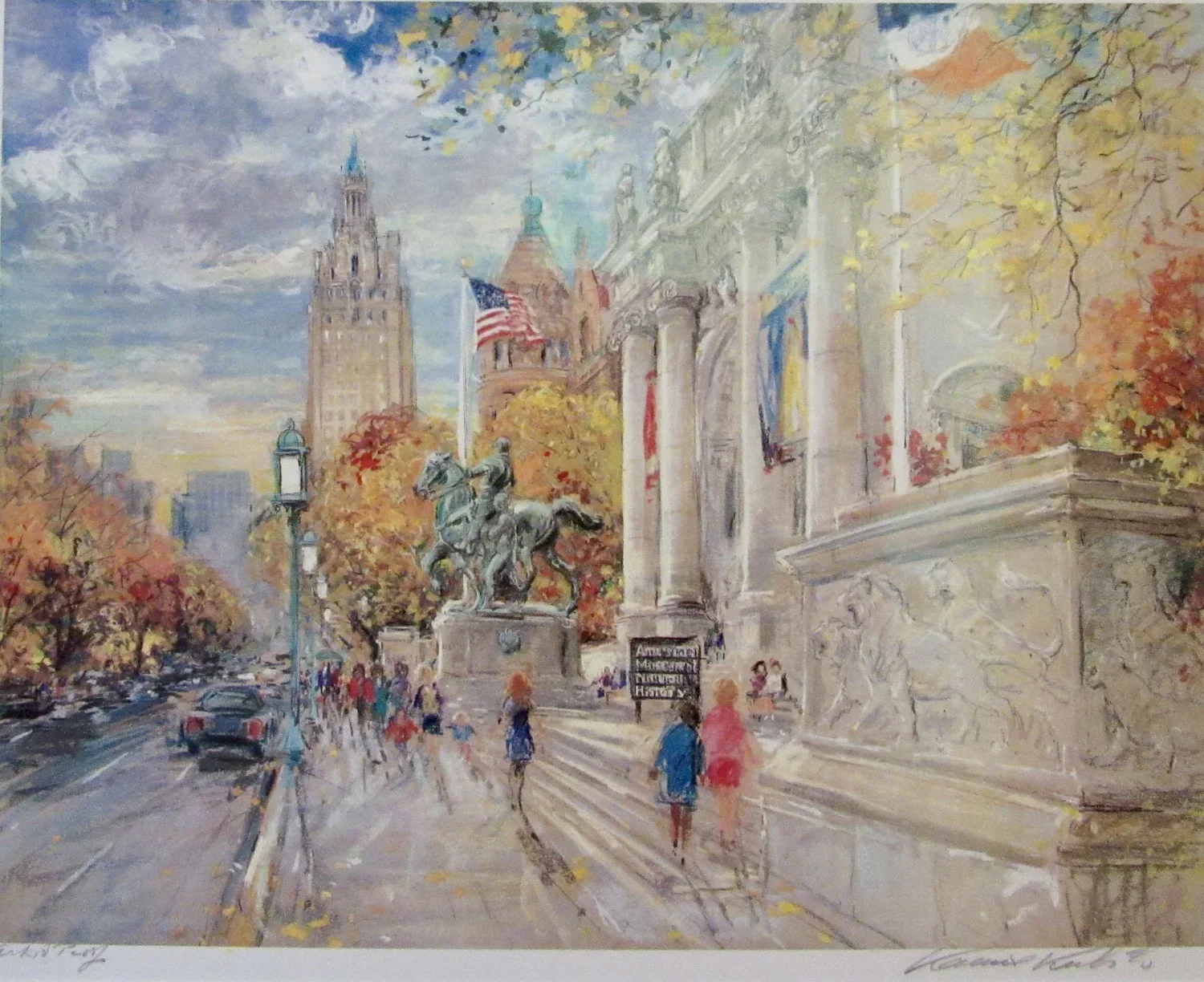
The American Museum of Natural History, founded in 1869, quickly became a large attraction in New York City. The Museum itself is known for its extensive collections, exhibits, and the prominent role it has played in scientific discovery since its inception.

The building's iconic façade is softened by Kubik’s loose handling of the medium. Instead of focusing on sharp angular architectural details, the presentation is of a familiar and accessible part of the city. As people and cars drive by, the emphasis of mood and place render a more atmospheric tone, resulting in an observational view of a well-known institution.

ARTIST
Kamil Kubik

TITLE
American Museum of Natural History, New York

MEDIUM
Pastel on paper

DIMENSIONS
Width 25.5 in x Height 21.5 in

CURRENT LOCATION
Collections

ACCESSION NUMBER
1000.99.7

CLASSIFICATION
Print

PROVENANCE
The piece was acquired by the Czech Center Museum Houston from an unknown donation.


České Slovo -Czech Newspaper Article about Kubik
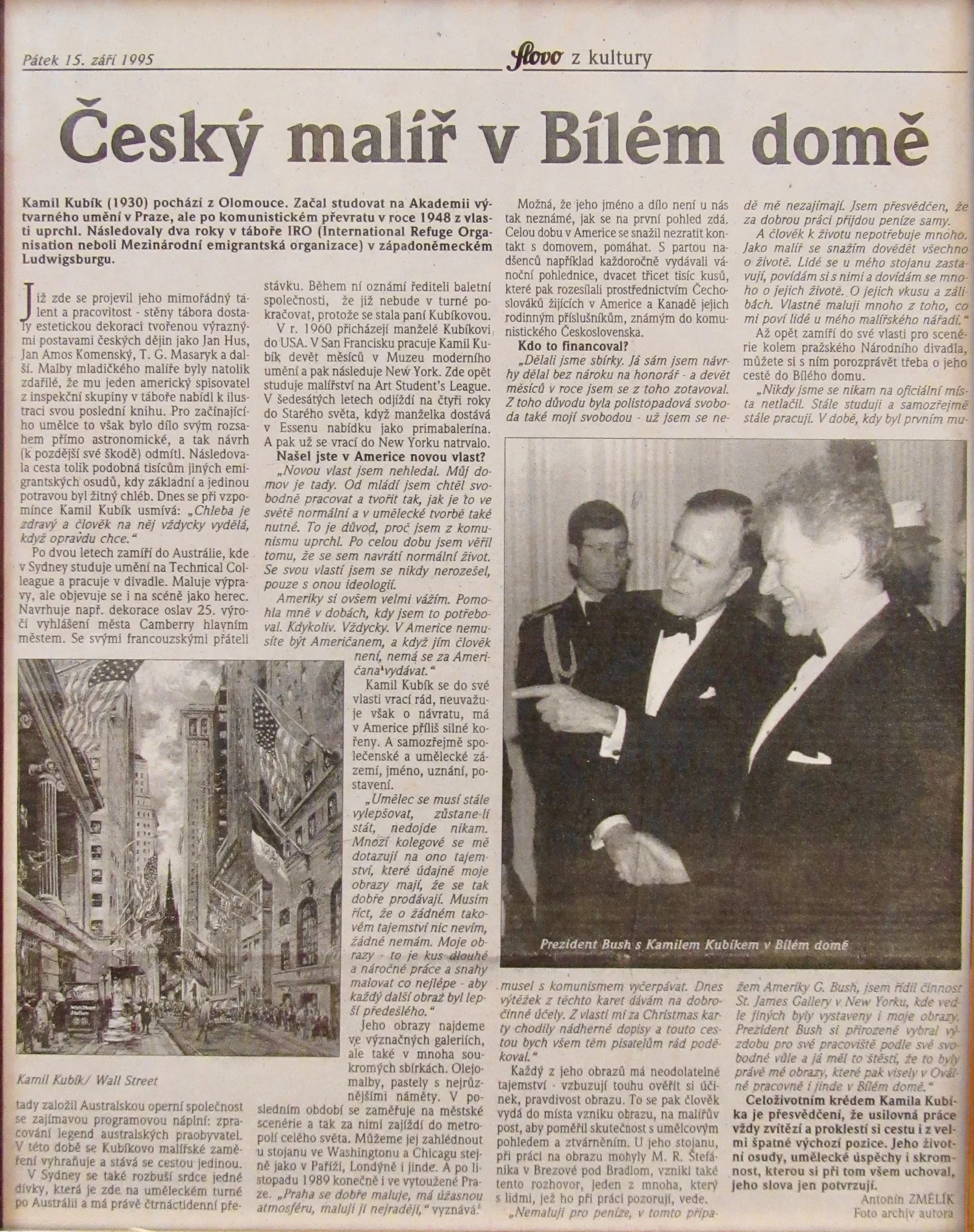
This article in České Slovo, a daily Czech newspaper –printed in 1995, with the paper being discontinued in 1997 – features an article about Kamil Kubik. The feature discusses his life history, artistic motivations, and personal relationship with President George H. W. Bush as the official White House Artist and prominently features a photograph one of his works depicting Wall Street as one of Kubik with President Bush.

AUTHOR
Antonín Zmélík in České Slovo

TITLE
Český malíř v Bílém domé

DATE
September 15, 1995

MEDIUM
Newspaper article

DIMENSIONS
Width 26 cm x Height 34 cm

CURRENT LOCATION
Collections

CLASSIFICATION
Newspaper article

PROVENANCE
The piece was acquired by the Czech Center Museum Houston through an unknown donation.


White House in Spring
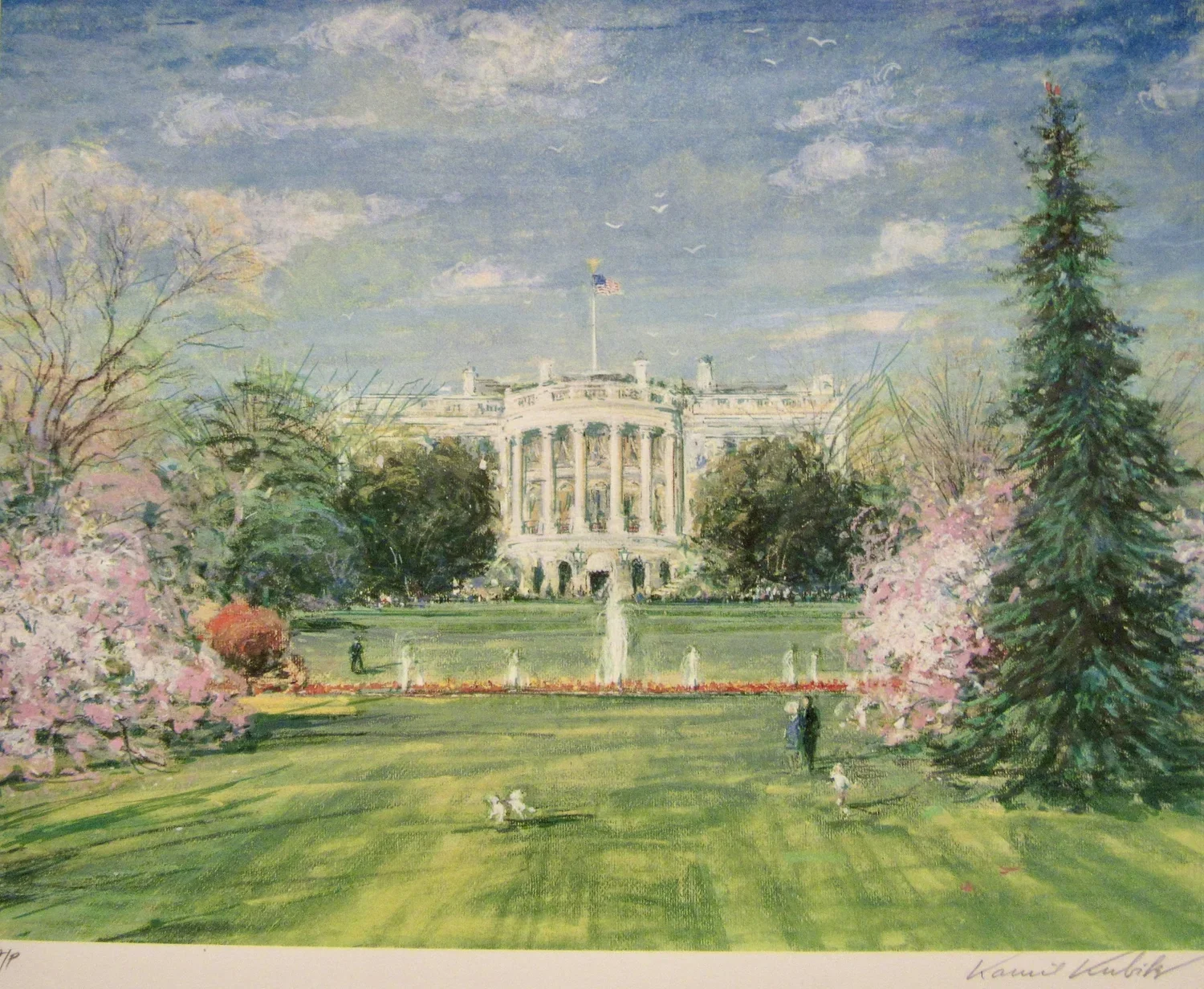
In the 1990s, Kubik became the official White House artist after establishing a close relationship and patronage with Former First Lady Barbara Bush. She had visited the St. James Gallery in New York and upon meeting Kubik, he offered her a print of the UN building for her to give to her husband. During Bush’s presidency, Kubik produced many different depictions of the White House and other government buildings. This piece shows President George H. W. Bush and First Lady Barbara Bush strolling leisurely on the front lawn. A child skips happily towards Millie, the Bushes’ English Springer Spaniel , running towards the group.

ARTIST
Kamil Kubik

TITLE
White House in Springtime

MEDIUM
Pastel on paper

DIMENSIONS
Width 26.5 in x Height 22.5 in

CURRENT LOCATION
Collections

ACCESSION NUMBER
2012.5.1

CLASSIFICATION
Print

PROVENANCE
The piece was acquired by the Czech Center Museum Houston from Effie and Billie Rosene in 2012.

Through his lively color palette, Kubik draws attention to the vitality of springtime at the White House, with its monumental architecture emerging through the soft landscape in bloom.


Inauguration of President Bush
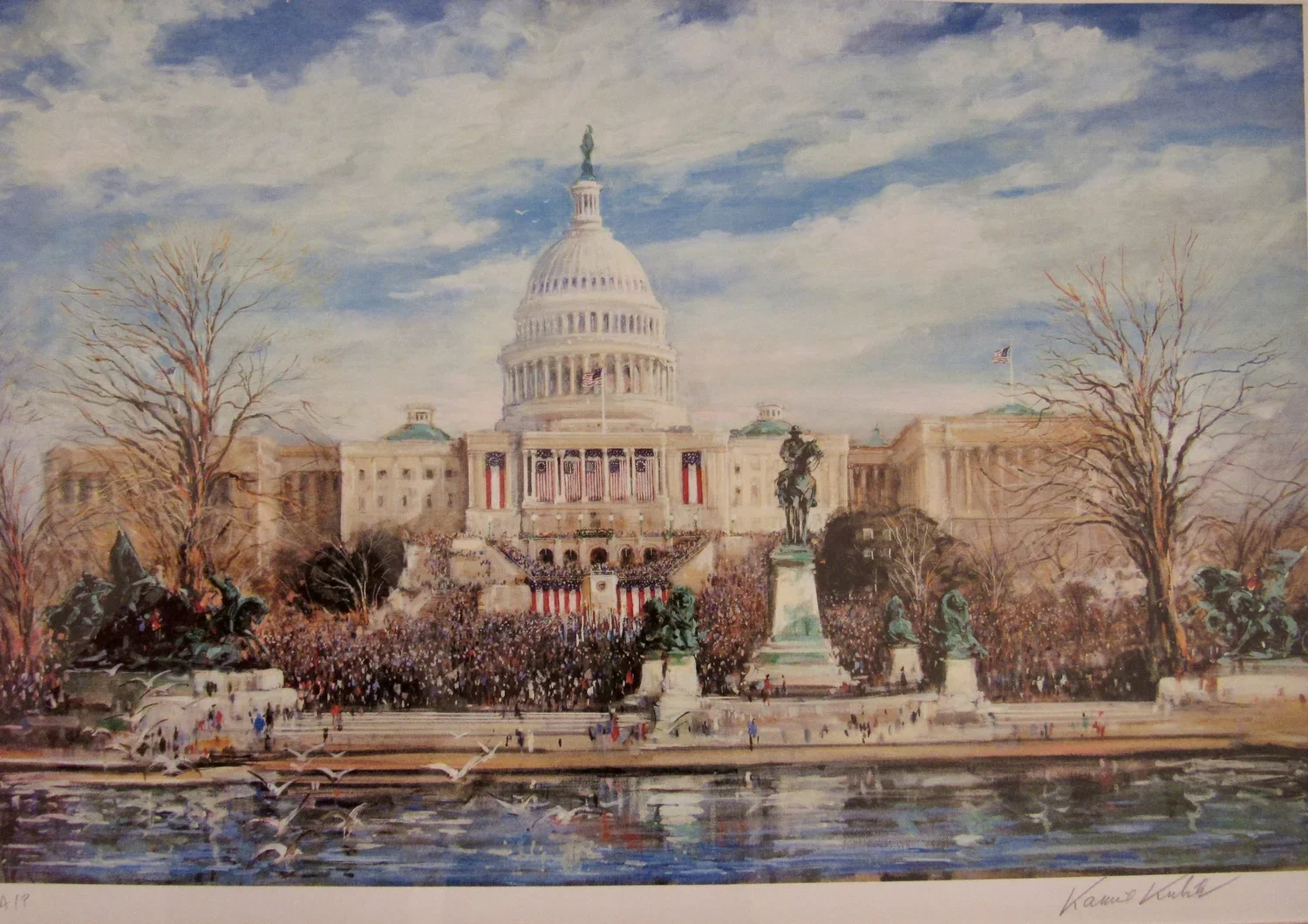
This piece depicts the Inauguration of President George H.W. Bush and Vice President J. Danworth Quayle on January 20th, 1989. Kubik served as the official White House artist during President Bush’s administration and several of Kubik’s works were hung in both the Oval Office and White House during Bush’s presidency. 

Kubik’s work serves as a record of public memory, the saturated palette creating a vibrant and lively atmosphere emphasizing the activity in the crowd and the patriotism of the event.

ARTIST
Kamil Kubik

TITLE
Inauguration of President Bush

DATE
1989

MEDIUM
Pastel on paper

DIMENSIONS
Width 38 in x Height 30 in

CURRENT LOCATION
Collections

ACCESSION NUMBER
1000.99.6

CLASSIFICATION
Print, signed by artist

PROVENANCE
The piece was acquired by the Czech Center Museum Houston from an unknown donation.


Winter at the capital
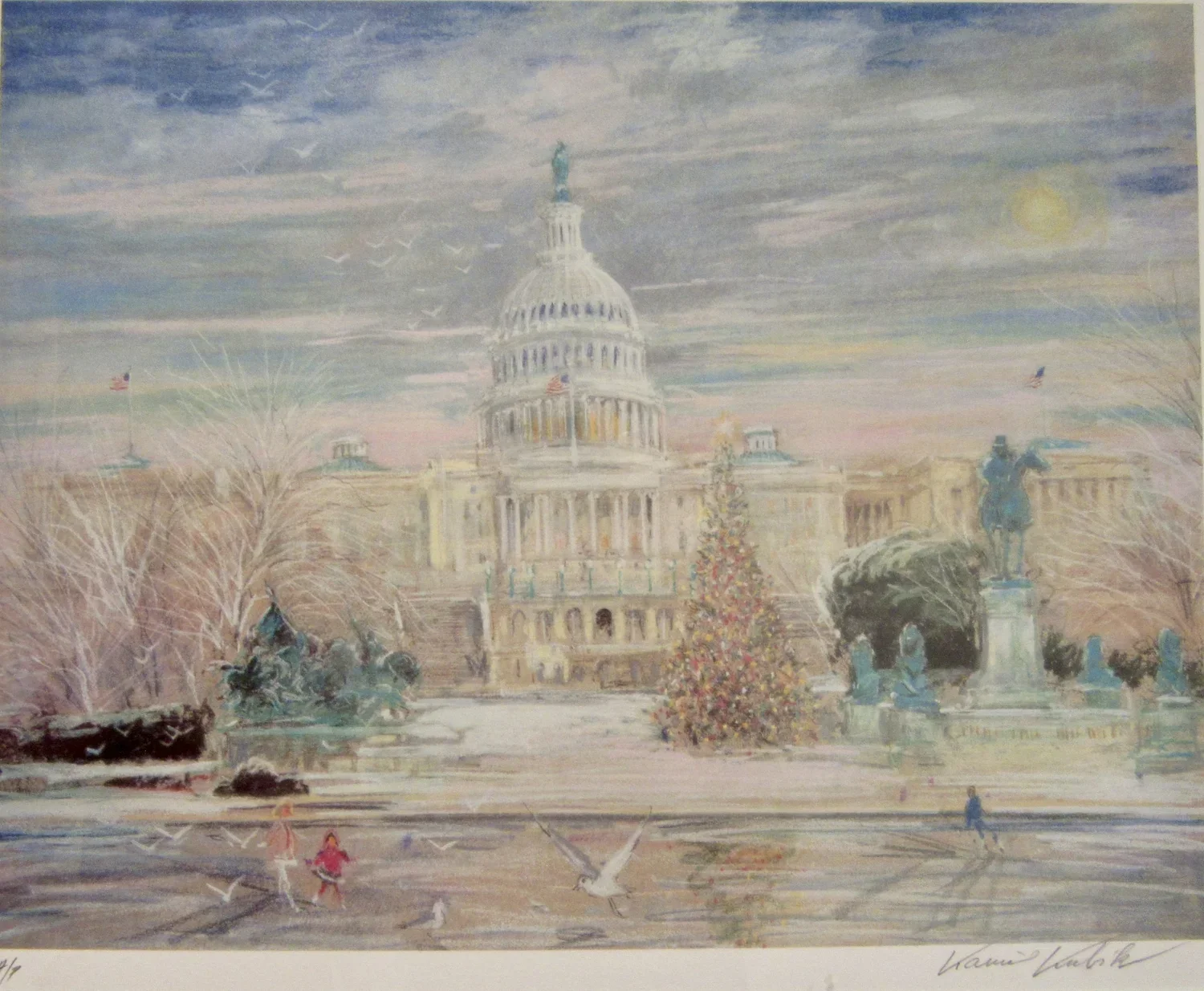
Kubik’s work frequently focused on street scenes and he first painted the United States Capitol building in the 1970s. The addition of the traditional Christmas Tree in front of the Capitol during the holiday season began in 1964, and is included in this piece. Kubik’s early career and works centered on creating Christmas holiday cards in Australia and he later painted the 1991 and 1992 White House Christmas cards as part of his position as the White House artist under Bush’s administration. 

ARTIST
Kamil Kubik

TITLE
Winter at the Capital

MEDIUM
Pastel on paper

DIMENSIONS
Width 25.5 in x Height 21.5 in

CURRENT LOCATION
Collections

ACCESSION NUMBER
1000.99.5

CLASSIFICATION
Print, signed by artist

PROVENANCE
The piece was acquired by the Czech Center Museum Houston from an unknown donation.

Kubik’s use of his most prolific medium, pastel, creates a serene winter scene, with the cool blue and gray tones balancing the warmth of the holiday lights. Kubik’s composition emphasizes approachability and an everyday view of life in Washington, D.C.


Bouquet of Flowers
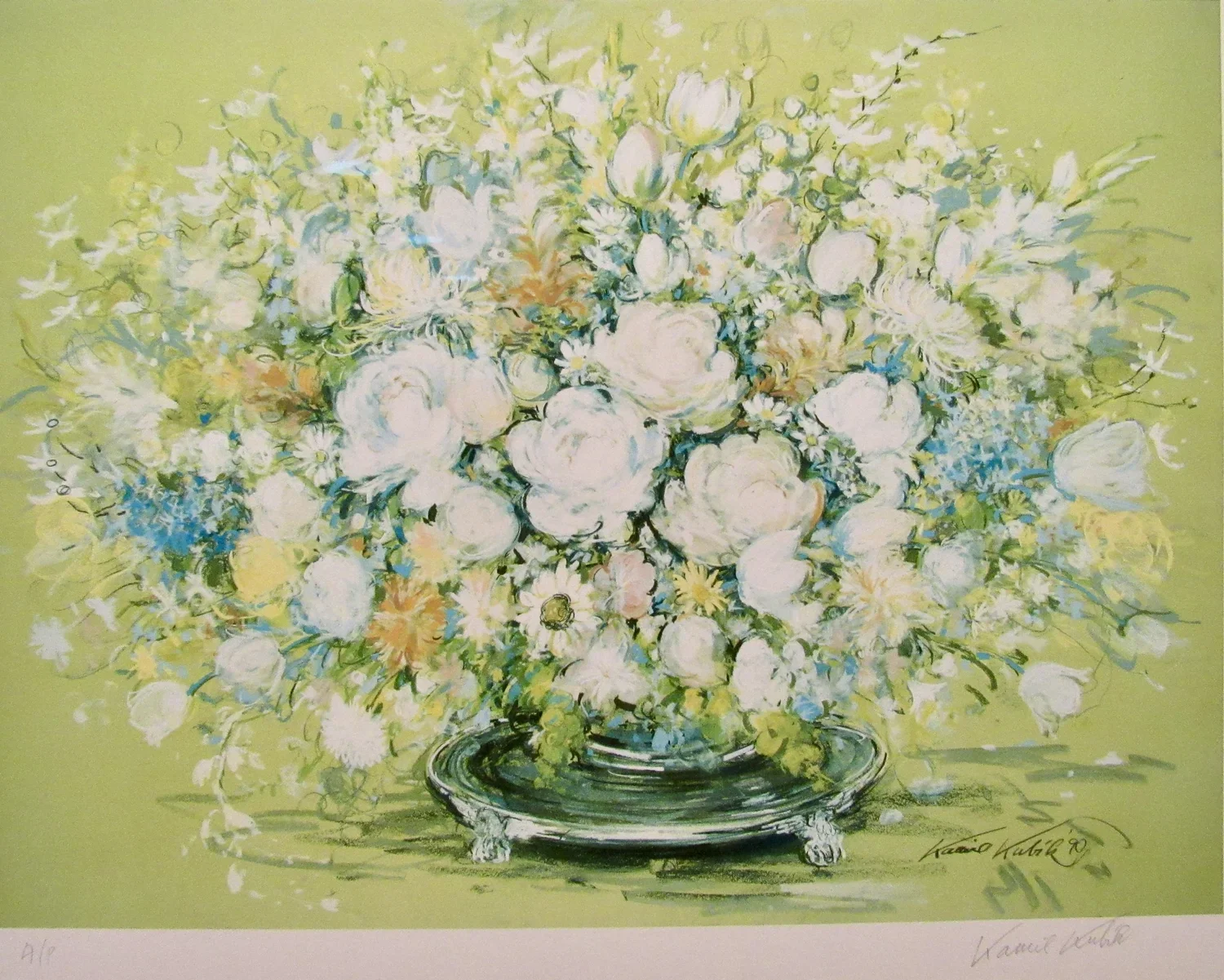
It is believed that the white roses portrayed in this piece were a tribute to Former First Lady Barbara Bush, a devoted patron and friend of Kamil Kubik. Barbara Bush was known for her love of flowers, particularly roses, and was inducted into the American Academy of Floriculture during her time as First Lady of the United States.  Many flower species, roses, and flower gardens are named for her in memory and tribute. 

ARTIST
Kamil Kubik

TITLE
Bouquet of Flowers

MEDIUM
Pastel on paper

DIMENSIONS
Width 35.75 in x Height 28.75 in

CURRENT LOCATION
Collections

ACCESSION NUMBER
1000.99.16

CLASSIFICATION
Print

PROVENANCE
The piece was acquired by the Czech Center Museum Houston from an unknown donation.

Shades of green, blue, and ochre help to define the dynamic bouquet. Green paper helps to make the monochromatic floral grouping stand out. White roses take center stage in the middle of the composition, nestled within the mixed florals, while sprays of other white flowers emerge in the margins. Emphatic lines help create a sense of liveliness within the arrangement.


“The legacy I want to leave, it’s a complicated thing. If I can produce good enough work, if I can help some people, that would be okay. All of us should strive to try to make out society just a little bit wiser, a little bit better, a little bit happier. The simple thing for a painter is to make a place a little bit more beautiful.”

Kamil Kubik

Written by Tria Van Horn and Erin Marashi
Alphonse Mucha (1860-1939)

Biography

Alphonse Mucha was born on July 24, 1860, in Ivancice, Moravia (now the Czech Republic). Growing up he witnessed the Austrian Administration of Moravia, the Austro-Prussian Ward, and an extensive cholera epidemic in his home town, all of which made him a passionate believer in an independent Czech nation. After being expelled from school due to poor academic performance, Mucha found himself inspired by a fresco at a local church and decided to become a professional artist. After an unsuccessful application to the Prague Academy of Art in 1878, he began a scenery apprenticeship with a theater company. When the theater closed after a fire, he began a career painting portraits of local figures until he found a patron who offered to help pay for Mucha to study in Munich. In 1887, he moved to Paris to further his studies in painting and drawing. When his patron sponsorship ended, Mucha worked creating commissioned illustrations for French and Czech publishers, as well as depictions of theater costumes. Mucha accepted a last minute commission to depicting Sarah Bernhardt as Gismonda in 1894, a move that would catapult his career to make him the face of the Art Nouveau movement in Paris.

Art Nouveau-A New Style Emerges

The Art Nouveau movement, which emerged in Paris, France in the early 1900s, became a primary source of inspiration for many artists. The style represented a break from the rigid lines and sharp edges of the Industrial Revolution, instead embracing the organic forms and fluidity motivated by the organic world and femininity, featuring floral motifs and curvilinear shapes to emphasize the harmonious relationship between form and function. The “New Art” movement signified a return to nature as the primary source of inspiration.

This new style encompassed a diverse array of artistic expressions, including painting, architecture, graphic design, and decorative arts. Heavily inspired by nature and the female form, Mucha made a significant impact on the Art Nouveau with his innovative manipulation of the form and detailed incorporation of natural elements. Despite its popularity, Mucha was not pleased to be affiliated with the new style of “Art Nouveau” since he viewed it as a fleeting trend. While he became heavily involved in print making and advertising at the time, he longed to gain sponsorship to work on his oil paintings. Regardless of his initial aversion, Art Nouveau became intrinsically linked to Mucha’s name, as the movement became famously known as “Le Style Mucha” in Paris. The Art Nouveau movement played a significant role in the development and shaping of modern design and laid the groundwork for later artistic movements, such as Art Deco and Modernism.

Career

Mucha’s artistic style centered on the idealized female form going so far as to have what became known as  “Mucha Women”. His works often feature graceful women in long, flowing garments, framed by intricate flowers and leafy vines. Mucha utilized gaze and positioning of the body to showcase a more powerful woman: self possessed, liberated and independent, the pinnacle of modernity. Incorporating nature as a design element and utilizing a muted color palette were also key elements of his work. After his success with the depiction of Sarah Bernhardt as Gismonda, Mucha created several series to be mass produced in order to bring fine art into the hands of the general public. These series included The Seasons, The Flowers, The Arts, The Times of the Day, The Precious Stones, and The Moon and the Stars.

Mucha spent time living in the United States with his wife Marie Chytilova, where he taught classes at the New York School of Applied Design for Women and the Chicago Art Institute. His daughter, Jaroslava was born in 1909 in New York. It was there that Mucha met Charles Richard Crane, who eventually sponsored the creation of the Slav Epic, a monumental project aimed at depicting the “joys and sorrows” of all Slavs, representing their people and history. This was an idea that Mucha had had for many years, but finally was able to begin in 1912, when he completed the first 3 canvases of the 20 canvas project. The completed Slav Epic was officially bequeathed to the City of Prague in 1928, marking the 10th anniversary of the creation of Czechoslovakia.

At the end of his life, Mucha continued to work on commissions for banks and churches, as well as planning other large scale projects that unfortunately never came into fruition. He was arrested in 1939 by the German Gestapo due to his ties to Freemasonry, and was finally released after enduring days of questioning. He passed away on July 14, 1939. As an innovator of his time and a leading figure of Art Nouveau, Mucha championed a movement that celebrated creativity and freedom inspired by the natural world.


Portrait of Mucha’s Daughter, jaroslava

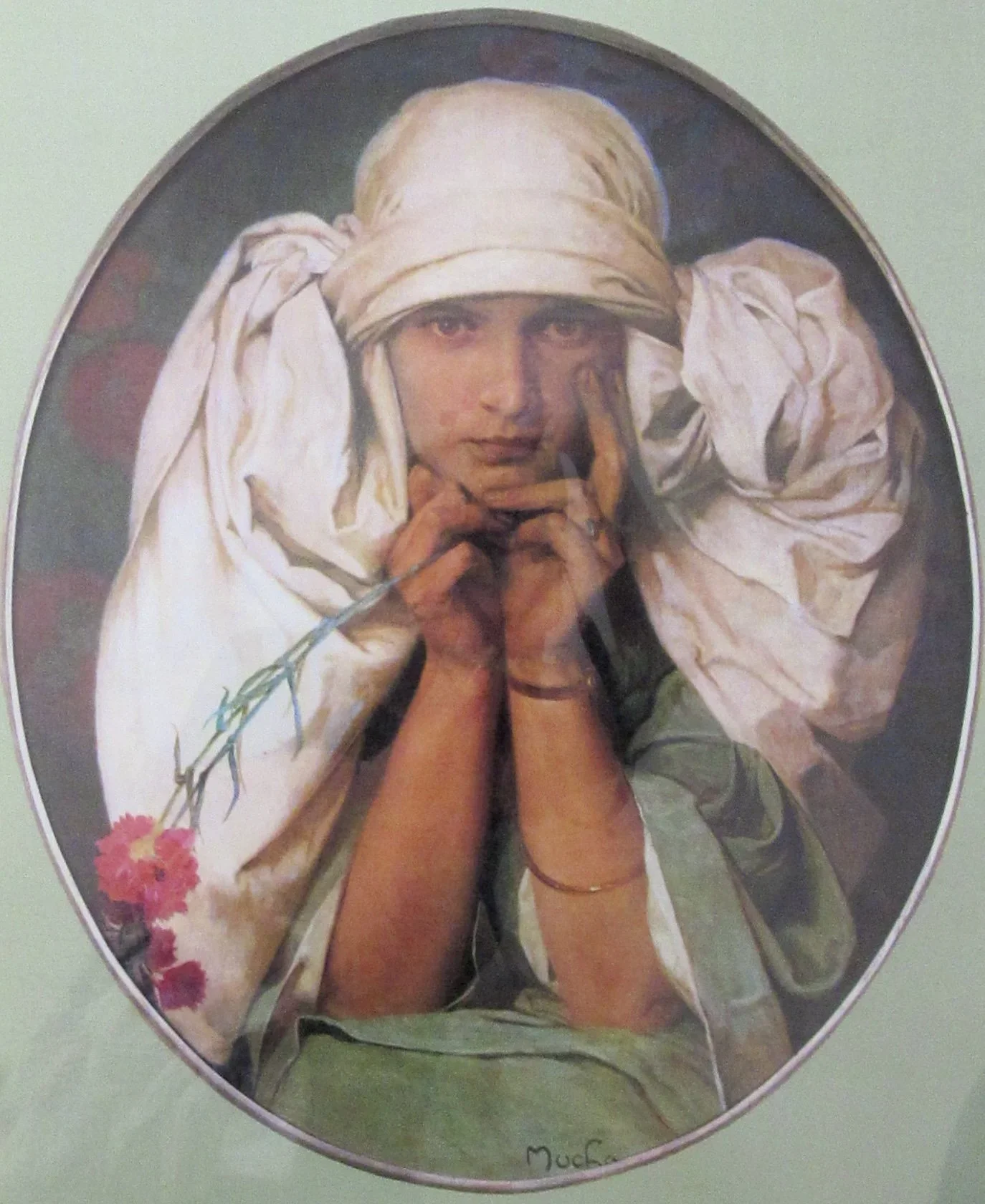
Jaroslava Mucha, born in New York in 1909, often helped her father in his studio. She worked as his technical assistant, working to mix paints, and frequently modeled for Mucha in different settings. Her portrait was included on the first Czechoslovak bank notes designed by her father in 1919 and again in 1929, and she even painted the night sky in one of Mucha’s works for the legendary Slav Epic. Her early training with her father most likely inspired her to pursue a career as a conservator of fine art, with one of her biggest projects being the restoration of the Slav Epic that had been damaged by frost and water while they were hid from the Nazi Regime. 

Rendered in oil, this painting represents one of many portraits of Jaroslava by her father. Mucha used classic techniques typical of the great masters of the renaissance to create a glowing, life-like representation of his daughter, wearing traditional clothing, adorned with an elaborate headscarf and bouffant sides alluding to her own Slavic ancestry. Her intense, direct gaze is characteristic of his typical female subjects.

ARTIST
Alphonse Mucha

TITLE
Portrait of Mucha’s Daughter, Jaroslava

DATE
1927-1935

MEDIUM
Print- Oil on Canvas

DIMENSIONS Width 40.64 cm x Height 48.26 cm

CURRENT LOCATION
Collections

ACCESSION NUMBER

CLASSIFICATION
Print

PROVENANCE
The piece was acquired by the Czech Center Museum Houston through an unknown donation.


Gismonda

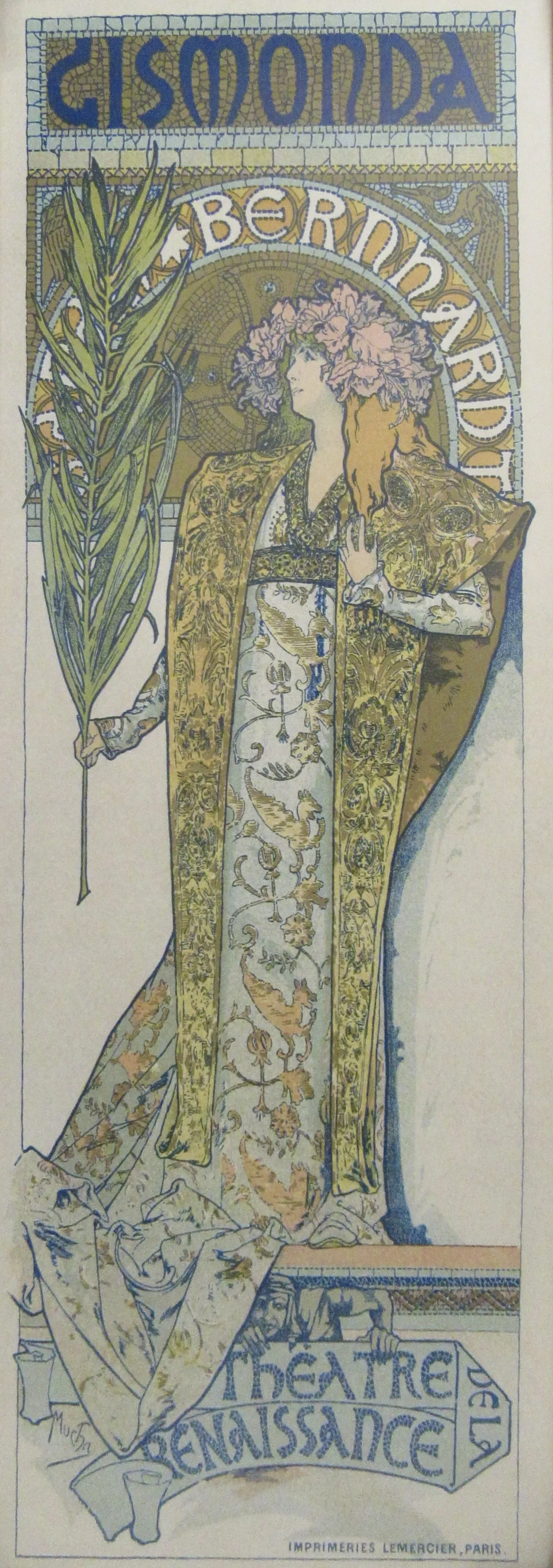
Alphonse Mucha created this lithograph poster for Sarah Bernhardt, the most famous actress in Paris at the time, in 1894. The Theatre de la Renaissance urgently needed a new poster for Brenhardt’s play “Gismonda” and turned to Mucha, who was the only available artist during the holiday season on such short notice. Mucha accepted the project despite never having designed a poster before, captivating the public with the resulting piece. The poster’s intricate detail and elegant design, exemplifies Mucha’s signature Art nouveau style, and became incredibly popular with the general public.

In this advertisement for Gismonda, Mucha creates a powerful and idealized interpretation of the Byzantine character. The lettering at the top of the poster calls to mind the mosaics of the Byzantine Empire filled with glistening tesserae. Sarah Bernhardt’s character takes center stage in this asymmetrical composition. The actress’s name creates a halo effect around her head, her heavily embroidered, golden robe, surrounded by native plants of the Byzantine region completes the scene. Upon viewing the piece, Bernhardt exclaimed, “Monsieur Mucha, you have made me immortal.”

ARTIST
Alphonse Mucha

TITLE
Gismonda

DATE
1894

MEDIUM
Print - Color Lithograph  

DIMENSIONS
Width 21.5 in x Height 52 in

CURRENT LOCATION
Collections

ACCESSION NUMBER

2024.0.1

CLASSIFICATION
Print

PROVENANCE
The piece was acquired by the Czech Center Museum Houston from an unknown donation.

The long, narrow, near lifesized shape, pastel color palette, and statuesque pose of the figure of Sarah Bernhardt became an immediate sensation in Parisian art, catapulting Mucha to fame as collectors flocked to the theater to bribe workers to sell them the poster, or would cut them down with razors in the middle of the night. Sarah Bernhardt was so pleased with the poster that she offered Mucha a five year contract to create props, posters, and costume designs, which fostered a relationship between the two for many years. This close relationship with the famous actress also enabled him to sign a contract with the printer, Champenois, to produce commercial and decorative posters, furthering his fame in the Paris art scene. Drawing from renaissance themes and composition styles of early 20th century Japanese graphic design, Mucha’s style became intrinsically linked to the Parisian Art Nouveau movement, becoming known as “Le Style Mucha”, despite his own hesitancy to affiliate himself with the movement.


The Times of the Day - Series

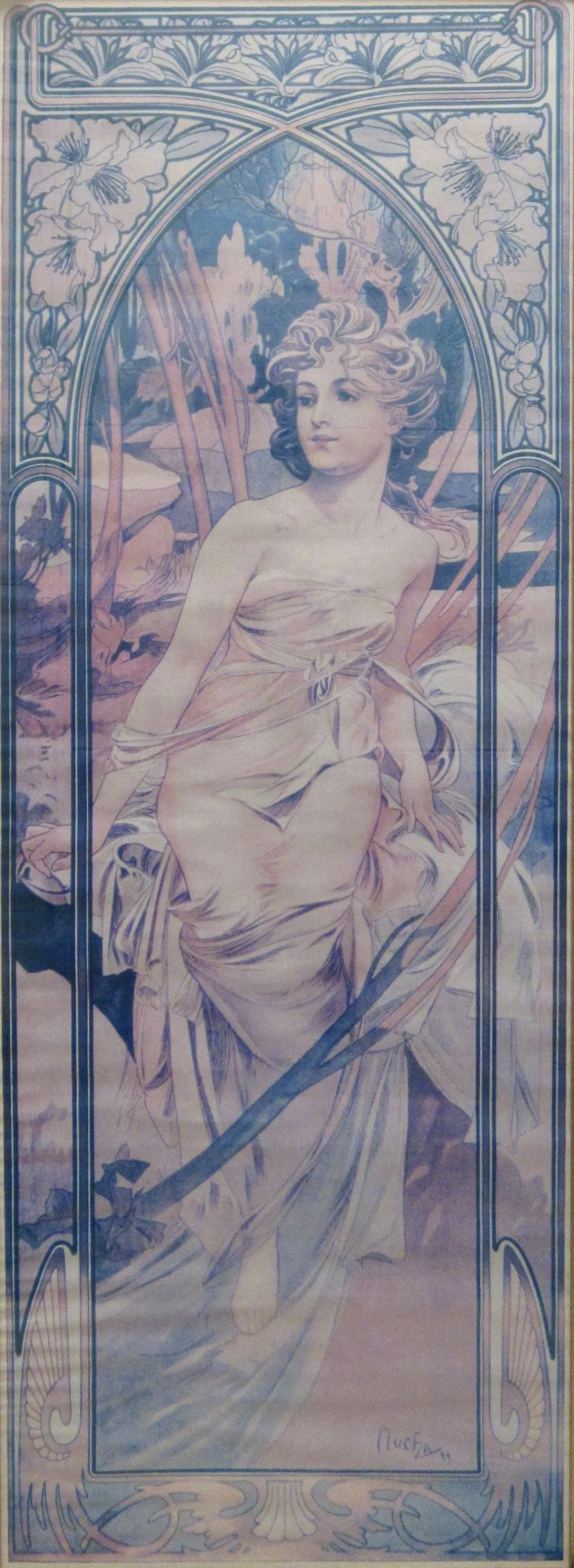
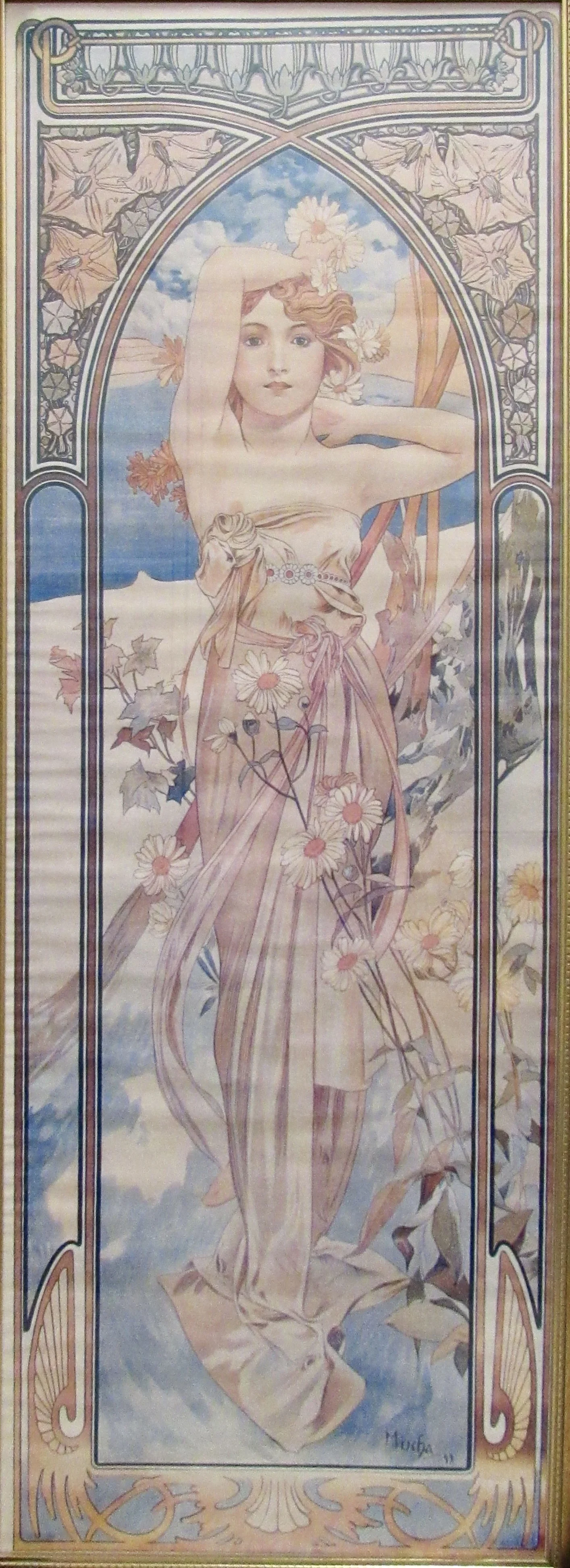
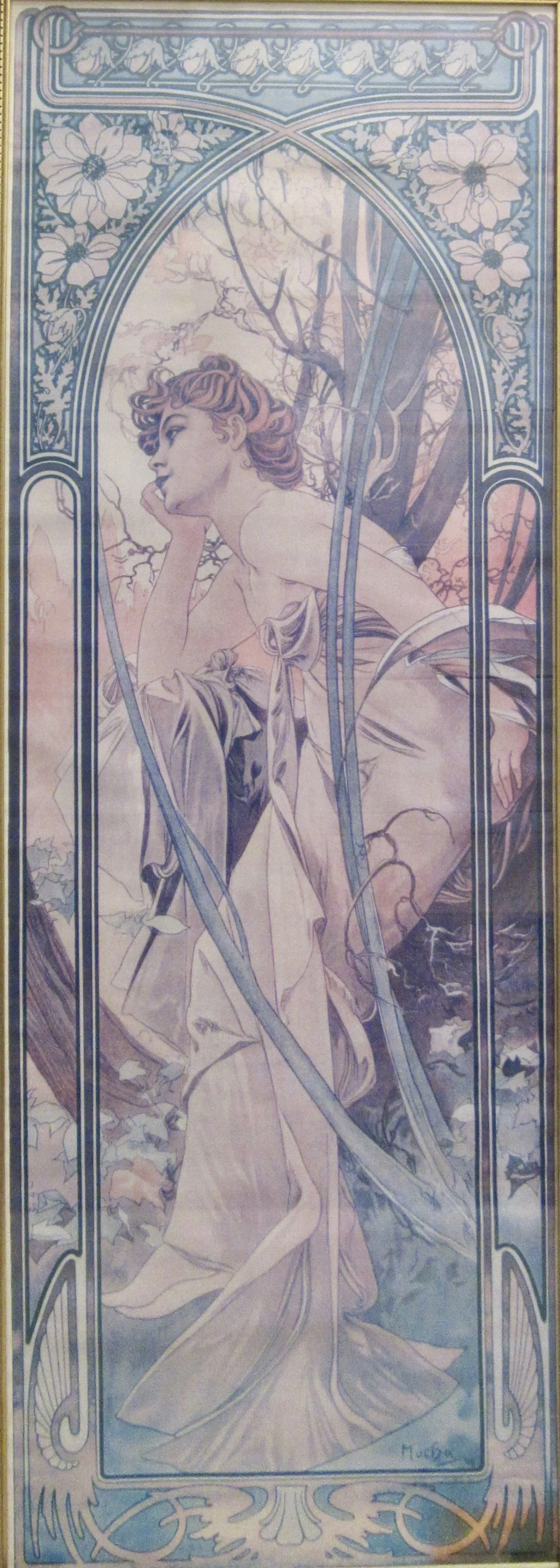
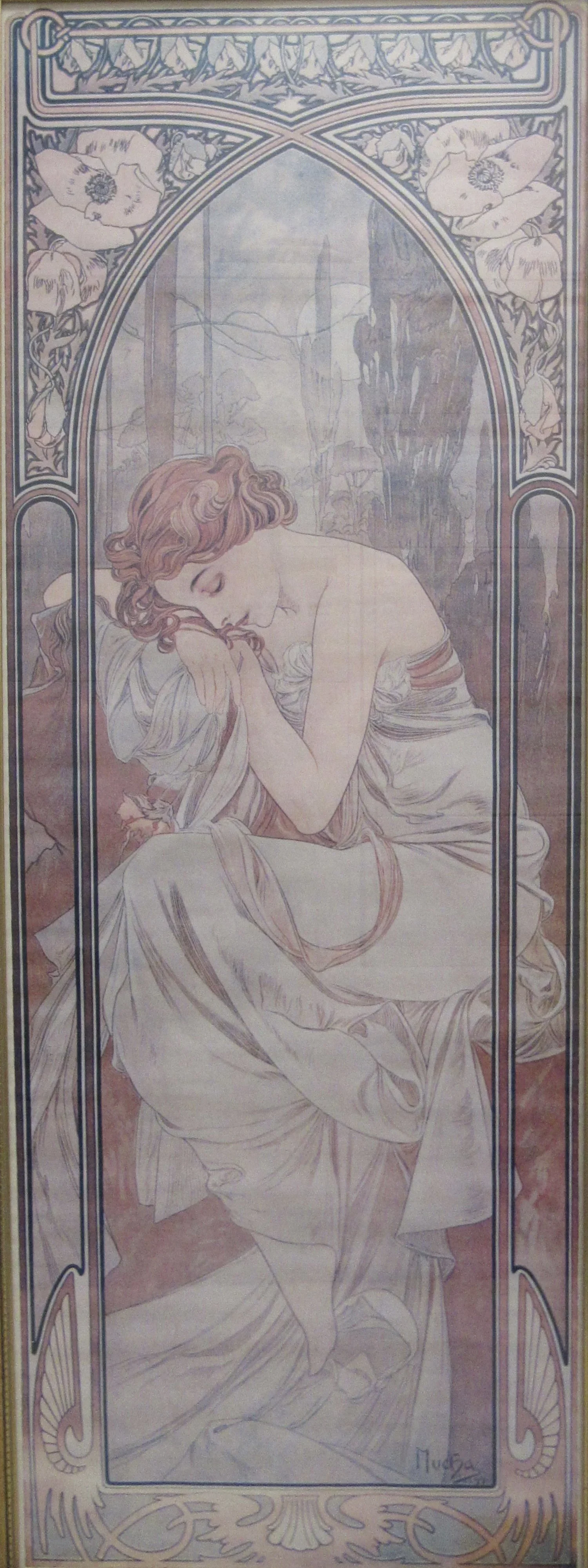
Designed as part of a commission for Champenois printer, The Times of the Day series combines elaborate yet delicate colors with intricate floral motifs. Mucha depicts each woman in the natural setting that mirrors her mood and reflects the emotion of her title. The whole is then enclosed in an elaborate ornamental frame reminiscent of a Gothic window.

ARTIST
Alphonse Mucha

TITLE
Times of the Day - Series
Morning Awakening

DATE
1899

MEDIUM
Print - Color Lithograph

DIMENSIONS
Width 21.5 in x Height 52 in

CURRENT LOCATION
Collections

ACCESSION NUMBER
2003.6.1

CLASSIFICATION
Print

PROVENANCE
The piece was acquired by the Czech Center Museum Houston from Robert J. Dvorak in 2003.

With the rise in the popularity of Mucha’s poster designs, he set out to create decorative panels for domestic use. The Times of Day was the fourth such series, which aimed to mass produce decorative art so it could be enjoyed by those of all classes. As in some of Mucha’s earlier series, he combines a fresh and delicate palette, which is enhanced by native flower motifs. The tight framing gives viewers a glimpse into an intimate space, where Mucha has personified the times of the day. 

Mucha’s Morning woman is draped in a soft pink garment, accentuating the form of her body. The pink tones in her gown are complemented by the shades of green in the foreground and background and her gentle expression also correlates with the time of the day she represents. 

ARTIST
Alphonse Mucha

TITLE
Times of the Day - Series
Brightness of Day

DATE
1899

MEDIUM
Print - Color Lithograph  

DIMENSIONS
Width 21.5 in x Height 52 in

CURRENT LOCATION
Collections

ACCESSION NUMBER
2003.6.2

CLASSIFICATION
Print

PROVENANCE
The piece was acquired by the Czech Center Museum Houston from Robert J. Dvorak in 2003.

Throughout this series, and others, we see that Mucha never forgot his Czech roots. Each frame includes florals often inspired by Moravian folk art, as well as organic and geometric patterns reminiscent of what can be found in Czech Baroque church designs. The flowers within the upper part of the frame are rendered in such detail, we can identify most of the plants as native to the Czech Republic. 

The mood is heightened in the Brightness of Day, where Day seems resplendent draped in marigold hues. She almost seems to float within the scene as cheery yellow Asteraceae flowers help to enhance the atmosphere. The Lady of Day’s direct gaze is a powerful reminder that Mucha women create a sense of modern sensuality and empowerment.

ARTIST
Alphonse Mucha

TITLE
Times of the Day - Series
Evening Contemplation

DATE
1899

MEDIUM
Print - Color Lithograph  

DIMENSIONS
Width 21.5 in x Height 52 in

CURRENT LOCATION
Collections

ACCESSION NUMBER
2003.6.3

CLASSIFICATION
Print

PROVENANCE
The piece was acquired by the Czech Center Museum Houston from Robert J. Dvorak in 2003.

The mass production of these decorative series posters allowed those who were in awe and inspired by the Art Nouveau movement to acquire decorative prints for their homes, even when unable to afford more expensive, original Art Nouveau inspired luxuries. Art was no longer just for the elite, but for anyone who felt inspired by its beauty.

Mucha's signature delicate and muted palette is echoed throughout the series as he expertly crafts detailed white flowers along the top border of the frame. The lady lounges within her framework in evening contemplation seemingly in intimate harmony with her surroundings.

ARTIST
Alphonse Mucha

TITLE
Times of the Day - Series
Night’s Rest

DATE
1899

MEDIUM
Print - Color Lithograph  

DIMENSIONS
Width 21.5 in x Height 52 in

CURRENT LOCATION
Collections

ACCESSION NUMBER
2003.6.4

CLASSIFICATION
Print

PROVENANCE
The piece was acquired by the Czech Center Museum Houston from Robert J. Dvorak in 2003.

Mucha was a firm believer in the idea that beautiful works of art improved quality of life and truly believed it was his duty as an artist to promote art for ordinary people. As he once said, “I was happy to be involved in an art for the people, and not for private drawing rooms. It was inexpensive, accessible to the general public, and it found a home in poor families as well as more affluent circles.”

Once again drawing on Czech roots for floral representation, poppies, typically a symbol of rest and sleep, encompass the top frame of Night’s Rest. Her soft blue garment drapes over her like an ethereal blanket, as she rests her head on her arm in resplendent sleep.


The Moon and Stars- Series

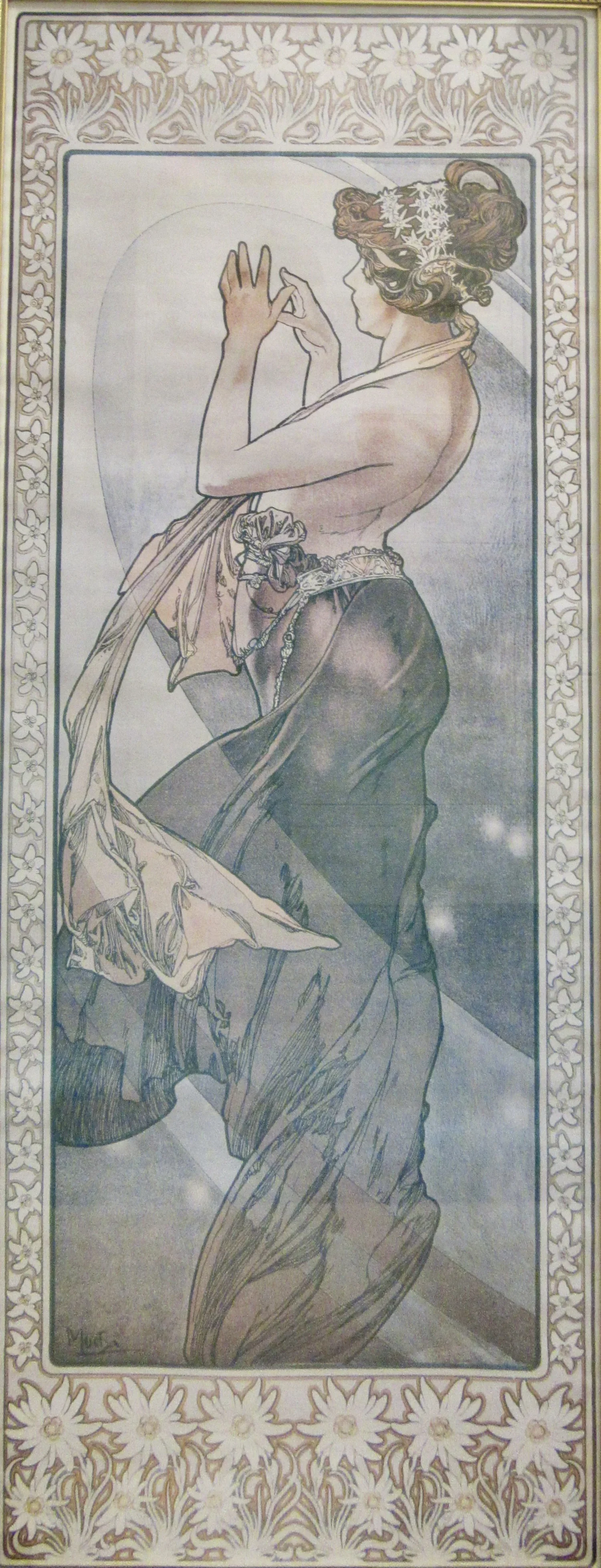
In The Moon and the Stars series, Mucha presents the stars as female figures, with a philosophical quality beyond mere decoration. Unlike his earlier, earthly representations, these women are depicted as divine beings, floating in a space illuminated by radiant light.

ARTIST
Alphonse Mucha

TITLE
The Moon and the Stars - Series
The Evening Star

DATE
1902

MEDIUM
Print - Color Lithograph  

DIMENSIONS
Width 21.5 in x Height 52 in

CURRENT LOCATION
Collections

ACCESSION NUMBER
2003.6.5

CLASSIFICATION
Print

PROVENANCE
The piece was acquired by the Czech Center Museum Houston from Robert J. Dvorak in 2003.

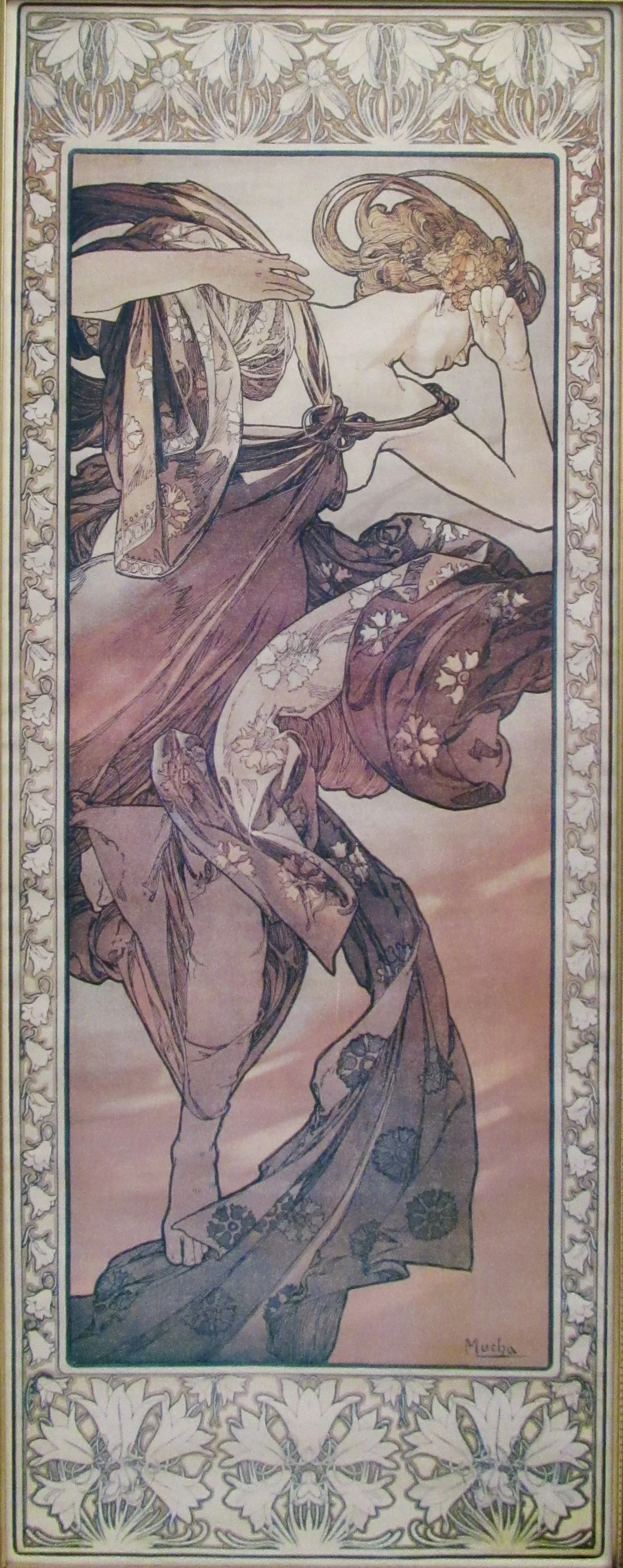
The planet Venus, often referred to as the evening star, stands out as the brightest star in the western sky as the sun sets. Its presence has been noted and tracked by ancient civilizations since the beginning of time, aiding in some of the most significant astronomical advances and discoveries throughout history. Observing the orbiting of Venus allowed early astronomers to place the Sun, rather than the Earth, as the center of the solar system. 

In Mucha’s depiction of the Evening Star, her body twists within the borders of the piece, creating organic curving lines within the composition. She turns her face away from a central source of light radiating from the middle. A contrasting red-orange glow emanates from the bottom of the frame bringing to mind the colors of a sunset. Like the other women in the series, she seems to levitate within the frame, accentuating her freedom to move through space, not held captive by her frame.

ARTIST
Alphonse Mucha

TITLE
The Moon and the Stars - Series
The Moon

DATE
1902

MEDIUM
Print - Color Lithograph  

DIMENSIONS
Width 21.5 in x Height 52 in

CURRENT LOCATION
Collections

ACCESSION NUMBER
2003.6.8

CLASSIFICATION
Print

PROVENANCE
The piece was acquired by the Czech Center Museum Houston from Robert J. Dvorak in 2003.

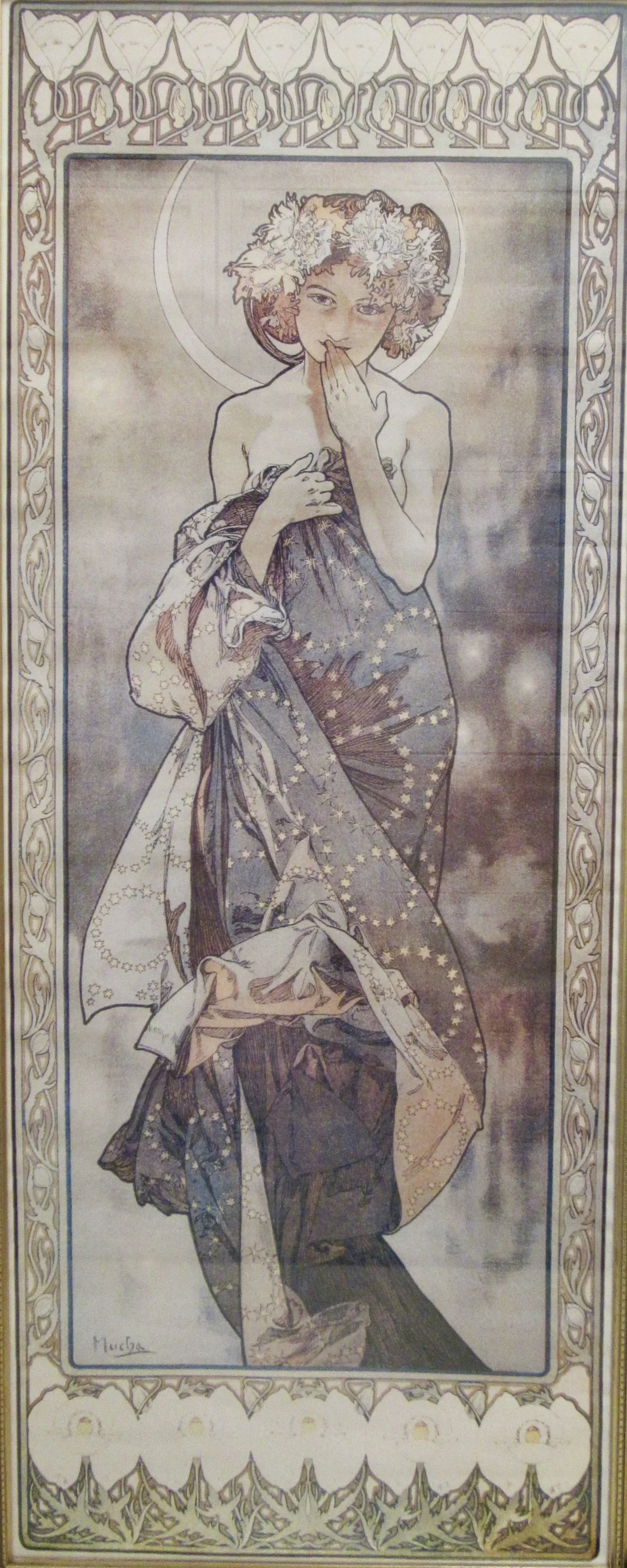
Mucha was interested in mysticism and occultism, which heavily influenced his work throughout his career. The moon has long held links to these ideas, particularly when considering the moon's historical significance as Earth’s constant companion, as well as a method of time keeping, source of mythology, and scientific advancement. Often seen as a representation of the divine feminine, the moon is not lacking in power and strength as she controls the tides and lights the night sky, remaining a guiding force and often turned to for her wisdom. 

Astral bodies are personified in this captivating series ensconced in Mucha’s organic spiralling framework. Radiating with an ethereal glow, the Moon lady's light seems to come from within, emphasized by the light tone of her skin against the moody textural background. Throughout Mucha’s last decorative panel series, viewers bear witness to his masterful handling of value, texture and color within the challenging medium. As the Moon woman gathers her starry robe in her hands, the texture and drape of the garment is accentuated by the attention to detail in the robes motifs, as well as folds and Mucha’s ability to play with light and shadow. A crescent moon shines behind her head creating a nimbus effect, accentuating her as an astral body. Her hand is covering her mouth, perhaps cueing viewers to take in the scene in silence.

ARTIST
Alphonse Mucha

TITLE
The Moon and the Stars - Series
The Morning Star

DATE
1902

MEDIUM
Print - Color Lithograph

DIMENSIONS
Width 21.5 in x Height 52 in

CREDIT LINE
Gift of Robert J. Dvorak

CURRENT LOCATION
Collections

ACCESSION NUMBER
2003.6.6

CLASSIFICATION
Print

PROVENANCE
The piece was acquired by the Czech Center Museum Houston from Robert J. Dvorak in 2003.

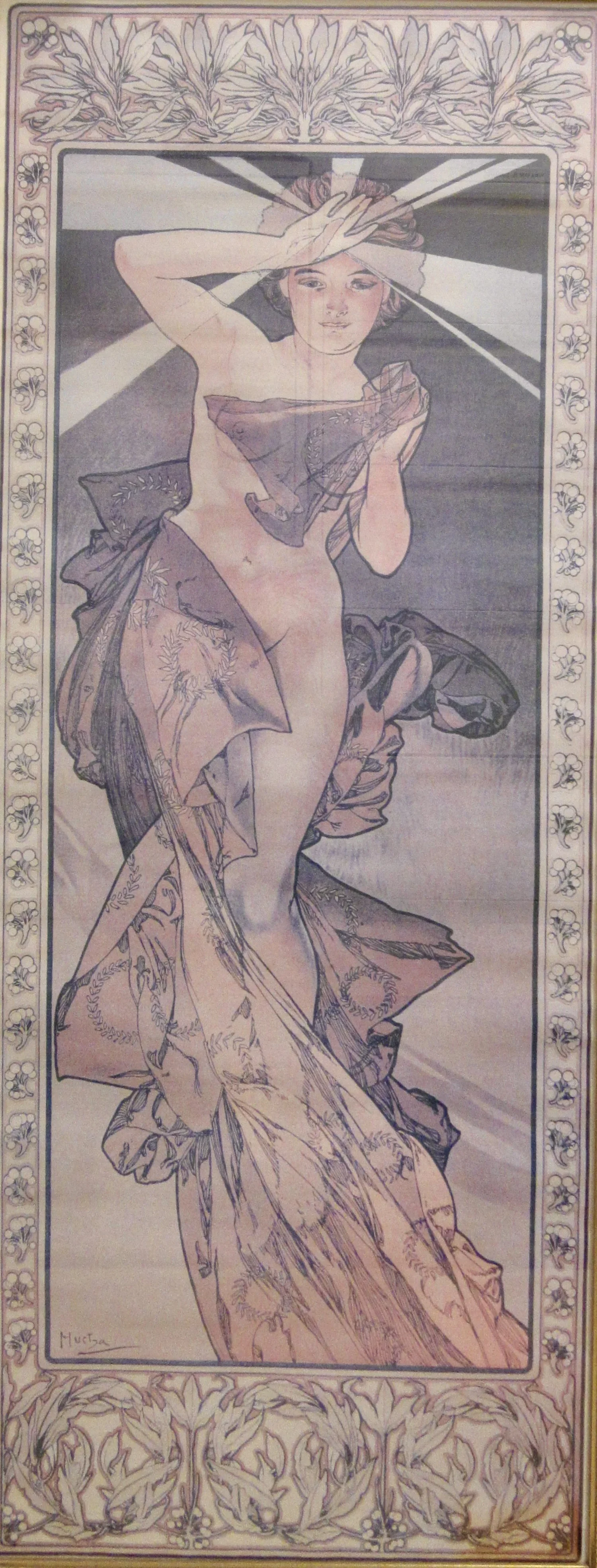
The ancients’ often referred to Venus as the Morning Star or the Evening Star. Although it took a period of approximately 584 days to complete this cyclical transition; they did not realize that both astral bodies were indeed one. A planetary twin to Earth, Venus shines so brightly that it is often mistaken for a star and can be seen, from November through Summer, shining brightly as the sun begins to rise in the eastern sky. Its dual identity as both morning and evening star could explain why Mucha had these stars flank the moon in the series, reflecting Venus’ nightly journey across the sky. 

In this image of the Morning Star, light radiates from her hand over her brow; she grasps the edge of the fabric in her left hand. While her posturing is front-facing, her downward gaze suggests a hint of mystery, avoiding the intimacy of direct eye contact. Through her frontal stance, Mucha helps to draw attention to the power of her femininity. As with the other forms in this series, Mucha endeavors to explore the intensely philosophical meaning behind his subjects. 

ARTIST
Alphonse Mucha

TITLE
The Moon and the Stars - Series
The Pole Star

DATE
1902

MEDIUM
Print - Color Lithograph

DIMENSIONS
Width 21.5 in x Height 52 in

CURRENT LOCATION
Collections

ACCESSION NUMBER
2003.6.7

CLASSIFICATION
Print

PROVENANCE
The piece was acquired by the Czech Center Museum Houston from Robert J. Dvorak in 2003.

Otherwise known as the North Star, the Pole Star remains steady in the sky, guiding those in need; unlike Venus whose position changes throughout the year. Though not as bright as the morning and evening star, its consistent location in the sky allowed it to be used as a navigational tool, stationary and immovable, often symbolizing guidance and direction for a weary traveler.

Mucha’s Pole Star woman floats in the firmament, her eyes fixed on a source of light she guards with her hands. Her soft and graceful posturing embodies the idealized version of a  “Mucha Woman”. A watery color scheme runs throughout the series linking all four of the works in a harmonious fashion. Mucha’s masterful handling of chromolithography can be fully appreciated here in his final series, where a clear display of his honed skills in rendering shadow and texture can be appreciated.


“The purpose of my work was never to destroy but always to create, to construct bridges, because we must live in the hope that humankind will draw together and that the better we understand each other, the easier this will become.” Alphonse Mucha


Written by Erin Marashi and Tria Van Horn
Jan Reich

Biography

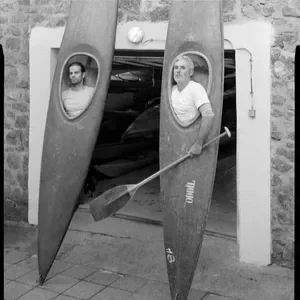
Born on May 21st, 1942, Jan Reich was a renowned Czech photographer known for his black-and-white, large-format cityscapes of Prague and the surrounding countryside. In his youth, he saw photos from his grandparents’ lives which were sent to him from overseas, likely sparking his interest in photography at a young age.

As the Communist Party came to power in Czechoslovakia in 1948, Reich and his family faced major changes as the family lost their estate. The Reich family moved to Sudetenland where Jan began to photograph the remains of abandoned buildings in the area with his friends. As a teenager, he continued to pursue photography as a hobby, creating his first photographs of Prague and starting his future interest and fascination with the history and architecture of the city. In 1963, he joined the photographic cooperative Fotografia in Prague, where he learned how to use a large format camera.

Although Reich was rejected from his first attempts, he finally joined the Film and Television School of the Academy of the Preforming Arts (FAMU) in Prague, where he studied from 1965-1970. With the Soviet military intervention in Czechoslovakia in August of 1968, Reich lost much of his contract work with dozens of periodicals he photographed for. This loss of work eventually leaded him to defect to Paris, where he lived from 1969-1970, photographing the hubbub of the streets of Paris, often featuring people in his photographs, something his later work often omits. 

Homesickness brought him back to Czechoslovakia within a year of his defection, where he had hoped to continue his same photography methods from Paris.

“But that was absolutely impossible. France is sunny. People spend time in the streets. They live there. In Prague, people were harried, everything was gray, fear was ubiquitous, and there was no joy. And so I wondered what I was going to photograph, and recalled the happy moments of my childhood. In that way I found vanishing Prague.”

His work on the Prague series gained him international recognition following the Velvet Revolution, with the book of his photographs becoming a best seller, allowing his photography career to take off.

Photography Work

At the beginning of Reich’s photography career, black and white photography was very popular. Reich himself was heavily influenced by the photography work of Josef Sudek, a fellow Czech photographer also known for his melancholic black and white photographs. When Reich became unhappy with the photos he was producing with a 35mm camera, he reached out to contacts at FAMU who were cataloging Sudek’s works and asked to buy Sudek’s large, wooden camera. Reich acquired three of Sudek’s cameras, which allowed him to take larger format photographs with more detail; he became well known for this attribute.

Reich used vintage silver gelatin prints to best showcase his work. Silver gelatin was a process developed in the 1880s that was shelf-stable and did not require manufacturing negatives before and after exposure. This allowed photography to become more portable and accessible, allowing photography to flourish in art scene for the first time. The paper used for this kind of photography consists of three layers: a paper base, a baryta (barium sulfate) layer in between, and an upper gelatin layer which contains light sensitive silver compounds that form the image after exposure and development in a chemical bath.

Silver gelatin prints were known for their smooth image surface and quick exposure time, only needing a few seconds of exposure to take the photograph. Because chemicals were needed to develop an image, the photographer could add different chemicals to change the tone of the photograph as well as to make the print more permanent, adding an extra layer of artistic subjectivity. During Reich’s time, this would have been a rather outdated means of taking photographs, yet it was his dedication to these antique methods that make his work so unique for his time.

Throughout his photography career, Reich’s work went through different phases or series, often subject to the areas he was living and the work he was performing at the time. Those periods are as follows:

  • Circus Series from 1964 to 1965. These photographs were taken during Reich’s time working as part of a circus crew and photographing those he knew personally.

  • Paris Series from 1969 to 1970. Works from this time period were taking during the year Reich spent in France after his defection from Communist Czechoslovakia following the Soviet Military intervention. These photographs often depict the bustling life of Paris streets, focusing more on the people rather than architecture seen in later series.

  • Vanishing Prague/Prague Series from 1980 to 2000s. Once he returned to Prague from Paris, Reich’s work shifted focus to landscape and architectural depictions that captured Prague during a time of political shifts and uncertainty, working to capture the beauty of the area before it was lost.

  • Bohemian Countryside by Sedlćany Series from 1999 to 2006. Reich bought a home in the countryside after his return to Prague, where he and his wife settled down when their children were born. He began documenting his family’s life in the countryside, as well as the local landscapes.

  • Bohemia Series from 1994 to 2000. With the fall of communism, Reich’s work became well known and he set out to document old architecture that seemed to have become part of the landscape across Bohemia, often returning to re-photograph the same place more than once.


Circus

Due to the political situation in the 1950s, Reich did not have the opportunity to attend secondary or post-secondary schools; as a member of bourgeois class he and his family were enemies of the regime, and Reich was sent to work as a manual laborer for several years. However, Reich eventually had the opportunity to work for a circus and in 1964,  joined their traveling crew.

“In the meantime, I encountered the circus. That was a magic time of my life,” Reich recalls. For two years he traveled about Slovakia and Moravia, set up the circus, looked after the animals, and worked as an usher during the performances. “I worked on setting up the big top and was in charge of a crew of Gypsies. They didn’t listen to me, because they’re Gypsies and don’t listen to anyone,” he says, laughing. “They stole the bears’ meat and made steaks out of them. And when it was pay time, they got drunk, didn’t come to work, and then for several days they looked for the circus in the neighboring villages. That didn’t bother me. Everyone else curses them, but I recall them with fondness.”

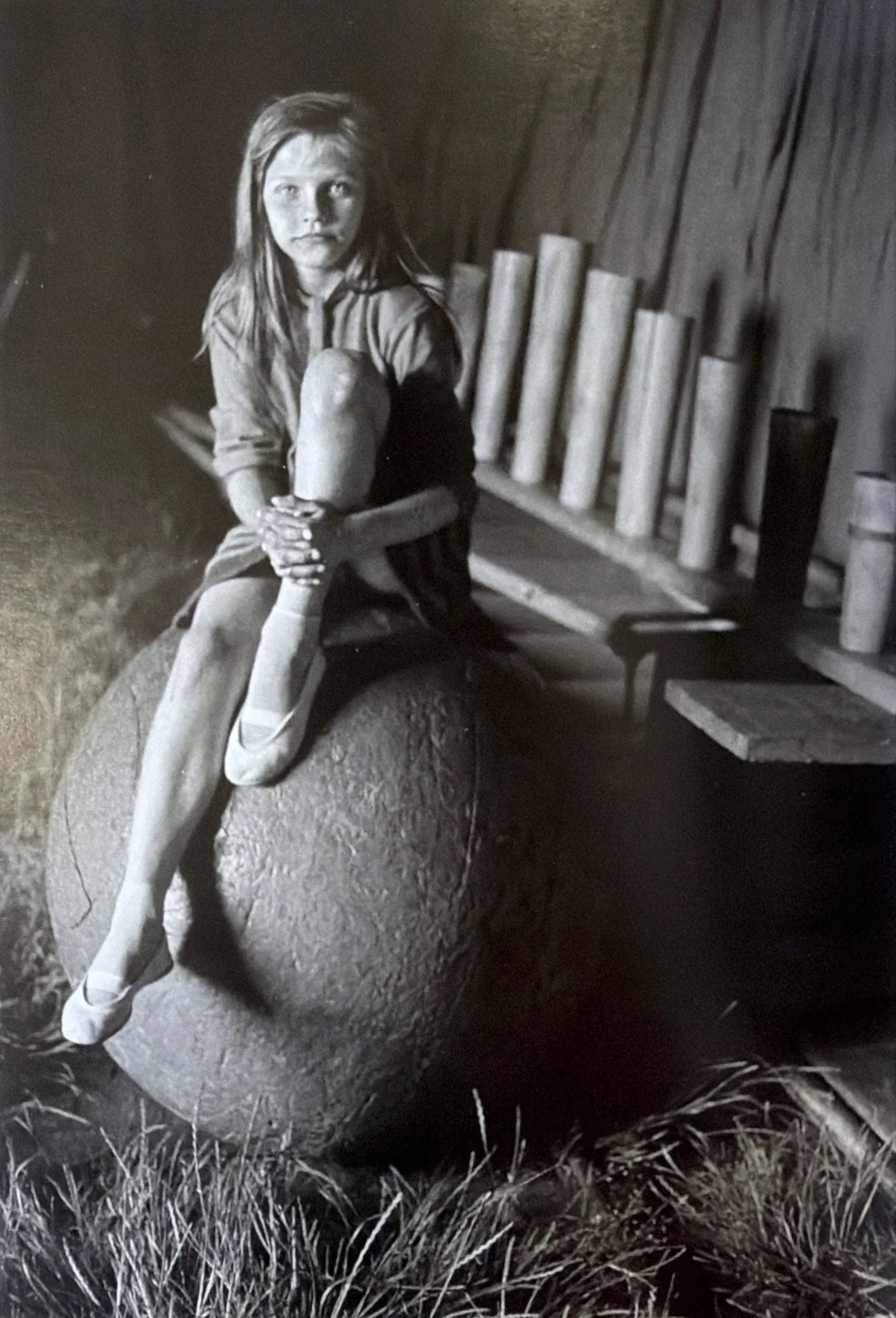
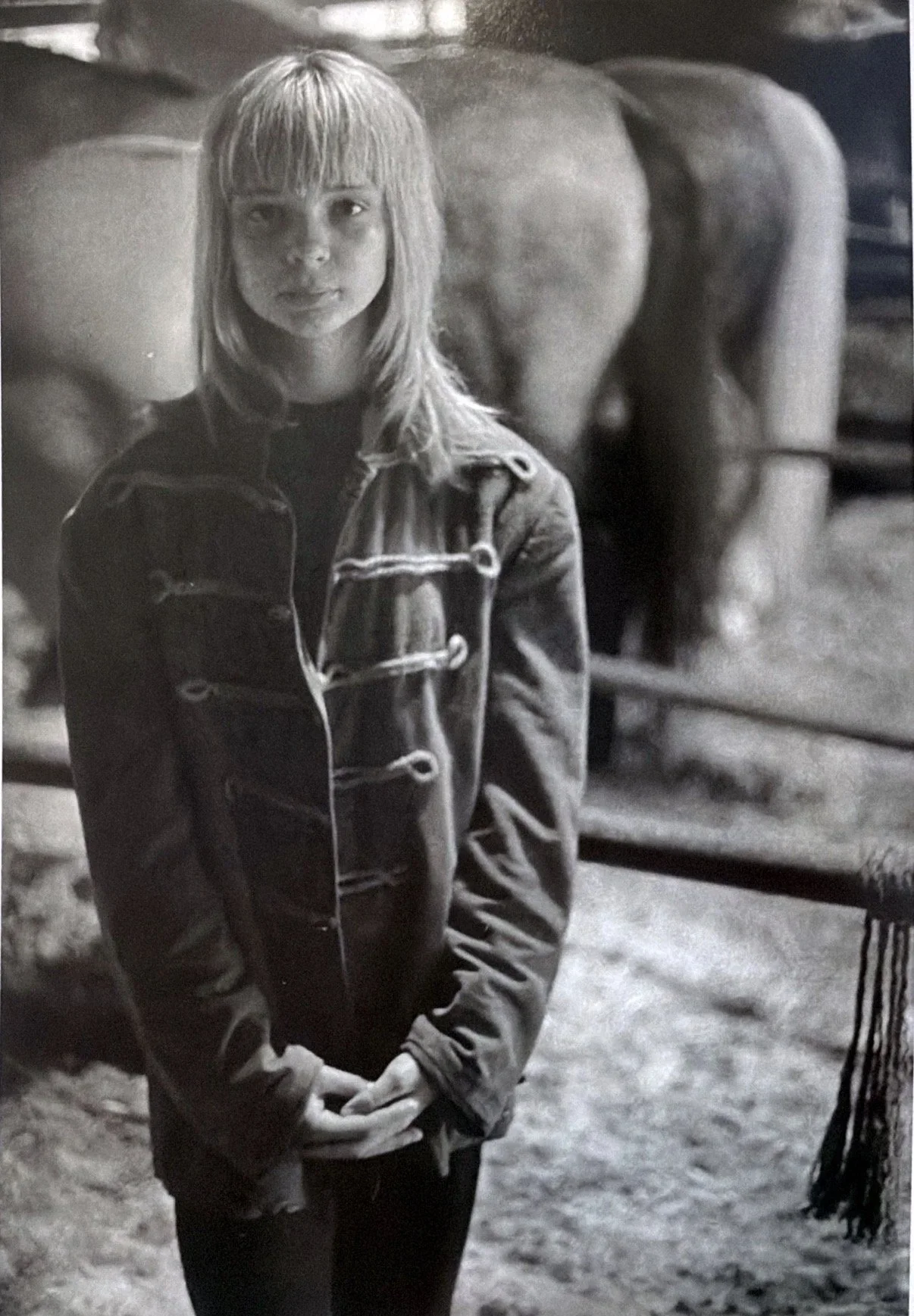
Traveling with the circus gave Reich the opportunity he needed to focus on his first serious creative series. Since Reich with the performers, he knew many of them personally, and was able to capture them in a more intimate way, focusing on their humanity, a marked difference from the snapshots that had been captured of circus performers before. The calm, documentary style compositions he created were perfectly suited for large format photography. The gaze of the performer's eyes and closeness of their relationship to Reich can be sensed through these portraits. 

It was not until after his travels with the group that he finally had the chance to join the Academy. From 1965-1970 he studied art photography at the Film and Television School of the Academy of the Performing Arts (FAMU) in Prague.

Circus Series, 1964-1965

ARTIST
Jan Reich

TITLE
Renata

MEDIUM
Vintage Silver Gelatin Print

CREDIT LINE
Courtesy of FotoFest

ARTIST
Jan Reich

TITLE
Berta in the Stable

MEDIUM
Vintage Silver Gelatin Print

CREDIT LINE
Courtesy of FotoFest


Disappearing Prague/Prague cycles

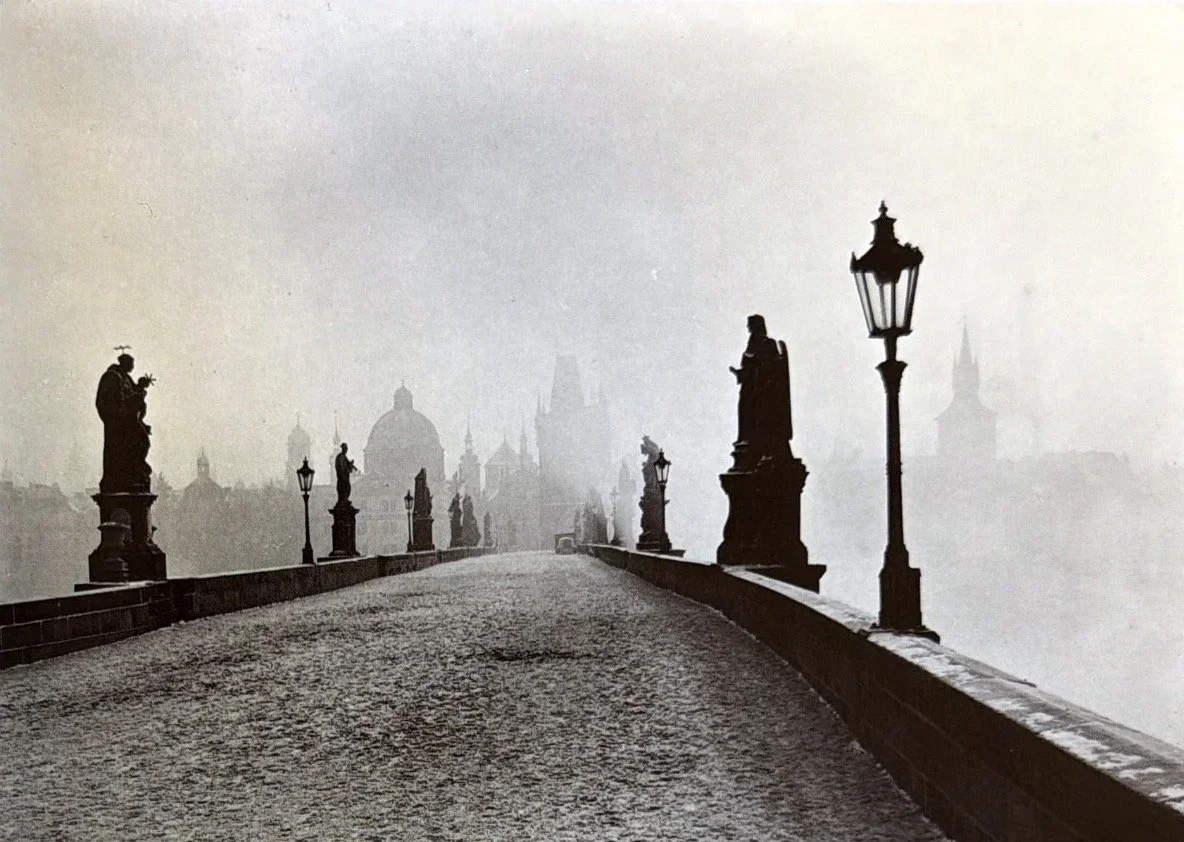
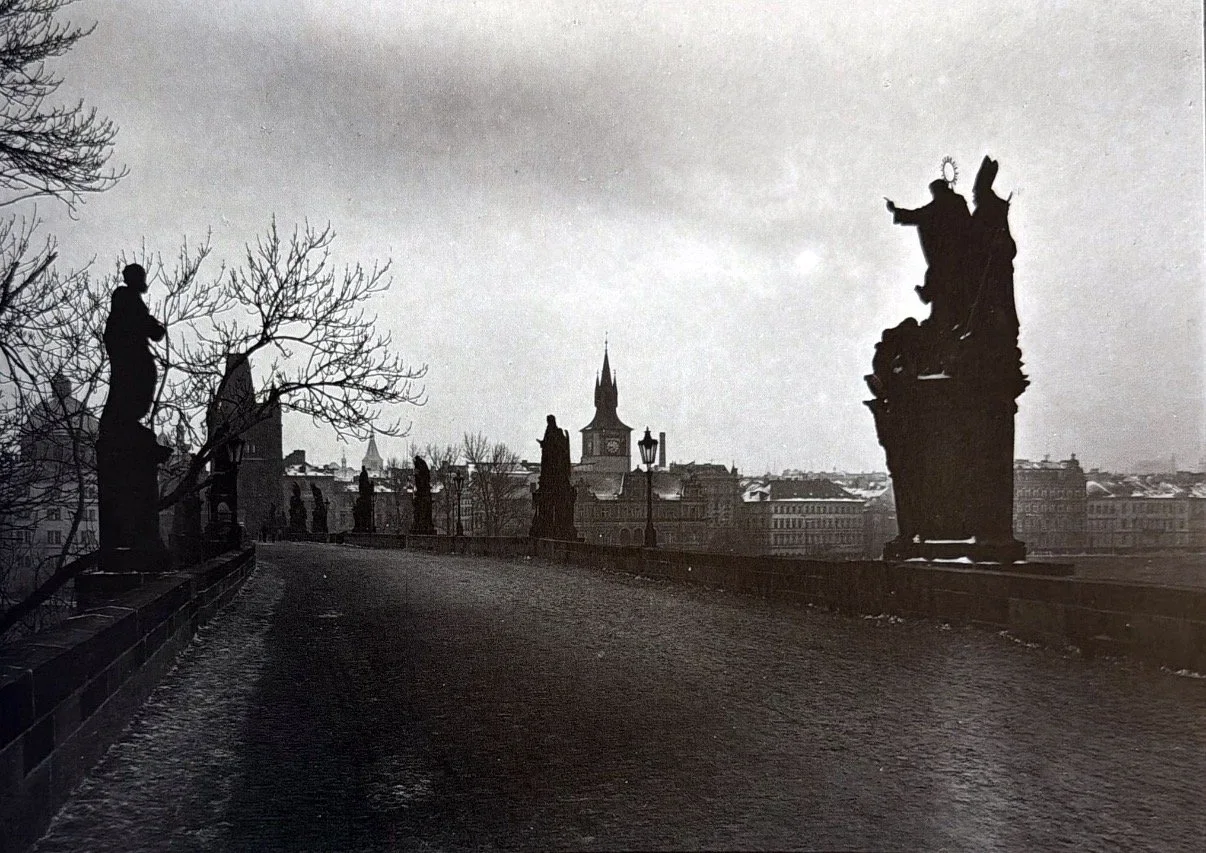
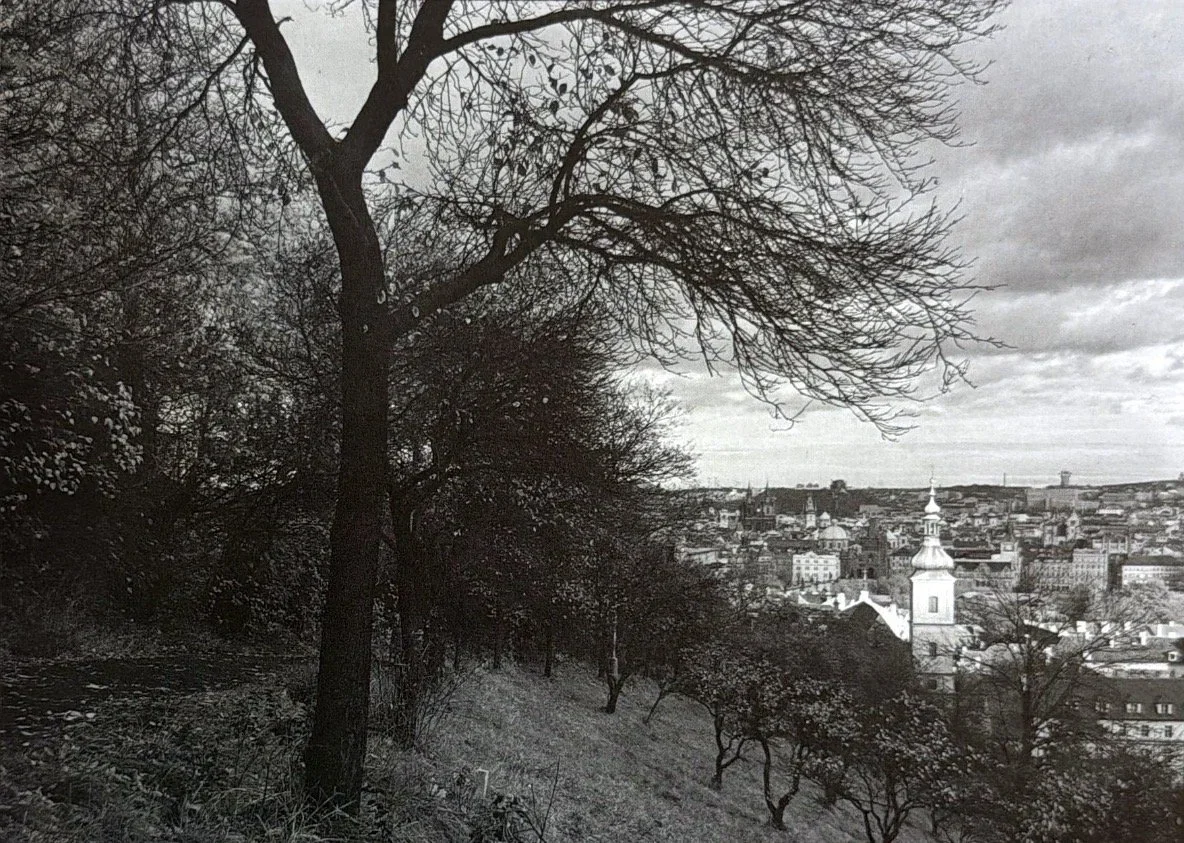
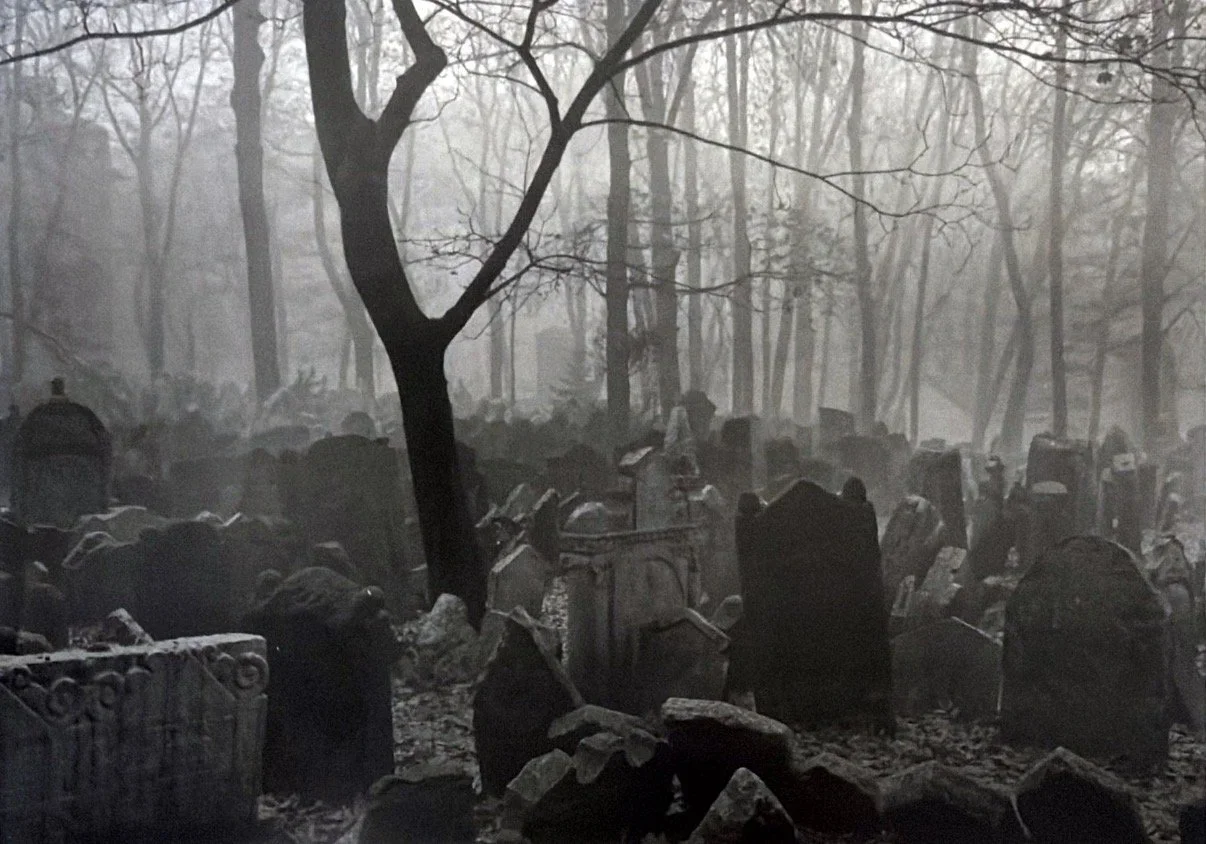
Reich returned to Prague from Paris after normalization in 1970, although he found continuing work with the same photography methods and subject matter impossible. When he graduated from college, he began his professional career by turning to capturing scenes from his childhood which he was sad to find gradually fading away. The outlying districts of Prague, Holešovice, Liben, Vysočany, were his primary subjects as he began his ‘Disappearing Prague’ cycle. Through his carefully composed black-and-white photographs, Reich captures abandoned factories, crumbling courtyards, neglected façades, narrow streets, and overlooked architectural details which were slowly vanishing during the past decades. Reich’s ‘Disappearing Prague’ cycle not only represents a significant artistic achievement in his career, but also captures an incredible historical record of a city in a state of major transformation.

His series were initially captured on photographic film and finished in the format 13x18 cm on a traditional wooden camera he acquired from the estate of Josef Sudek. 

Prague Series, 1980-2000

ARTIST
Jan Reich

TITLE
Charles Bridge I, 1986

MEDIUM
Vintage Silver Gelatin Print

CREDIT LINE
Courtesy of Jan Reich Estate

ARTIST
Jan Reich

TITLE
Charles Bridge II, 1986

MEDIUM
Vintage Silver Gelatin Print

CREDIT LINE
Courtesy of Jan Reich Estate

ARTIST
Jan Reich

TITLE
Church of Our Lady Victorious, 1986

MEDIUM
Vintage Silver Gelatin Print

CREDIT LINE
Courtesy of Jan Reich Estate

ARTIST
Jan Reich

TITLE
Old Jewish Cemetery, 1992

MEDIUM
Vintage Silver Gelatin Print

CREDIT LINE
Courtesy of Jan Reich Estate


Countryside

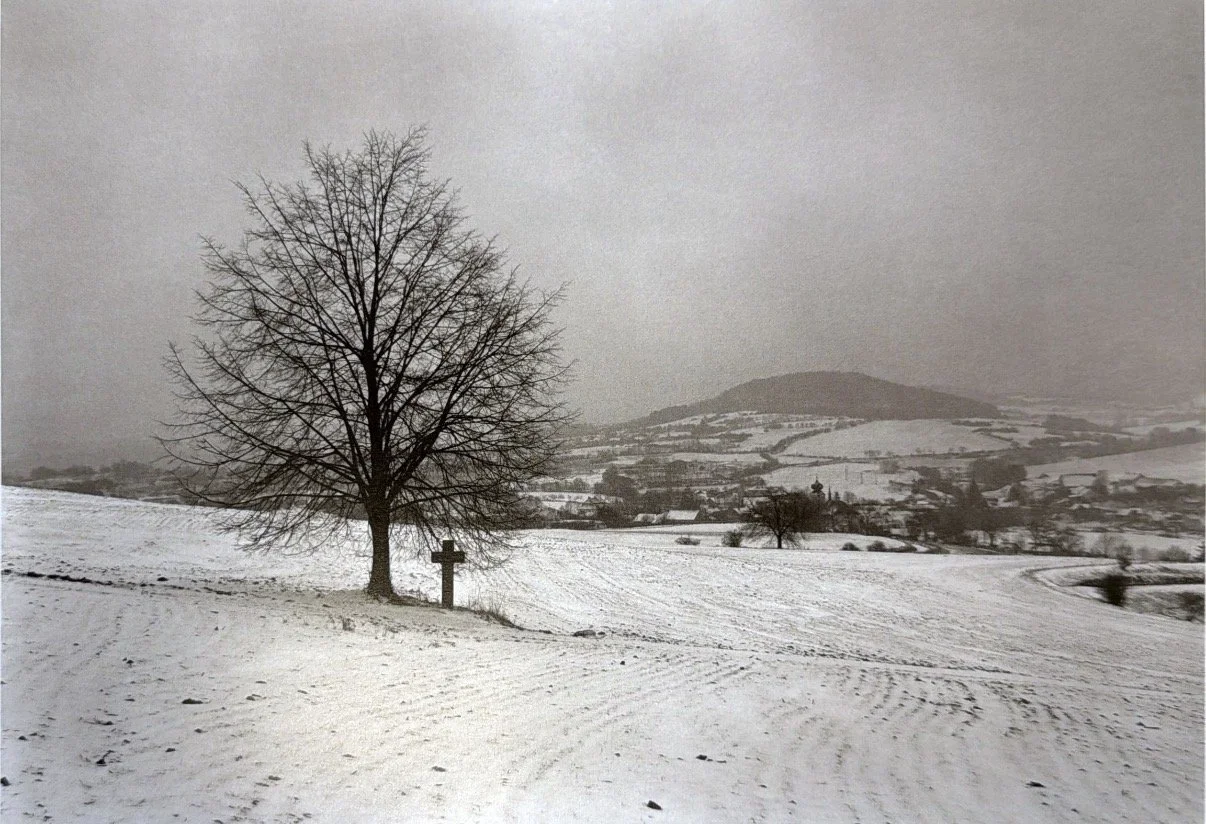
Reich’s work continued to evolve dramatically over the next few years. He met his wife Jana Reichová (born 1954). Jana was a key supporter of his work and helped to curate his legacy. She also managed the Galerie Nový Svět in Prague, which she founded in 1994, and later established a publishing house to promote his photography. They bought a house in the country and Reich’s artistic focus shifted to the documentation of values of the Czech countryside.  For the next thirty years, he continued to use large-format, wooden cameras to capture the landscape of Sedlčany county, where he and his wife moved after their children were born.

The photos in this series were captured over several decades and are comprised of the Czech countryside, and the many subjects surrounding it, with its historical sites making up the body of this work, including rural interiors, still life studies, portraits of local people, and his family.

Bohemian Countryside by Sedlćany, 1999-2006

ARTIST
Jan Reich

TITLE
Above Počepice, 1999

MEDIUM
Vintage Silver Gelatin Print

CREDIT LINE
Courtesy of Jan Reich Estate


Bohemia

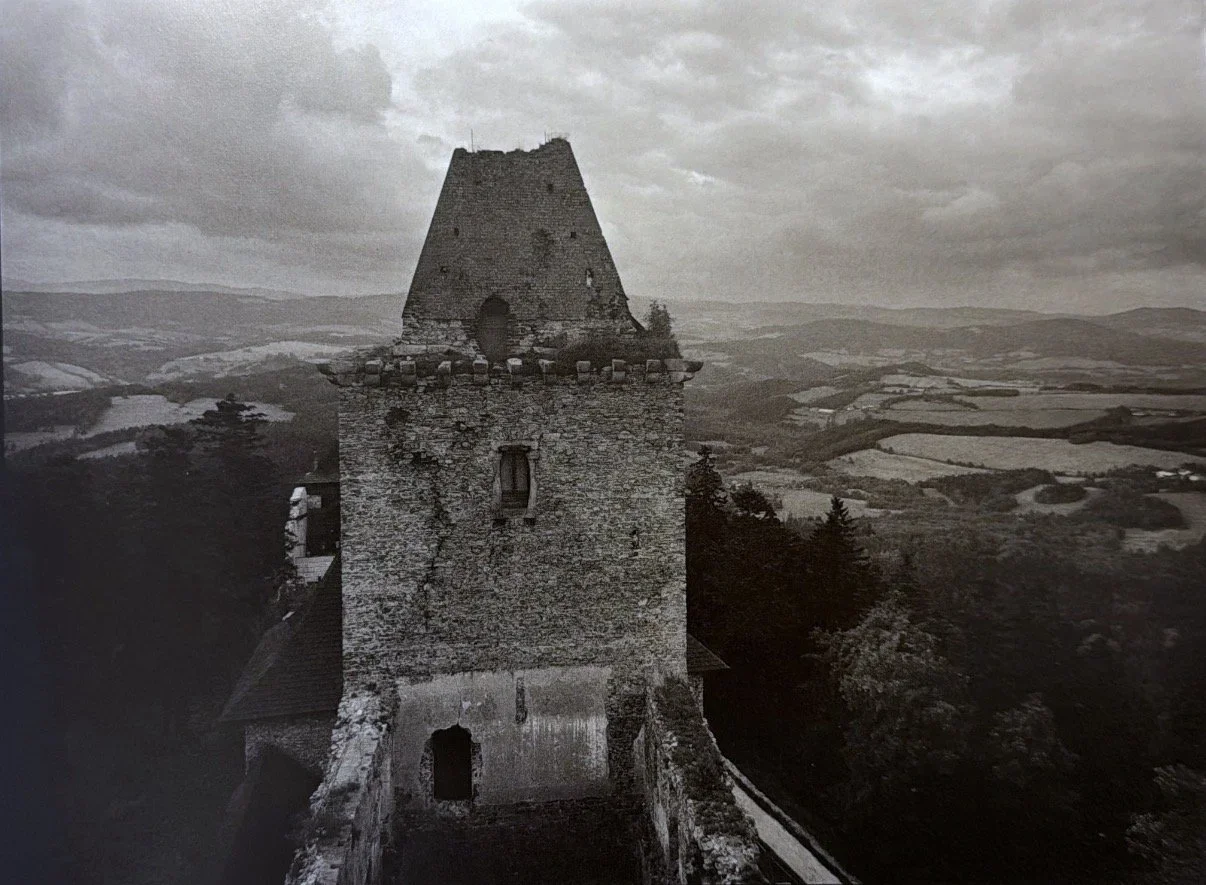
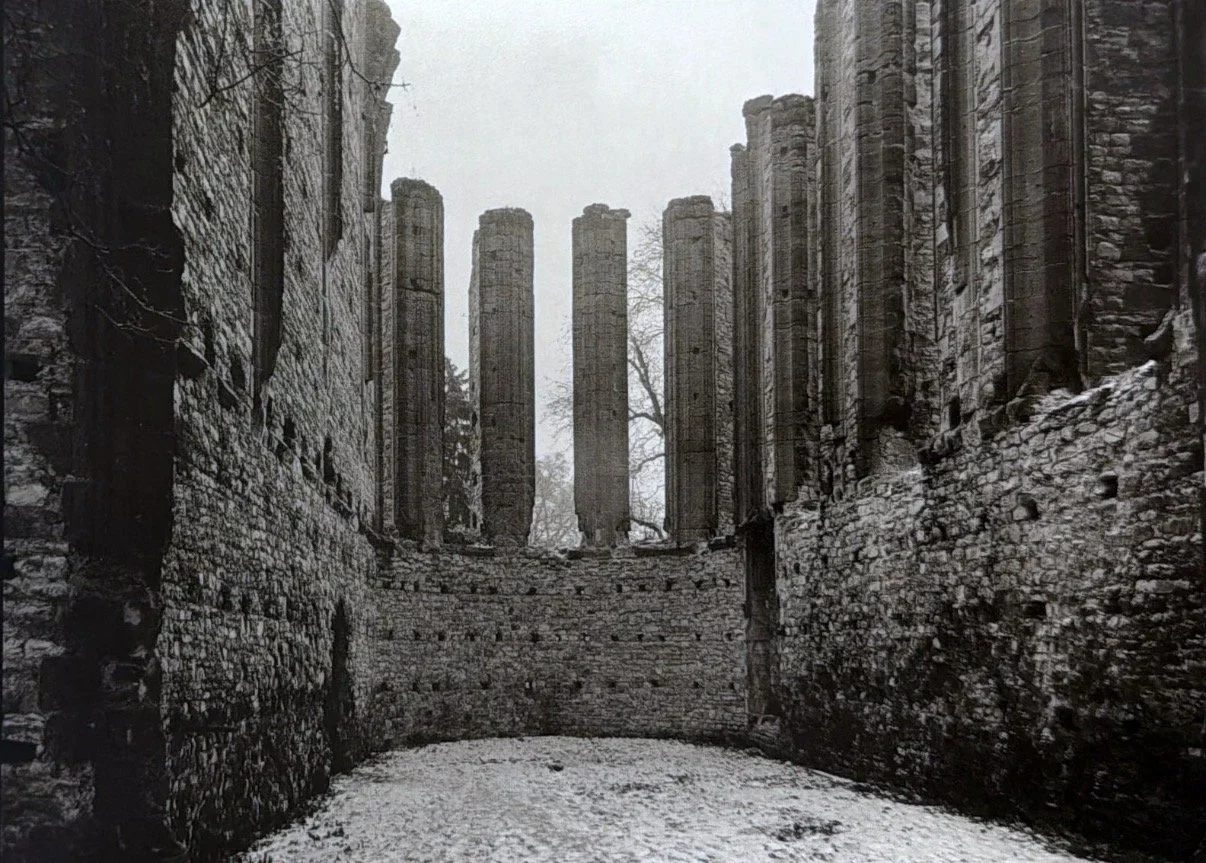
After 1989, he started photographing sites throughout Czechoslovakia with his large-format wooden camera; for nearly a decade, Jan Reich traveled to all parts of Bohemia, intent on capturing famous landmarks as well as places unknown and almost lost to the world as well as historical and spiritual spaces. His aim was to capture Bohemia in its forgotten glory, featuring landscapes and cityscapes littered with dead leaves and the last of the season's snow, winding paths, towers and walls overgrown with ivy, and graves whose shapes are becoming smudged around the edges, slowly crumbling into a long forgotten memory. Although these forgotten landscapes are no longer inhabited, Reich highlights them with his lens. By capturing these sites before they are gone, he helps to create an important record of the past.

As recompense for his hard work, Jan and his wife worked to publish a book, a selection of 150 photographs, Bohemia, which was published in 2005. These photos were from the Bohemian countryside, taken over the course of nearly a decade from 1994 to 2004. The book was recognized with the Magnesia Litera - Book of the Year award.

Bohemia Series, 1994-2000

ARTIST
Jan Reich

TITLE
Kašperk, 1995

MEDIUM
Vintage Silver Gelatin Print

CREDIT LINE
Courtesy of Jan Reich Estate

ARTIST
Jan Reich

TITLE
Panenský Týnec

MEDIUM
Vintage Silver Gelatin Print

CREDIT LINE
Courtesy of Jan Reich Estate and Tom Van de Ven


Still Life with Abstract

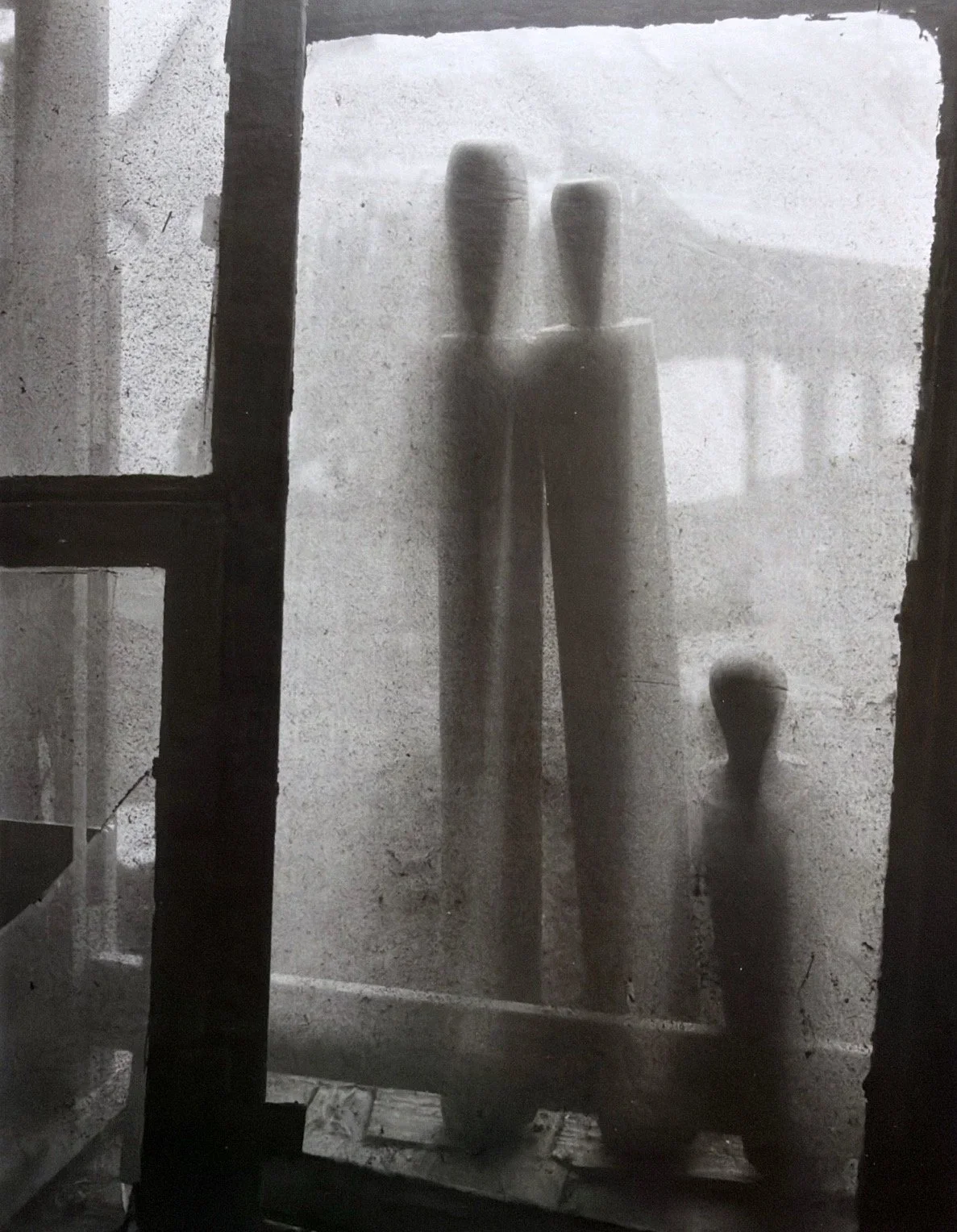
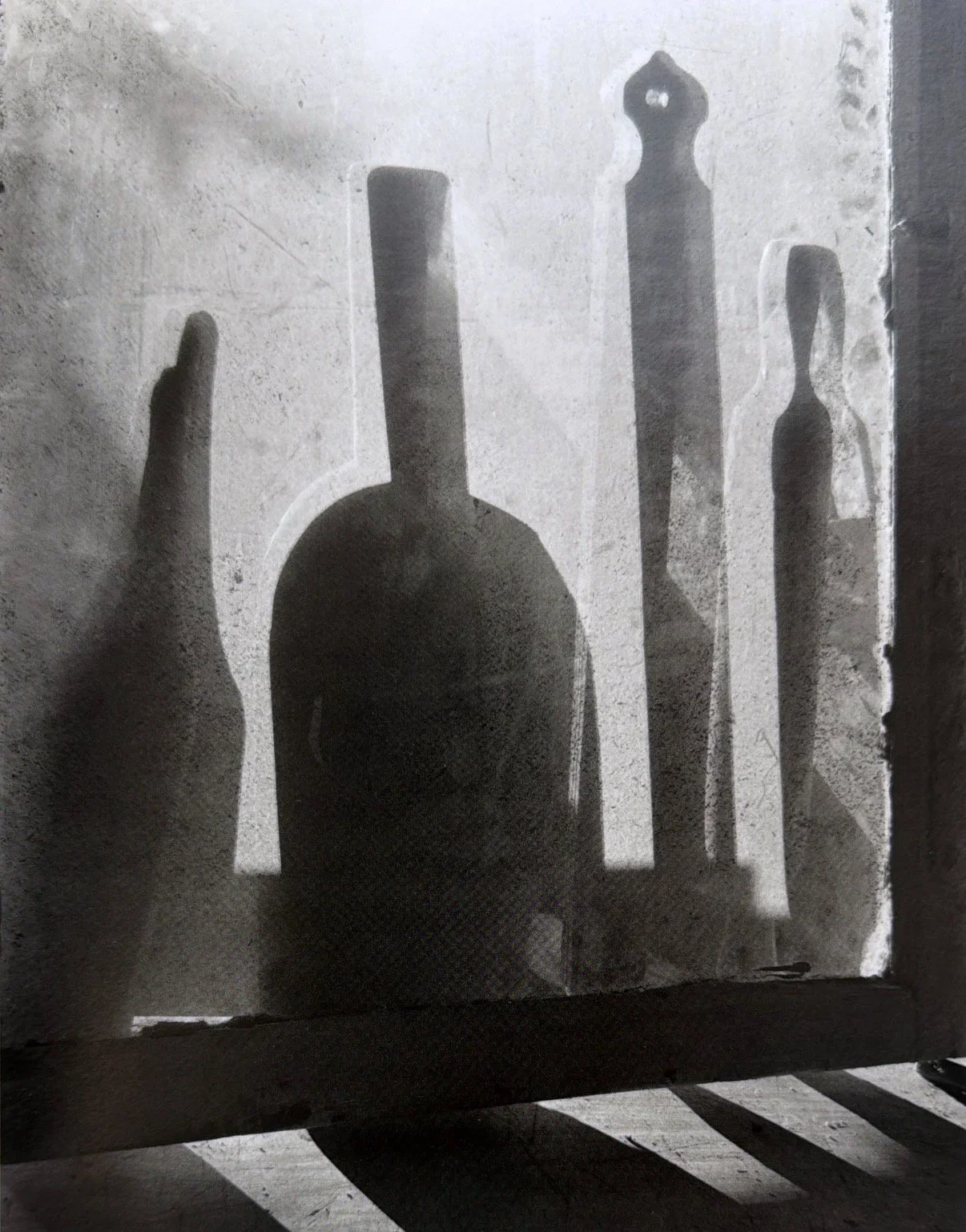
In Jan Reich’s final collection he begins one of his last series, still lifes of abstract composition. Perhaps the reason for this was his inability to travel as frequently in his old age, but the stillness of this time of his life allowed him to reflect on the internal. This collection is full of contrasts between light and shadow, the haunting shapes give way to mystery in our imaginations. Several of these contain forms or shapes that create a sense of body, leading the viewers to reflect on the human form. 

Without the continuous need to travel, Reich focuses on capturing the mysteries within. Abstraction allows audiences the opportunity to appreciate the piece for its simplicity, to apply their own deeper meanings to the works, but also to allow the works to stand powerfully in their simplicity. Through these works we see how the artist has reached to a pinnacle in his craft. He has set aside the unnecessary bits and left only the raw, essential pieces to create his works; perhaps taking this time to glean deeper meaning onto these objects, that would be seen as mundane to some, inviting the viewer to engage directly with form, light and shadow.

Reich reached new heights of restraint and control in this series. His focused now shifts to what viewers do not usually see at face value, audiences have a chance to see his vision of raw light, shadow, and the simplistic forms of domestic objects. By lingering over what others might overlook, he uncovers a depth in the mundane and transforms it into something profound.

Still Lives-Abstract Series, 2005-2007

ARTIST
Jan Reich

TITLE
Still life, 2005

MEDIUM
Vintage Silver Gelatin Print

CREDIT LINE
Courtesy of Tom Van de Ven

ARTIST
Jan Reich

TITLE
Still life, 2007

MEDIUM
Vintage Silver Gelatin Print

CREDIT LINE
Courtesy of Tom Van de Ven


Written by Erin Marashi and Tria Van Horn
Tiffany Leigeber

Tiffany Leigeber is a self-taught artist based in Jonesboro, Arkansas who donates half her proceeds to charities. Her palette uses white, gray, black, and gold--namely leaf gold. This gives her art a rich brightness to contrast the softer shadows and unfinished simplicity of her paintings and sculptures. She cites Rembrandt, Matisse, and Lichtenstein as some of her influences. Her display at the Czech Center and Museum, Czechs and Americans, presents 16 pieces of Czech heritage and history.

ARTIST

Tiffany Leigeber

TITLE

Devotion

 DATE

2020

 MEDIUM

Wood, canvas, oil paint and 24k gold leaf

 DIMENSIONS

Width 18” x Height 24”. (548.64 cm x 731.52 cm)

 CREDIT LINE

On display from the artist

PAST LOCATION

Prague Hall

CLASSIFICATION

Painting

PROVENANCE

Jonesboro, Arkansas

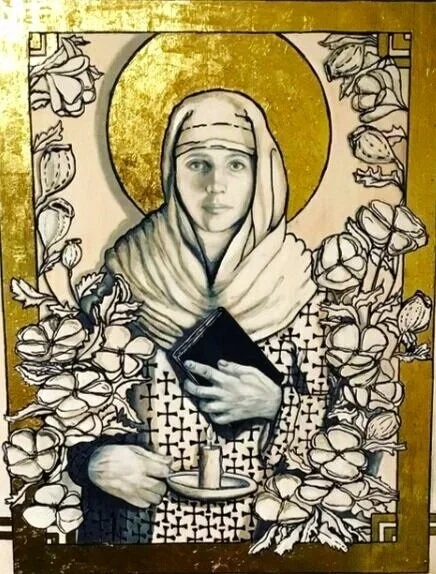
‘Devotion’. Photo courtesy of the artist’s Instagram.

‘Devotion’ uses black and white oil paint on wood to create an unfinished look for an icon of a famous Bohemian saint. Icons are traditional paintings used for religious devotions, particularly in Roman Catholic and Eastern Orthodox religions. They are characteristically rich in symbolism, painted on wood, and use gold leaf to depict heavenly light. 

This painting is a modern icon to Saint Ludmila of Bohemia, patron saint of duchesses, widows, and problematic in-laws. She and her husband Borivoj are credited with being the first Czech Christian rulers, though they were temporarily exiled for their beliefs. Ludmila became regent for her grandson Wenceslas (patron saint of Bohemia) and raised him as a Christian. This caused conflict with the pagans, including Wenceslas’s mother Drahomira. Leigeber represents the significance of Ludmila’s religious choice through the Bible in one hand and the single candle in the other, which often represented the light of God through humanity in religious iconography and services. Leigeber frames the saint in poppies, which symbolize death, the underworld, and funeral rites. Ludmila was assassinated, and legend says Drahomira had her strangled with her own shawl.

TITLE

Vanoce

 DATE

2020

 MEDIUM

Wood, canvas, oil paint and 24k gold leaf

 DIMENSIONS (approx.)

Width 12.5” x Height 15”. (32 cm x 38 cm)

 CREDIT LINE

On display from the artist

PAST LOCATION

Prague Hall

CLASSIFICATION

Painting 

PROVENANCE

Jonesboro, Arkansas

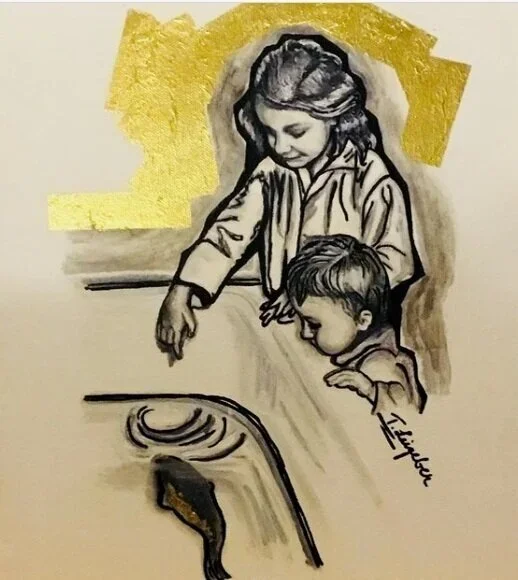
‘Vanoce’. Photo courtesy of the artist’s Instagram.

‘Vanoce’, based on an old photograph, shows two small children playing with a carp in a bathtub. On Christmas Eve, bathtubs throughout eastern Europe are a temporary home to carp fishes before they become Christmas dinner. Carp became a traditional Christmas dish in the 17th century thanks to the Czech tradition of a meatless holiday fast--and the historical notion that carp was not technically meat. This tradition has continued even after the popularity of refrigeration, but some Czech families now practice the tradition of setting the carp free on Christmas Day. The figures in the painting represent the children who play with their dinners on Christmas Eve. Here, the children interact with the gilded carp represent the children who play with their dinners on Christmas Eve. The gold surrounding them reflects the warm glow of a cozy winter night.


TITLE

Milena

 DATE

2020

 MEDIUM

Wood, canvas, oil paint, and 24k gold leaf

 DIMENSIONS (approx.)

Width 26” x Height 38”. (66 cm x 96 cm)

 CREDIT LINE

On display from the artist

PAST LOCATION

Prague Hall

CLASSIFICATION

Painting 

PROVENANCE

Jonesboro, Arkansas

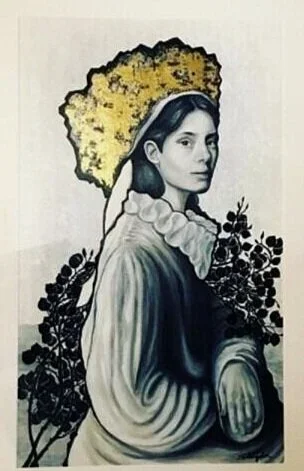
Leigeber paints Milena in a similar style to Saint Ludmila in ‘Devotion’, as if Milena was a saint herself. Her traditional white outfit and stoic face are painted with careful attention to shadow--a stark contrast to the undefined cloud of white and gold paint above her veiled head. Leigeber details this symbolic headdress with tiny black dots or small lines grouped in threes.

‘Milena’. Photo courtesy of the artist’s Instagram.

‘Milena’ is an homage to Milena Jesenska--journalist, editor, translator, and a member of the Czech resistance during Nazi Occupation. She was part of Vienna and Prague’s intellectual and ideological circles, a Communist until the Soviet ‘show trials’ of 1936, and one of the first to translate Franz Kafka’s works into the Czech language. Milena’s independent streak continued into Nazi occupation of Czechoslovakia, when her home became a way station for those being smuggled out of the country. She was arrested in 1940 and died in the Ravensbruck concentration camp in 1944, three weeks before D-Day.

Liberation Festival Pilsen

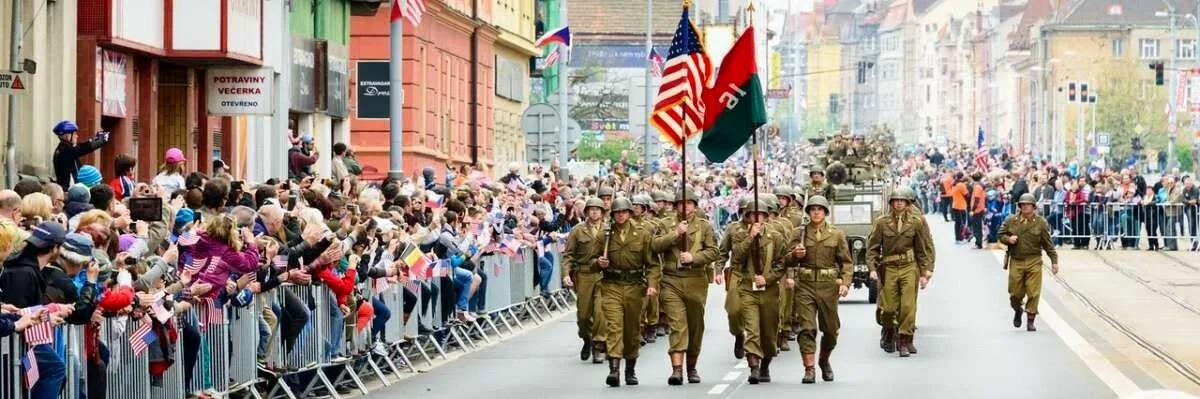
Photo courtesy of Darrell Hancock

Patton and pilsen

On May 5th, 1990, hundreds of thousands of people descended onto Pilsen, Czech Republic in celebration of the city’s Allied liberation in 1945. This celebration was 45 years in the making. During the Communist era, Allied liberation of West and Southwest Bohemia was repressed to preserve the Red Army’s reputation as Czechoslovakia’s liberators.

The celebratory crowd was gathered not just to honor the end of World War II and Nazi occupation, but to honor the cultural independence denied to Czechs as a Soviet satellite. “It felt so right that our town was freed from the Nazis by a western army,” Frantisek Kotva told the Associated Press that day in 1990. “We all loved the GIs, but then we had to forget about them for a long time.”

In 2015, photography enthusiast and Houston native Darrell Hancock joined the now-annual festivities with his camera. Several of his pictures were on display at the museum to educate visitors on Liberation Festival Pilsen (Slavnosti svobody Plzeň). 

Members of Czech historical societies reenacted American and Belgian forces entering Pilsen and forcing the German Army to retreat. The same tanks also performed in the Convoy of Freedom, a parade traveling through Pilsen. Reenactors saluted, people waved flags, and World War II veterans mingled with the population just as they did in 1945. 

After liberation, American soldiers would often recall how their tanks would be flooded with cheering, laughing, celebrating Czech people, often wearing native clothing as a symbol of Czech independence. Many soldiers received gifts of food, flags, and flowering lilac branches. The few surviving American soldiers return to Pilsen to honor the city’s liberation in what is now called “The Day of the Lilacs”.

CZECHS, COLLECTED: Czech and Slovak photographers at FotoFest 1990 – present


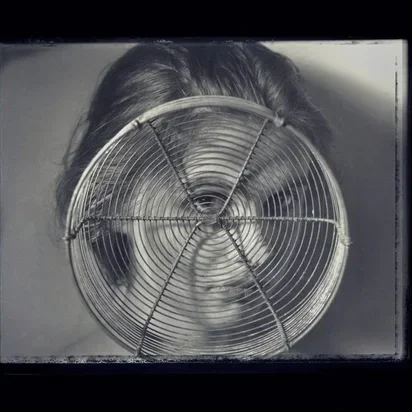
Pavel Baňka

Like a Target, 1986
From the Figuration series, 1960–
Silver Gelatine Print
Image courtesy of the artist

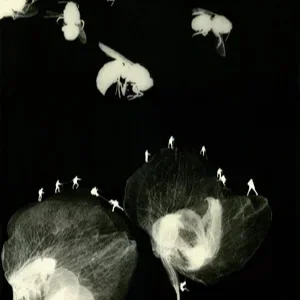
Roman Franc

In the tip
From the My Little Miracles series, 2018
Silver Gelatine Print
Image courtesy of the artist

Štěpán Grygar

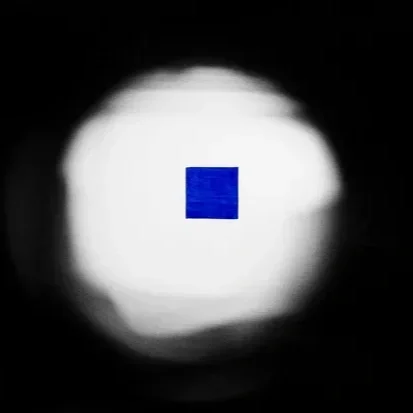
Untitled (Blue Square),1993
Silver Gelatine Print (Mixed Media)
Image courtesy of the artist


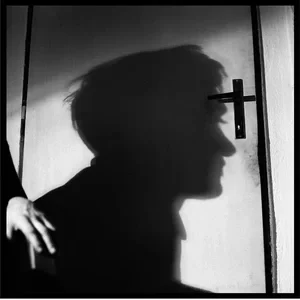
Igor Malijevský

Petr's Shadow
Čelechovice, Czech Republic, 2000
From The Signs series, 1996-2006
Silver Gelatine Print
Image courtesy of the artist

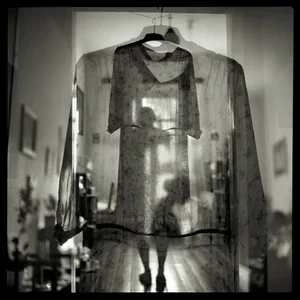
Gabriela Sauer Kolčavová

The Ascent of Mont Blanc (after the Bisson brothers), 2007
From the MEMOIR series, 2007
Silver Gelatine Print
Image courtesy of the artist

Vojtěch V. Sláma

Many Kisses, meanwhile
Brno, Czech Republic, 2006
From the Wolf’s Diary series, 2005–
Silver Gelatine Print
Image courtesy of the artist


Miro Švolík

Big Woman Little Man, 2010
From the Big Woman Little Man series, 2010 Silver Gelatine Print
Image courtesy of the artist


CZECHS, COLLECTED is an exhibition featuring the works of Czech and Slovak photographers who have presented at FotoFest since 1990. Viewers get an exclusive peek into works from Houston's private collections and from FotoFest archives.