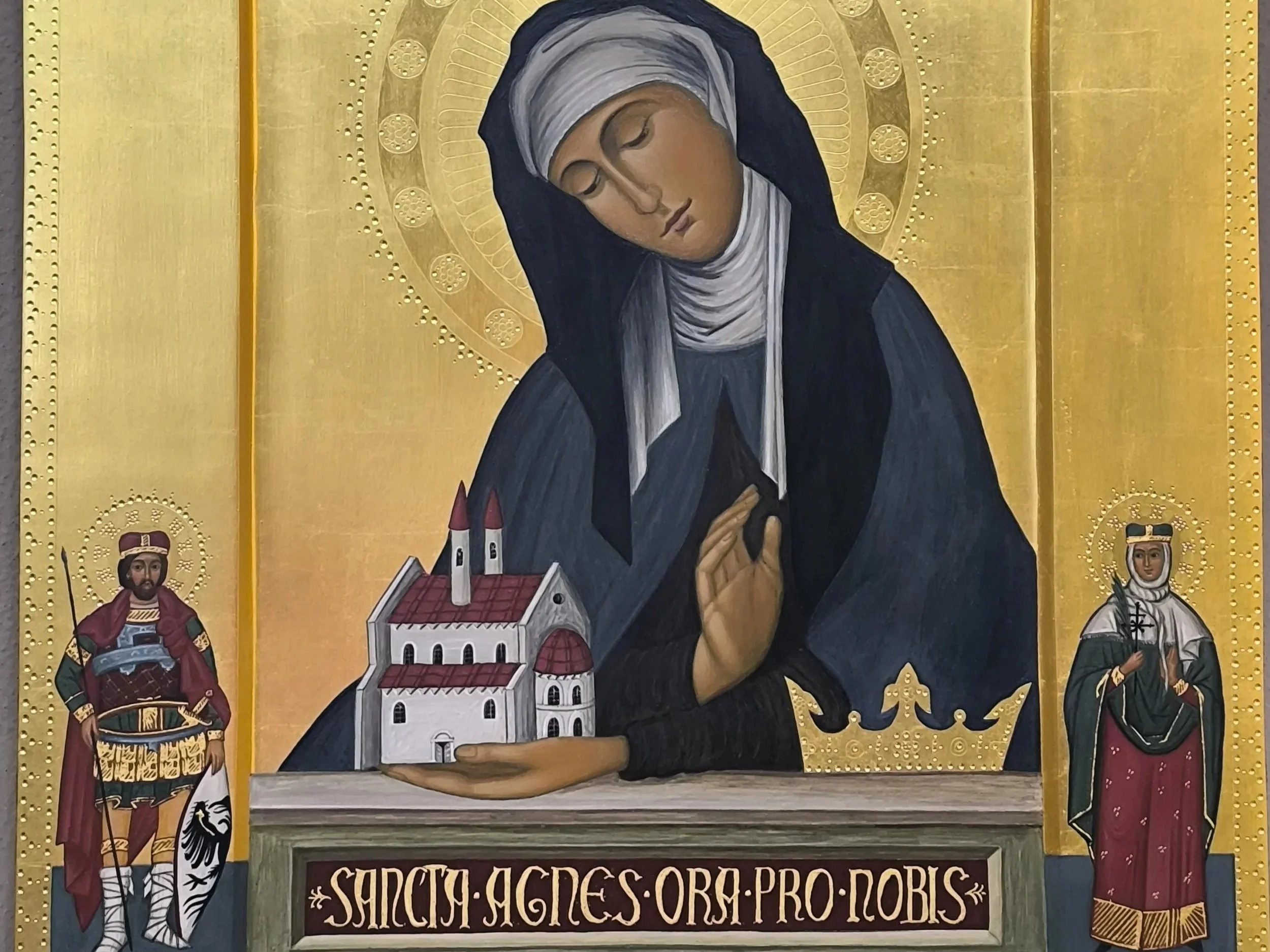
Painting of Saint Agnes of Bohemia. Photo taken by Dobroš
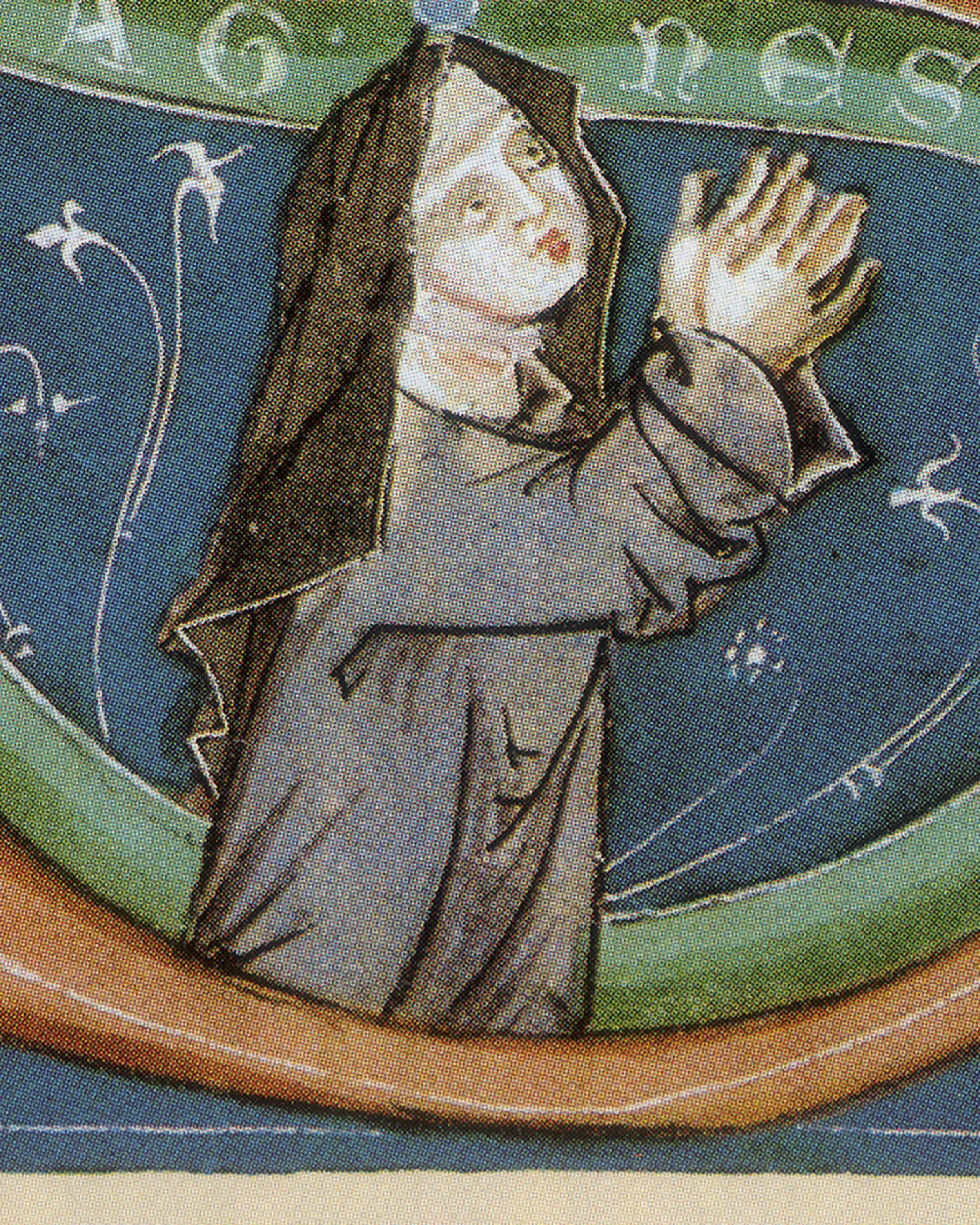
Depiction of Saint Agnes of Bohemia. Photo taken by: Osecký lekcionář.
Saint Agnes of Bohemia has been venerated in the Czech Republic for over 800 years. She has served as both a religious and political symbol, as she was canonized a few days before the Velvet Revolution began in 1989. Her story takes place in the 13th century, during which her life changed from Bohemian royalty to an abbess who devoted herself to God and to the teachings of the Catholic Church. After her passing, her memory and good deeds to the people of Bohemia were kept alive for over 800 years until her canonization by Pope John Paul II.
Childhood
Agnes was born on the 20th of January, 1211, in Prague, Bohemia. Her father, Ottokar I of Bohemia, was part of the Přemyslid dynasty. Her mother, Constance of Hungary, was the second wife of her father. Born into her father's lineage, the Přemyslid dynasty, she was related to two of the patron saints of Bohemia: St. Ludmila and St. Wenceslaus I, Duke of Bohemia.
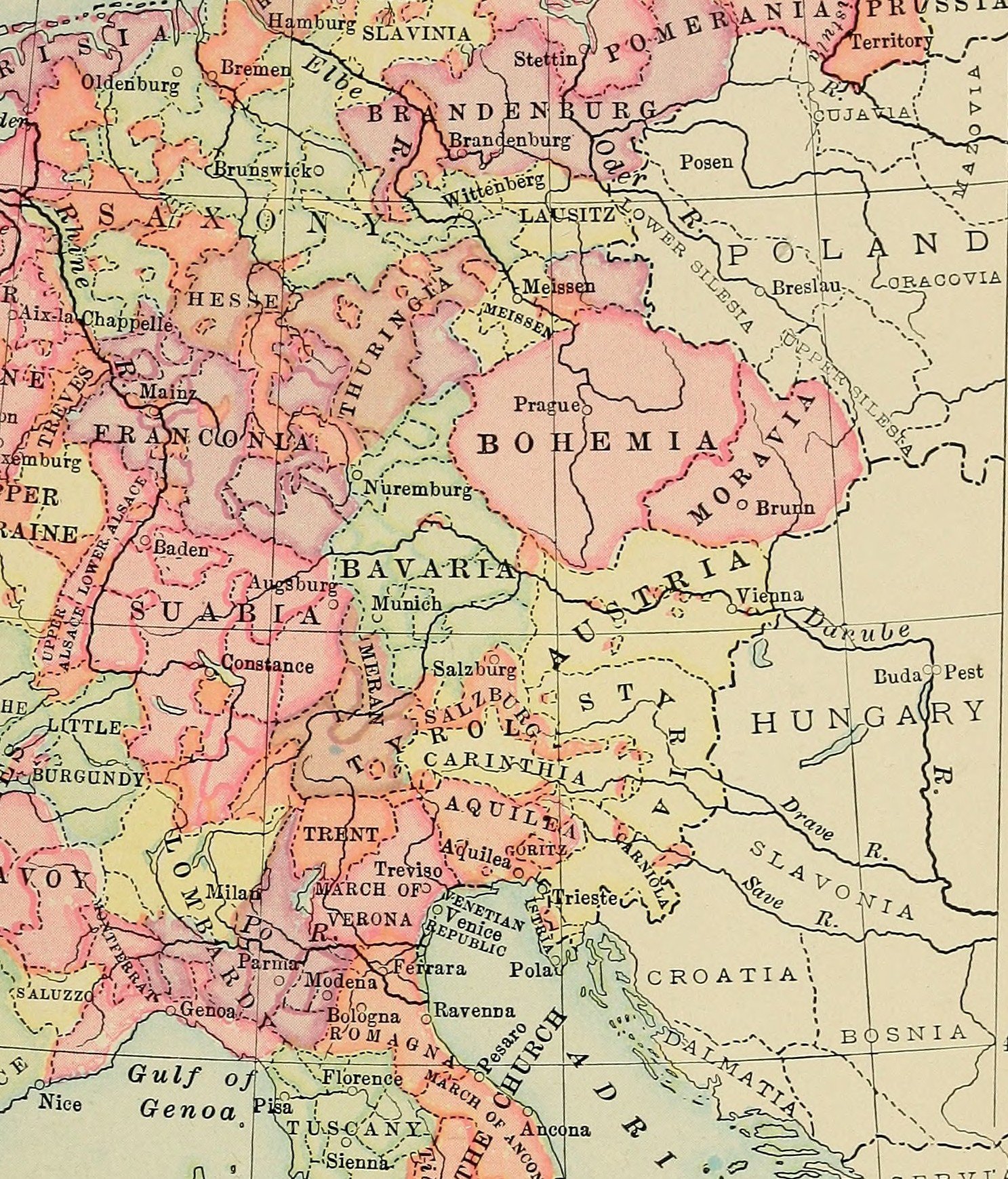
Map from around the 13th century depicting the Holy Roman Empire, with the Kingdom of Bohemia depicted. Map is taken from, Modern history; Europe 1904.
As was common at the time, young Agnes was seen as a political tool to secure alliances between the dynasties of Europe. Her Father, who was a political genius of his time, attempted to ensure the future of Bohemia. So, at the age of three, Agnes and her sister, Anna of Bohemia, were sent to Silesia. They were to be married to the children of Duke Henry I, the Bearded, of Silesia. Anna was betrothed to Henry II, whom she later married in 1216. Agnes was also betrothed to another one of his children and placed under the care of her Aunt, Duchess Hedwig of Silesia, the wife of the Duke.
Hedwig at this time had begun to withdraw to the Cistercian monastery of Třebnice. It was at the monastery that Agnes was taken care of by the nuns and Hedwig herself, receiving an education befitting her royal lineage. During her stay, Hedwig made an impression upon the young Agnes. She was charitable, cared for the poor and the sick; all characteristics which Agnes would eventually embrace. Agnes would stay for three years before departing due to the death of her future husband. Upon her return to Prague, at the age of six, she was sent to the Premonstratensian convent of Doxany in Bohemia to continue her education for the next two years.
In 1220, when Agnes was around nine years old, she was once again betrothed. This time to Henry VII, son of the Holy Roman Emperor Frederick II. Agnes was sent to spend time at her future husband's court in Vienna, Austria. Henry, on the other hand, was placed under the watch of the Duke of Austria, Leopold VI. Leopold took advantage of the situation to negotiate a marriage between Henry and his daughter, Margaret of Badenberg, which worked. In 1225, Agnes’s betrothal contract was canceled. The fallout enraged Agnes’s father, who had politically maneuvered his daughters to secure the Přemyslid dynasty’s hold on Bohemia's throne. Because of this, Ottokar declared war on Austria, leading to some minor border skirmishes.
Determined to secure future alliances for Bohemia, her father refused to give up. Upon her return to Bohemia, at the age of fourteen, he began negotiations with the King of England, Henry III, to get her married off again. This went nowhere, as she was reluctant. Suddenly, in 1228, an embassy from Frederick II, the Holy Roman Emperor, arrived in Prague. The embassy proposed a marriage offer from Frederick II to Agnes. Ottokar I was ecstatic, as this was an offer that could not be refused. The union between the two houses would place them into a powerful position within the empire. However, Pope Gregory IX, due to political motives, subsequently vetoed this notion. This left Agnes with no more suitors. Her father, Ottokar I, died in 1230, placing her brother Wenceslaus I on the throne. Her brother did not attempt to marry Agnes as their father did. Instead, he let Agnes do as she pleased.
Road to Becoming a Nun
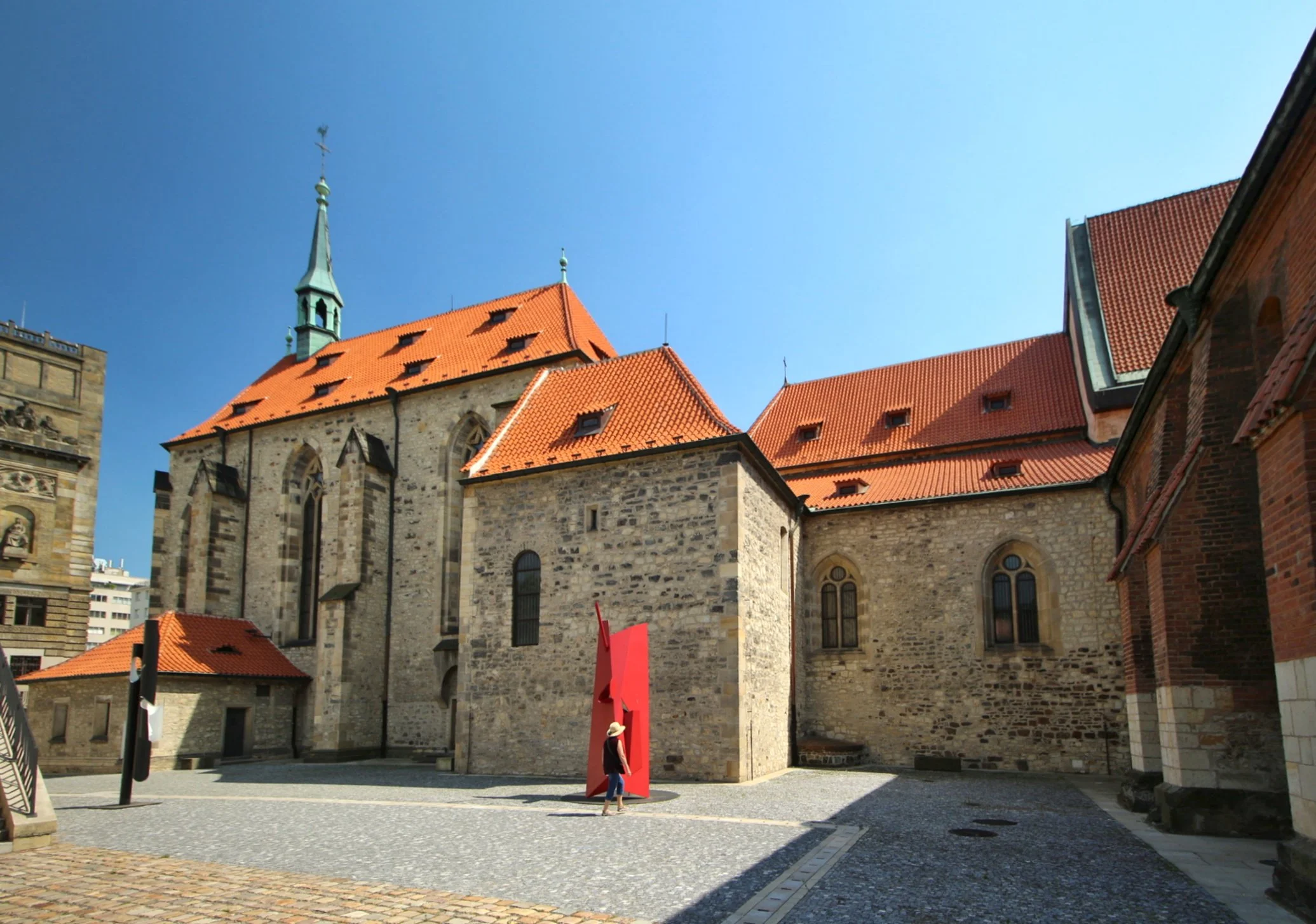
Photo of the Convent of St. Agnes now the National Gallery Prague. Photo taken by VitVit.
Agnes, now 20, had begun spending more time in prayer. She began to strive to become one with God. Yet another obstacle awaited. In 1231, Frederick II once again attempted to win her hand in marriage. Upon hearing this, Agnes wrote a letter to Pope Gregory IX, in which she asked to live her life as one with God. The Pope was thrilled to have such a generous devotion from her. He quickly sent back a letter confirming and commending her resolution. Agnes went to her brother Wenceslaus I, now King of Bohemia, and proclaimed her resolution to God. He dispatched messengers rejecting the advance by Frederick. Frederick agreed, believing that it was a matter between Agnes and God, not that of mortals, and retracted the marriage proposal.
Now officially being released from any marriage, Agnes was given her dowry by her brother. It was during this time, in 1232, that her brother also welcomed minorities back to Bohemia (small denominations of the Catholic Church). Wenceslaus I also built the church of St. James for them, where Agnes began to learn about the life and teachings of St. Francis.
Agnes created a temporary hospital at the Church of St. Castulus in 1232, and a year later, in 1233, she founded the Hospital of St. Francis and the St. Francis of Assisi Church. While Agnes worked at the hospital, she cared for the poor, lepers, and the ill of the city. During this time, Agnes also founded a hospital fraternity which eventually became the Knights of the Cross with the Red Star. Agnes then placed the hospital under their care, but continued working at the hospital. Other members of the Přemyslid Family took notice of her actions in Prague and followed suit, building several more hospitals that were placed under the care of the Knights.
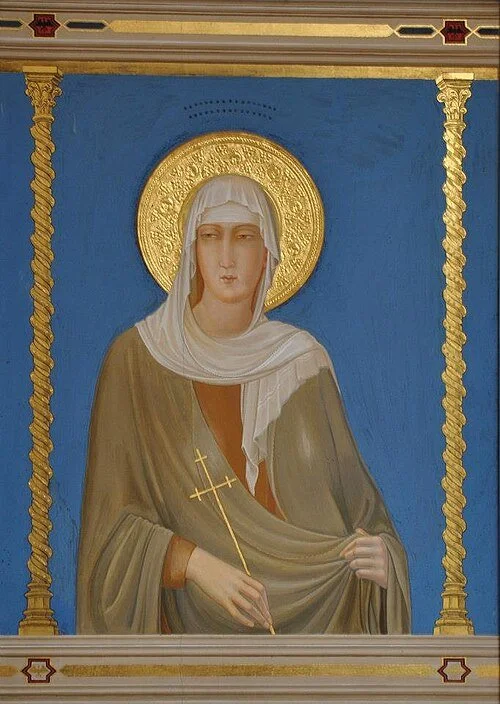
Saint Clare of Assisi from the fresco St. Clare and St. Elizabeth of Hungary made by Simone Martini
Somewhere around this period of time, a Franciscan priest gave Agnes details about Clare of Assisi. Telling her how she was living her life in poverty. This spurred Agnes to join Clare's own Order. In 1234, she was given land by her brother. Agnes sold her dowry to begin the construction of a monastery in the northern part of the city by the bank of the Vltava. She sent a message to Rome asking for both approval of the monastery and a request for sisters from Clare's monastery to join hers, following the teachings of Clare. Pope Gregory IX agreed to both, so five sisters were sent from Clare’s Monastery of San Damiano. Later that year, during the Feast of Annunciation, in front of many members of the nobility and clergy, Agnes gave up her royal garments, exchanging them for a simple robe, and entered the monastery along with seven women from Bohemian nobility.
Clare sent a letter and simple gifts to Agnes, congratulating her on opening her monastery and following her teachings. It was from here that their correspondence began. Agnes received a total of four letters, that we know of, from Clare between 1234-1253. During Pentecost in 1236, Agnes made her solemn vows under Bishop John, and he gave her the title of Abbess of her covenant, as Pope Gregory had ordered in 1234. However, Agnes did not like being called an Abbess, so in 1238 she humbly requested the pope to have the title removed, preferring to be called elder sister by the members of her monastery.
Agnes also kept frequent contact with Rome from 1234 until 1245. A multitude of letters and correspondence were exchanged between Pope Gregory IX and her until he died in 1241. They sent letters discussing her life following Clare’s beliefs, with him often giving advice or attempting to help her Monastery. When Innocent IV became Pope, he also kept in contact with Agnes and maintained a good relationship with her and her Monastery.
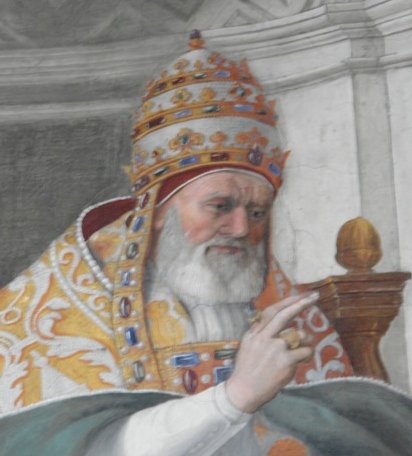
Pope Gregory IX painted by Raphael Santi
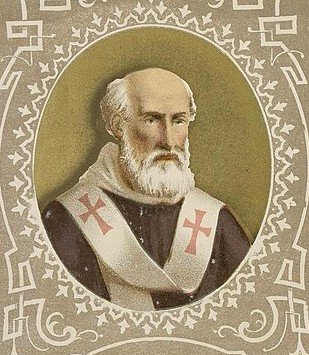
Innocent IV, from the Municipal Library of Trento
Later Years
As the years rolled on, Agnes continued to help in the Hospital of St. Francis, tending to the sick and the poor. She kept up with her family consistently. To such a degree that during the general council of the Church at Lyon in 1245, letters from King Wenceslaus praised Agnes. In 1248, her nephew Ottokar II led a rebellion, with the help of the nobles, against her brother Wenceslaus. Agnes used her standing as both a member of the Přemyslid dynasty and the Catholic Church to act as a mediator between the sides. She was able to get them to reconcile, leading the rebellion to an end and keeping the peace in Bohemia.
Her relations with Rome also stayed in good standing. In 1251, Pope Innocent IV sent gifts to Agnes containing relics of saints, which were sent in their ordained reliquaries. After being persuaded by both Agnes and Clare, Pope Innocent IV went on to pass Clare's beliefs: allowing the rule of living in poverty in 1253. Clare died two days after.
That same year, Wenceslaus I died, and Ottokar II was crowned King of Bohemia. He led the kingdom into a series of wars attempting to carve out an empire in Central Europe. Agnes stayed in her monastery, in the lifestyle taught to her by now canonized St. Clare. She pleaded with her nephew to stop these wars and attempted to maintain the peace in Bohemia and the surrounding countries. She even warned him that she had been given a vision of his downfall, even accepting his daughter Kunigunde of Bohemia into the monastery. Ottokar II did not listen, and a period of war broke out from 1254 to 1278. In 1278, while fighting Rudolf of Habsburg, the King of the Germans, Ottokar II died in battle. Agnes, walking in her monastery when it happened, received a vision of his death and proclaimed it to her sisters.
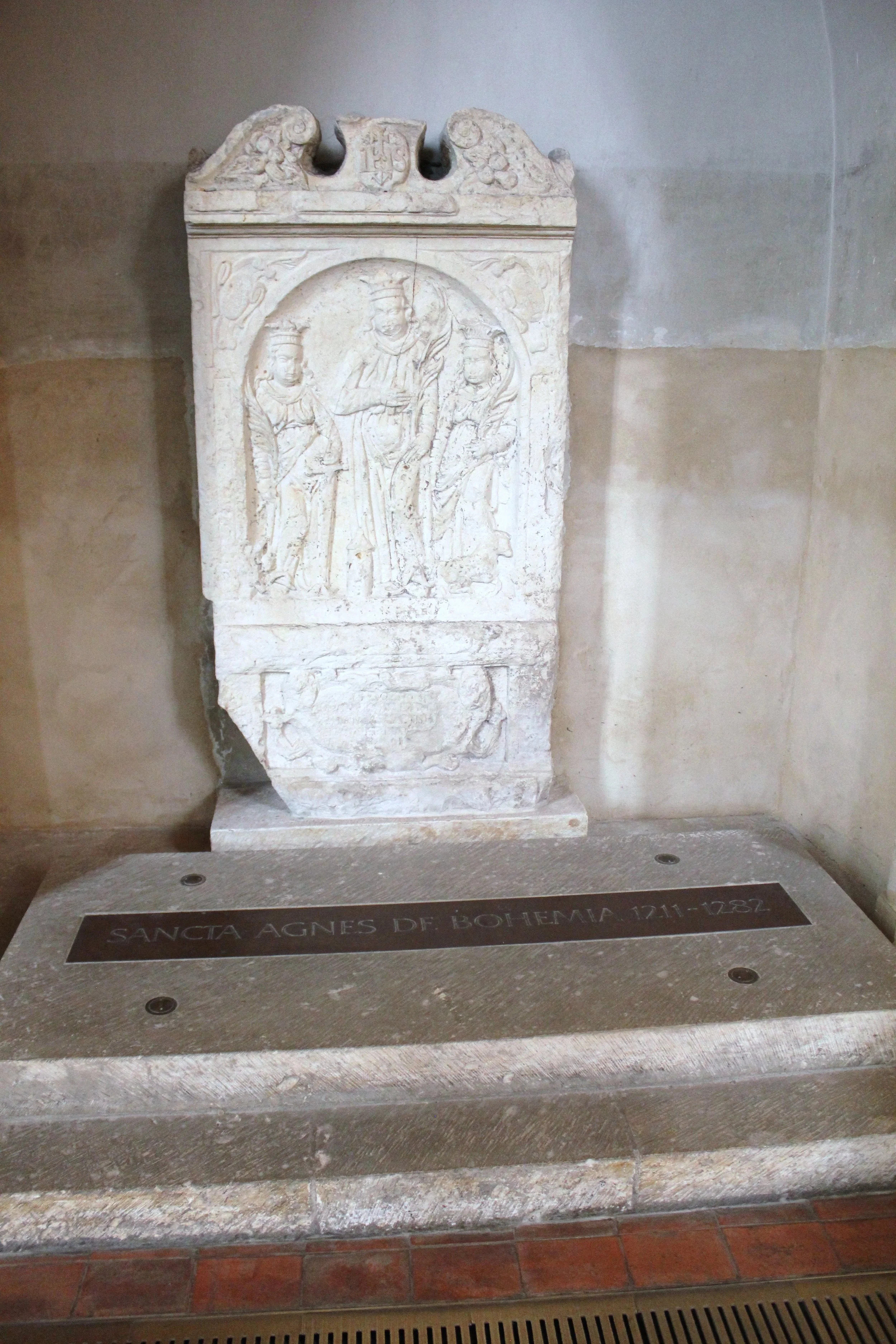
Tombstone of St. Agnes, written upon the floor is “Saint Agnes of Bohemia 1211-1282.” Photo taken by: Øyvind Holmstad
After Ottokar II's death, Bohemia was given to Otto, the margrave of Brandenburg, who misused his power, leading to widespread famine, epidemics, and warfare throughout the lands. It was during this time that Agnes’s convent became a refuge for many. It soon worsened; several floods caused widespread destruction, and food became even more scarce, prompting some people to turn to cannibalism to survive. Agnes, who had chosen to live a life of poverty, also suffered during this time and is believed to have died in 1282 due to starvation. Her funeral was simple, with her body believed to have been laid at the choir and left there for 14 days before being buried beneath the altar of Our Lady at the Church of St. Salvator. Her remains stayed at the church until they were hidden during the Hussite Wars to protect them.
Several of St. Agnes’s Miracles and Visions
Agnes lived her life in poverty, attempting to live with no material wealth, and helping the sick and the poor. Through her acts of caring, she was looked up to by many Czechs, especially residents of Prague. The people of Prague kept her deeds alive by word of mouth and veneration for generations to come.
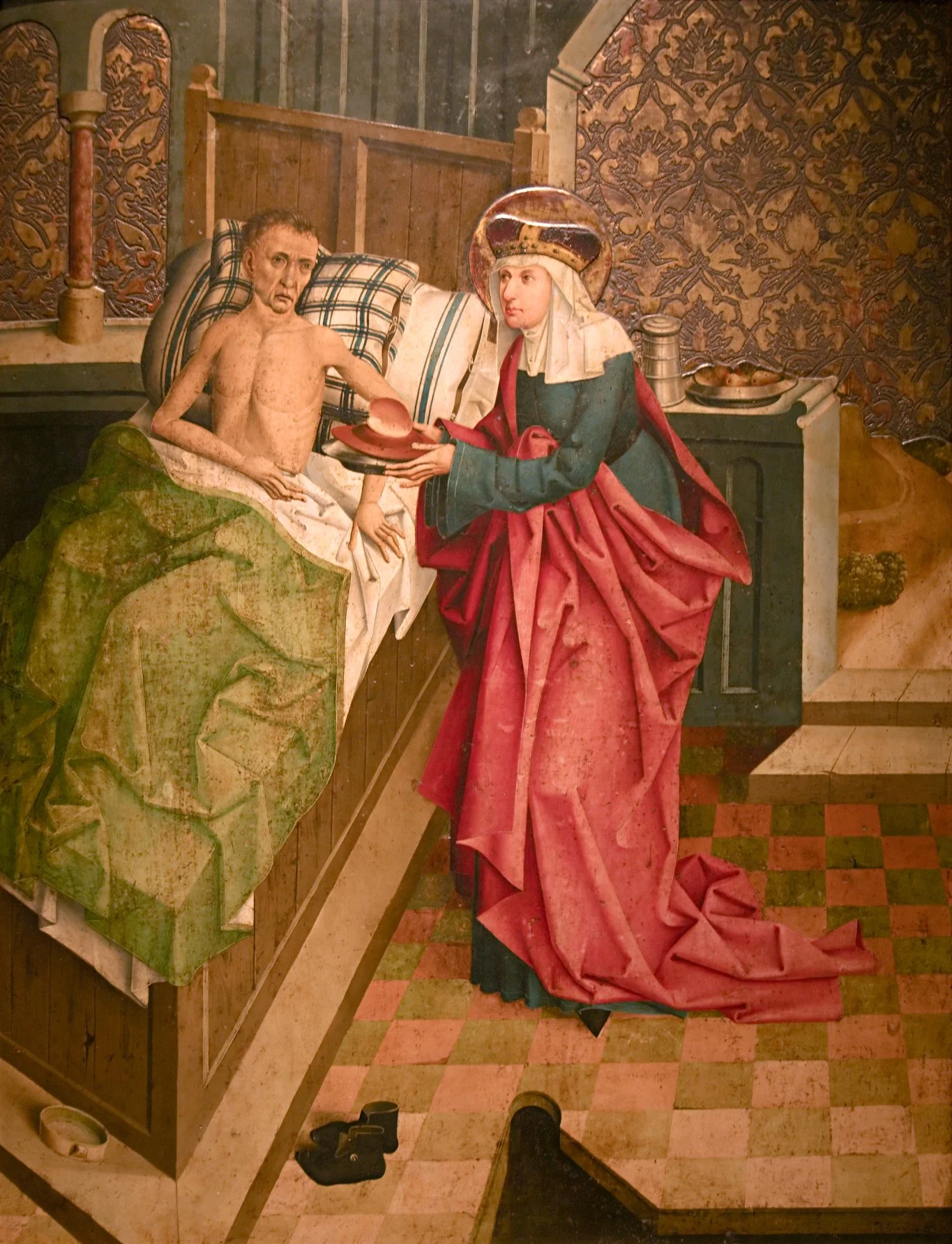
Master of the Altar by Nicolas Puchner, depicts St. Agnes taking care of a sick man. the reproduction was made by Adrian Siemieniak
While Agnes was still alive, she performed multiple miracles. Twice, when the sisterhood needed food. Agnes prayed, asking the Lord for food. Suddenly, food was left for them on the window. Another time, Agnes blessed a sister who was dying from an illness, whereupon she was cured. Later, the wife of a knight who was dying from childbirth asked for apples that were blessed by Agnes. Upon the wife eating the apples, she was healed. A few people went to ask Agnes for apples. She obliged and went out into the garden, blessing them before giving them to the group.
Agnes also had visions. When her brother, King Wenceslaus I, went to war against the Austrians, Agnes foretold that her brother would emerge triumphant. At the conclusion of the war, her brother was victorious against the Austrians. Another vision she told of was that upon her death she would be buried not by bishops or other members of the prelates. Instead, her last rites would be carried out by a foreigner, specifically by a Friar Minor who had never been in Bohemia. She also had an early vision of the death of Ottokar II and warned him. Later, when Ottokar II died in battle, Agnes, who was in the monastery, was given a vision that he had died. She immediately told it to her sisters; it was confirmed soon thereafter.
During her funeral in 1282, another three miracles occurred along with the confirmation of Agnes’s burial prophecy. Scholastica Habart of Žerotín, a noble lady and founder of a convent at Týnec, suffered from a disease. When she went to mourn at Agnes’s body, she was suddenly healed in front of the crowd. Later that night, sister Judith was left alone to tend to Agnes’s body. Judith wanted a piece of memorabilia from Agnes herself and attempted to pull off her large toenail. Blood suddenly gushed out of Agnes. Judith attempted to stop the bleeding with a cloth, which didn’t work, so she knelt and prayed, asking for forgiveness, when the bleeding stopped. The cloth that contained Agnes’s blood was then made a relic. After this incident, Agnes’s body was placed in a coffin. This caused an issue with Scholastica of Sternbeck, who was the grandmother of Žerotín. Scholastica had been in frequent contact with Agnes and had visited the monastery several times before. She wanted to see Agnes’s body one last time before she was buried. The Papal Legate was present and gave his consent to allow Scholastica to see the body, but the sisters hesitated, believing that Agnes would rather be left alone. It was during this debate that the coffin’s nails and hoops gave way and the lid of the coffin slid off, allowing Scholastica to view Agnes’s body one last time. After 14 days passed, Agnes needed to be buried. Bishop Tobias of Prague and other members of similar rank declined to do the task. Instead, the task fell to a monk who had never been to Bohemia. He was the highest superior of the Franciscans, the general Bonagratia. Fulfilling her prophecy.
Years after Agnes’s funeral, she was connected to several other miracles. Wenceslaus III, the sixth King of Bohemia, and his wife Judith of Habsburg invoked Blessed Agnes's name to save their daughter from an illness. After the invocation, Margaret, their daughter, made a full recovery. Another miracle happened while Elizabeth of Bohemia, the mother of Charles IV, had her son locked up by his own father. Elizabeth was then urged by a voice to visit Agnes’s Monastery. When she went, Agnes appeared and reassured her. Soon thereafter, Elizabeth learned that Charles was suffering from an illness but had been healed. One further miracle then took place while Elizabeth was suffering from a fatal illness, during which she invoked the name of Blessed Agnes and began to make a recovery.
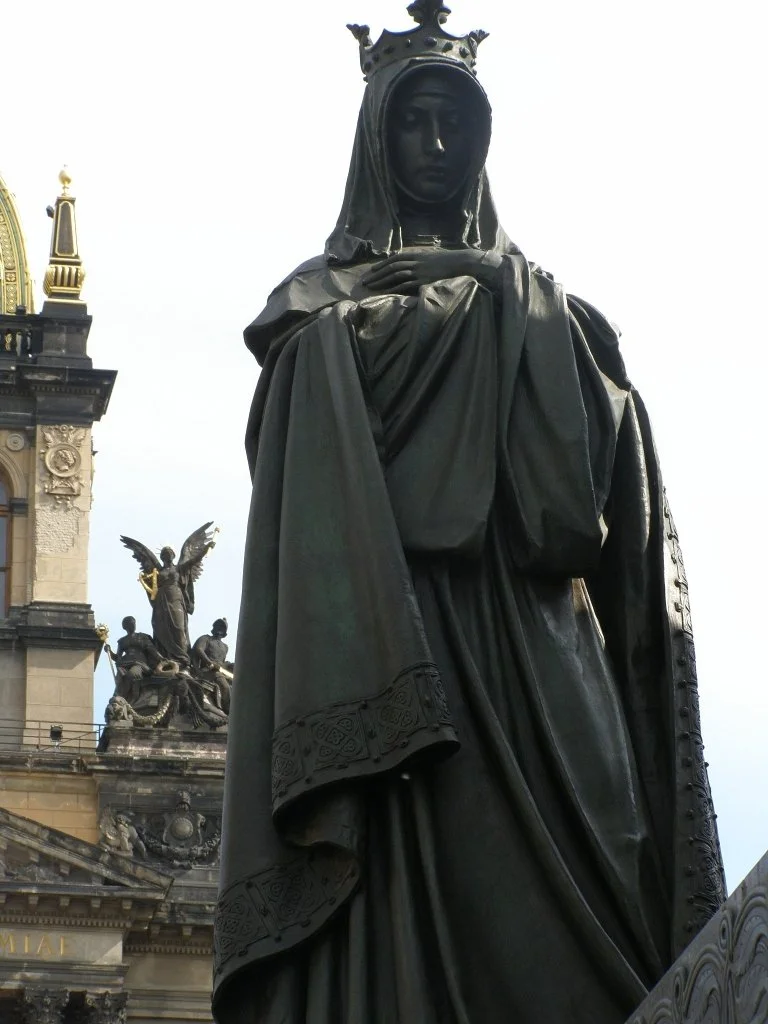
Statue of St. Agnes in Wenceslas Square. Photo taken by Ľubomír Repta.
At the monastery, there were also several miracles that were recorded. One sister became deathly ill, and the other nuns, in an attempt to save her, placed Agnes’s Cloak on her, after which she made a rapid recovery. Another sister prayed to Agnes when she was sick. Promising that she would perform three Masses, upon which she was healed. But the Masses were not said due to delays, and the sister fell ill again; upon telling the Masses, she was instantly healed. Two more sisters were healed from drinking wine that had a bone from Agnes’s body dipped in it. This remedy was called “the wine in which St. Agnes Washed”, which was believed to heal sore throats. When Agnes was alive, she would also give out wine to her devotees that had been dipped in a strand of her own hair. Her tomb was also a place of worship and miracles, with mothers praying for their sick and dying children at her tomb. People with aching limbs also asked the saint at her tomb for help with their injuries.
The monastery viewed Agnes as a saint, holding Agnes in high regard and preserving her remains. They kept her clothes and a few items of hers in reliquaries. To the nuns of the monastery, Agnes was a saint. They bore witness to several miracles performed when she was alive. After her death and she was laid to rest, she continued to grant miracles from her own grave.
The Road to Canonization
There were several attempts to canonize St. Agnes throughout the ages, with none of them succeeding until 1989. The first major attempt to canonize her was in 1329. This was after Elizabeth of Bohemia had recovered from her sickness, believing that her prayers to Agnes had been answered. On St. Martin's Day of that year, Elizabeth, along with a grand assembly of clergy, nobles, and other people from Bohemia, gathered. Together they made a declaration; they wished for the holy father to canonize Agnes. With the approval of the Bishop of Prague, John IV, an ambassador was sent to Rome carrying the formal request. The letter reached the pope, but there was major turmoil in the Papacy, so the letter was viewed as of little importance. The following year Elizabeth died. Without her influence, the main effort for Agnes's canonization fell onto her son, Emperor Charles IV. Yet since Charles was incredibly busy, he was unable to accomplish this goal. Charles, on his deathbed, asked his son, Wenceslaus IV, to help with her canonization. However, just like his father, he became swamped with more pressing issues and forgot about his father's request.
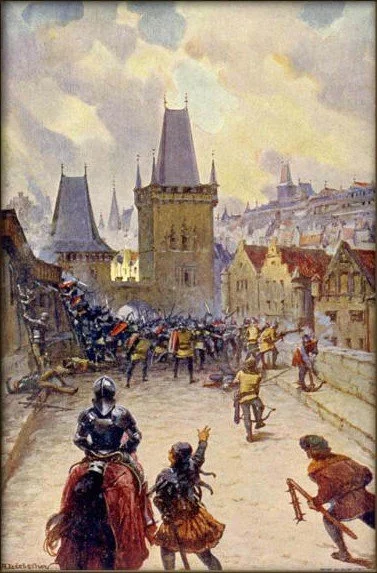
Hussite Uprising in Prague Painted by Adolf Liebscher
During 1419, the Hussite Wars began to sweep across the lands of Bohemia. This crisis forced the nuns to abandon the monastery in 1420. further pushed back any attempts at Agnes’s canonization. As the monastery was being abandoned, the nuns, in an effort to protect the remains of Agnes against their potential destruction, hid her remains. When they returned in 1436, they could not find her remains. They restarted their attempts to canonize Agnes, but her missing remains proved a massive issue because the Catholic Church at the time required that any attempts at canonization needed the remains of a person to be examined. The unknown location of Agnes’s remains halted the process in 1450. This did not mean that the nuns of the monastery gave up, as they attempted several times again during the 1500s and the 1700s. Their attempts were constantly interrupted by turmoil in Bohemia, with the monastery having to be abandoned several times. In 1782, the monastery came to an end with Holy Roman Emperor Joseph II, and Archduke of Austria, dissolving the monastery under his church reforms. Over time, a foretelling became common: upon canonization of Agnes, freedom would come to Bohemia.
In 1872, the Archbishop of Prague, Cardinal Friedrich von Schwarzenberg, asked the Sacred Congregation of Rites to declare Agnes blessed. The following investigation process lasted two years, showing that the “Cult” or Veneration of Agnes has continued unbroken since her time. To the people of Bohemia and especially to the citizens of Prague, she was seen as a saint. Agnes was frequently called either “Blessed Agnes” or simply “Saint Agnes”. In paintings or statues of Agnes, she would be depicted with a halo. The investigation also showed that before her remains were hidden, her tomb received gifts and offerings. It was believed that miracles and healings could be received. After some deliberation, on November 28, 1874, she was beatified by Pope Pius IX.
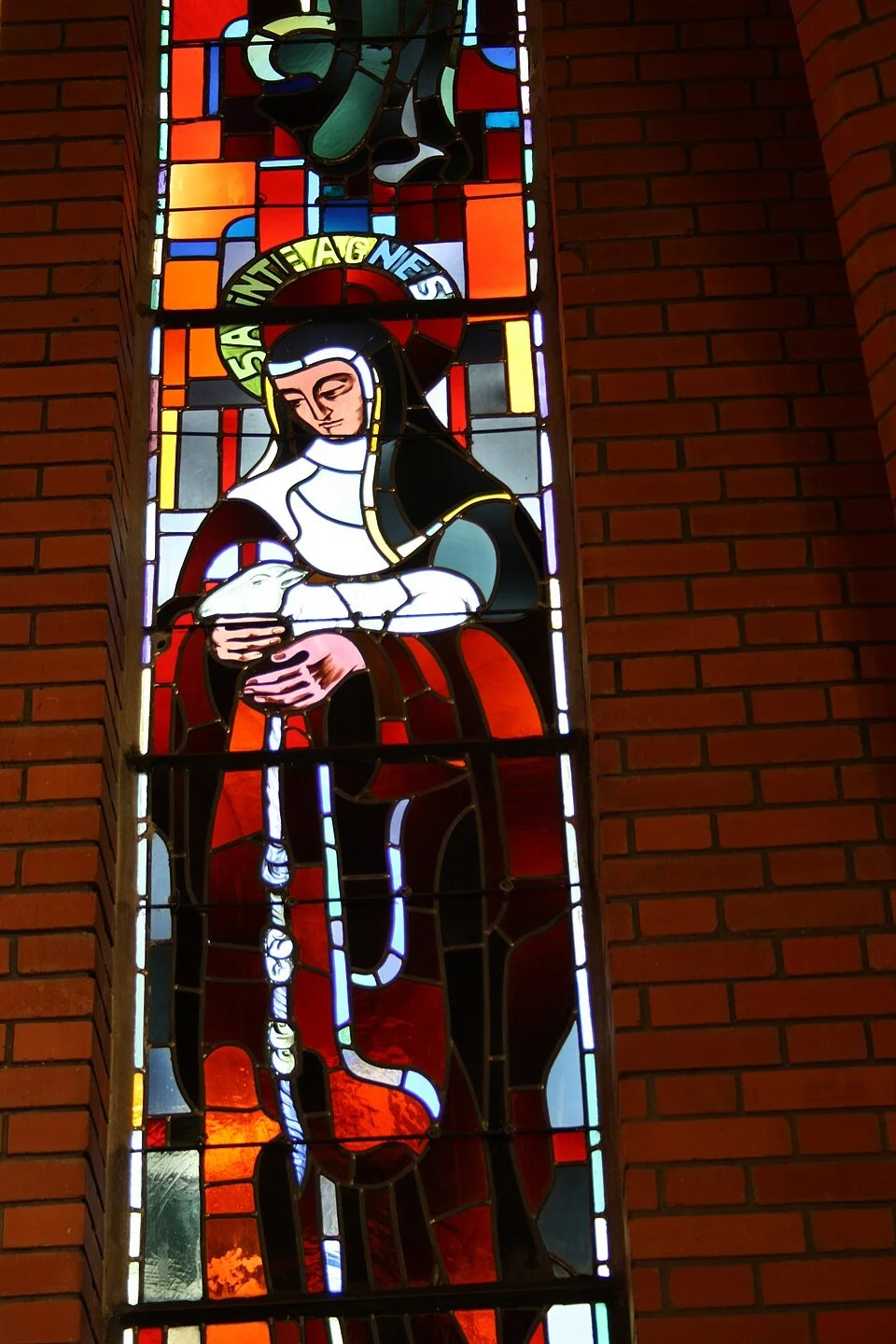
Stained glass portrayal of Saint Agnes in the Paris Chapelle des Franciscains. Photo taken by: GFreihalter.
During the mid-20th century, Cardinal Josef Beran, the Archbishop of Prague, began to lay the groundwork for an eventual canonization of Agnes. He created a new biography of Blessed Agnes, which greatly helped push her closer towards canonization. His successor, Cardinal František Tomášek, along with Priest Jaroslav Vaclav Polc, built upon the work that Josef Beran left behind and began a new push to canonize Blessed Agnes in the 1980s. In 1987, the Vatican Offices for the Causes of Saints (Ex Officio Concinnata) created a dossier (Positio Super Virtutibus) looking at Agnes’s life. After some deliberation, it was announced that Agnes would be canonized.
The communist government of Czechoslovakia refused to allow the ceremony to take place in the country, but they allowed people to travel to Rome to attend. On the 12th of November 1989, Pope John Paul II canonized St. Agnes of Bohemia in St. Peter's Basilica in Rome. Over ten thousand Czech pilgrims attended. Five days after Saint Agnes was canonized, the Velvet Revolution began. In December of that year, the communist party’s stranglehold over the government was eradicated, and democracy was restored to the Czech lands. Thus, in the hearts of Christians, it seemed that the prophecy had come true, as freedom had come.
St. Agnes lived her life as the Gospel asked, and her actions show it as well. She lived in poverty, but this did not stop her from helping the poor and the sick. She strove for peace in Bohemia even during war. Her work in creating hospitals and the Knights of the Cross with the Red Star to watch over them showed her actions to help the people of Bohemia. Her kindness and commitment to the welfare of others is what carried her name through the centuries. Eventually, her work, commitment to the Gospel, and miracles performed led her to be canonized. People may not have known her personally, but knew of her actions and dedication to venerating the Gospel.
Written By Artemio A. Mendoza Estrada
Sources
Acta Sanctae Sedis: In Compendium Opportune Redacta et Illustrata, Editio Stereotypa A., Volumen VIII, 1874 -75, pp. 299; 406 - 424. Accessed 19 Sept. 2026.
Joan Ferrante “Agnes of Prague.” Epistolae, Center for Teaching and Learning at Columbia University, epistolae.ctl.columbia.edu/woman/74.html. Accessed 24 Sept. 2026.
Pavla Horáková “The Life and Legacy of Saint Agnes of Bohemia.” Radio Prague International, 7 Apr. 2021, english.radio.cz/life-and-legacy-saint-agnes-bohemia-8559099. Accessed 19 Sept. 2026.
Seton. Some New Sources for the Life of Blessed Agnes of Bohemia: Including a Fourteenth-Century Latin Version (Bamberg, Misc. Hist. 146, E. VII, 19): And a Fifteenth-Century German Version (Berlin, Germ. Oct. 484). Cambridge University Press, 2010. Accessed 24 Sept. 2026.
“12 Novembre 1989, Canonizzazione Di Agnese Di Boemia e Di Alberto Adamo Chmielowski Nella Basilica Vaticana.” Vatican, www.vatican.va/content/john-paul-ii/it/homilies/1989/documents/hf_jp-ii_hom_19891112_due-canonizzazioni.html. Accessed 19 Sept. 2026.
Blahoslavená Anežka Česká, dcera českého krále Přemysla Prvního. 2nd ed. Prague: Marianska druzina dam, n.d.. Accessed 24 Sept. 2026.
Beran, Josef. Blahoslavená Anežka Česká. Křest̕anská Akademie, 1974. Accessed 24 Sept. 2026.