Hand-Painted Ceramic Plates

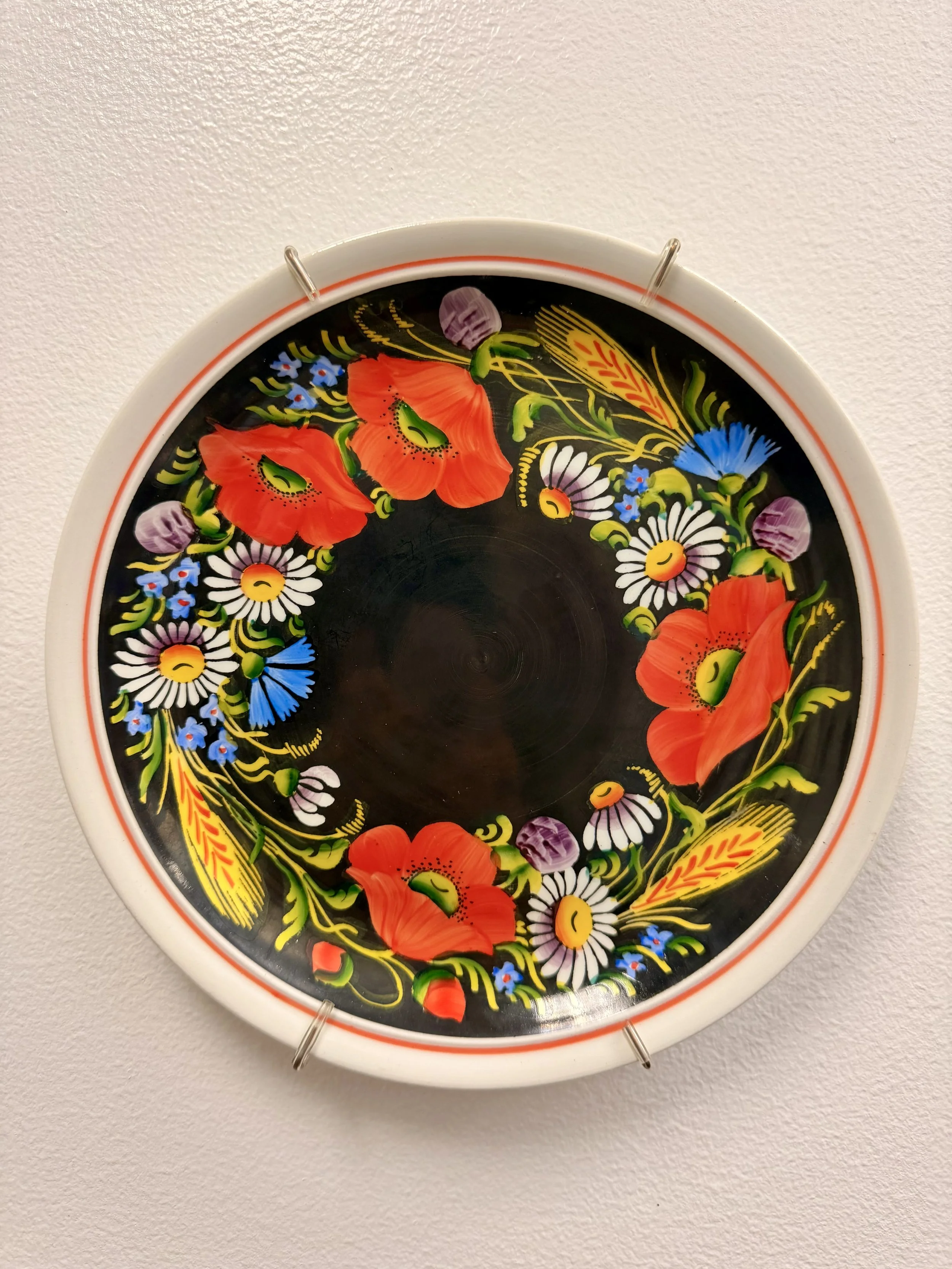
The ethnographic area of Chodsko in the southwestern region of the Czech Republic is well known for its Bohemian folk art pottery. The Chodové—the people of Chodsko—have preserved their customs over the years, so the traditional ceramic pottery is still being made to this day. One of the pottery manufacturers of the area, Chodovia Klenci, is famous for its hand-painted products—the ceramic plate being one example.
The pottery from Chodsko is recognized for its hand-painted floral designs. These designs were originally white painted on a red-brown background. In the 1930s, František Míča, inspired by the designs on traditional folk dress in the area, developed a more vibrant style of decoration, with vivid colors on a black background. This plate is decorated in Míča’s style, with various flowers, but the bright, vivid, red poppy takes center stage. The flower is intrinsically tied with Czech culture, as the poppy flower is the most popular motif since its seeds are usually used in Czech food. Other flowers always included in these designs include the golden grains, white daisies, and blue forget-me-nots. These richly ornamented plates, however, were not used for food consumption but only for decorative purposes.
Chodsko was the perfect region for the development of pottery as it was a good geographical location and had plenty of resources. It is documented that by the mid seventeenth century, there were only eleven potters registered in the area. However, it was the introduction of porcelain in the 1790s that enabled the rapid development of ceramic design, and in the early twentieth century, pottery manufacturers were able to start large-scale production of their artifacts. Chodovia Klenci did produce their own pottery to be painted, however this particular plate was produced by the Ditmar Urbach Ceramic and Porcelain company. This suggests that porcelain blanks were shipped to Chodovia Klenci, where the company would put on the decorative touches and then do the finishing glaze and firing, cutting down on production time and costs and allowing more time to be dedicated to the painting of these pieces.
Ditmar Urbach was a ceramic and porcelain manufacturer started in 1885 by two brothers, Alfred and Otto Urbach in Trnovany u Teplice. They eventually opened an additional factory in Znojmo, and the marker’s marks on their ceramics often have either a “Z” or “T” within the mark to note which factory produced the piece. This particular piece was produced at Znojmo, with a series number 83 included just above the mark. The brothers ran the company for over 40 years before they were arrested and sent to a concentration camp during the Nazi invasion because of their Jewish heritage.
This particular plate is decorated in the popular Chodsko style, though it has some stylistic differences when compared to the plate above that was produced by a company in the Chodsko region like the Chodovia Kelnci Pottery. Ditmar Urbach Chodsko designs are still hand painted, but have differences in the depiction of the flowers, which is especially noticeable with the poppy flowers. Ditmar Urbach also favored leaving the rim of the plate white, as well as creating a wreath design, with flowers around the edges and negative space in the middle.
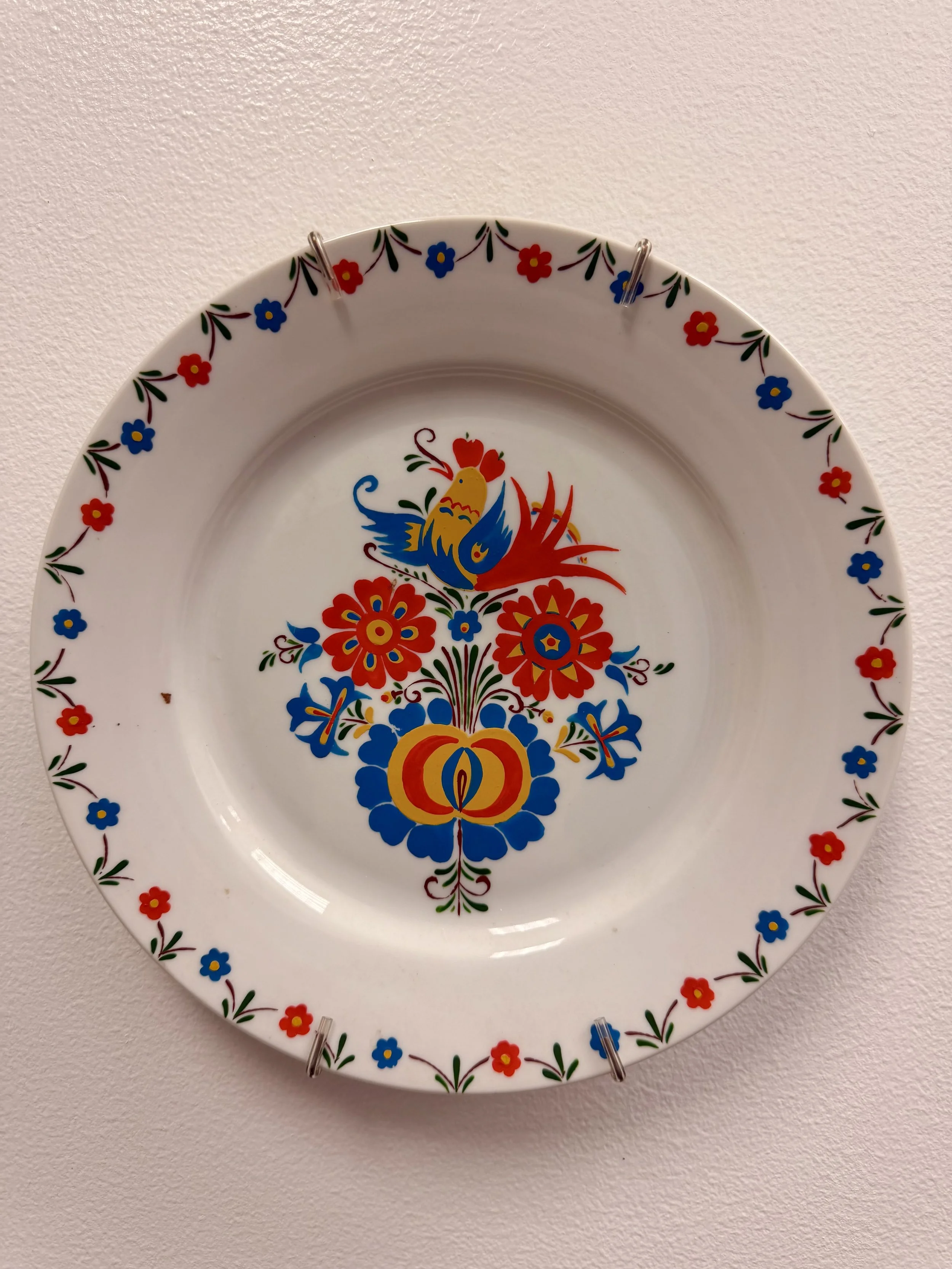
This plate is decorated with traditional folk themes from the Southern Moravian region. Most designs from this area feature floral designs, often in reds, blues and yellows and with a rooster at its center. For many folk art traditions across Europe, the rooster symbolizes protection, vigilance, awakening and rebirth as the rooster greets the rising sun each morning. These styles of designs were first seen on embroidery and also decorating the outside of homes in many towns and villages. Over time, they were then painted on decorative plates, preserving the folk art style, and becoming increasingly popular with tourists and visitors.
This particular plate was handpainted during the Communist Era by members of the Municipal Services Enterprise in Hustopeče. During the communist era, all production and services were state-controlled, including regional craft production. These artisanal groups were run under the umbrella of municipal utilities and services of the region, and plates like these were often exported to be sold internationally.
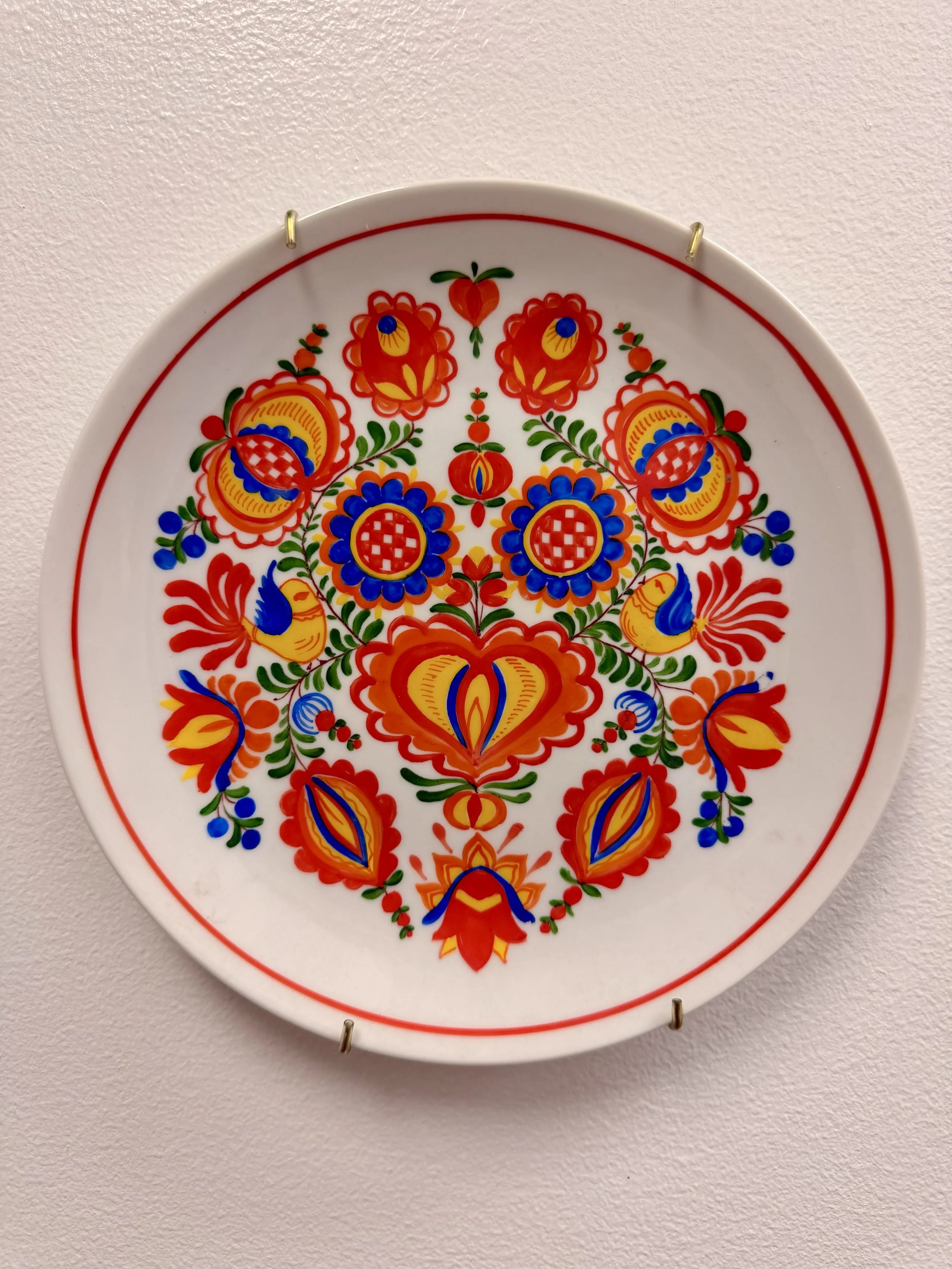
This folk art style comes from the Moravian Slovak region, and is often seen either in embroidered works or hand painted on ceramics or other decorations. Central to this particular style are the vibrant colors, stylized florals and geometric patterns. At the center we see the stylized heart, which is typical in such designs, surrounded by song birds, and flowers of all shapes and sizes. Although easily recognizable, there have been many efforts to preserve these traditional decorative styles, with folk artists often traveling to provide traditional folk art classes at different museums, schools, and community centers both in the Czech Republic as well as in areas with larger Czech populations in the United States.
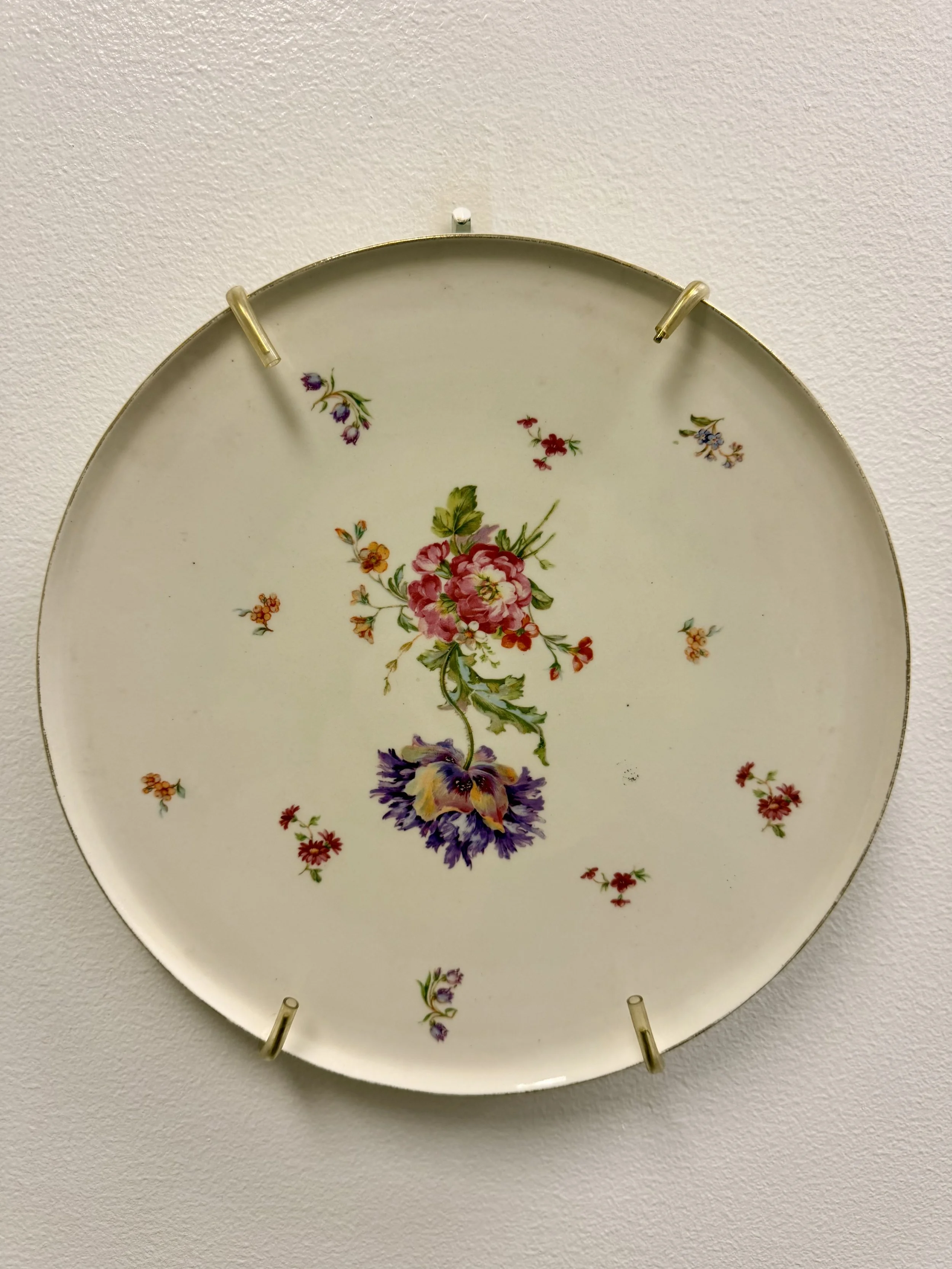
This plate demonstrates the far reaches of Czechoslovakian ceramics and porcelain. Although made in Czechoslovakia, this plate was exported and bought by the Ebeling & Reuss Company in the United State under the importer name Erphila. Erphila created decorative giftware and ceramics, but did not manufacture the pieces themselves. Instead, they contracted with different European countries, usually Czechoslovakia or Germany, to import blanks that they could then decorate and sell to American consumers. This particular plate was imported from Czechoslovakia, and bears a red Erphila makers mark, which dates it to sometime between 1918-1921, which would have been at the height of Czechoslovakian ceramic exports before the Nazi occupation, World War II and the subsequent Communist coup d'état that severely impacted ceramic exports from the country for decades.
Although Erphila did produce handpainted ceramics, this particular cake plate features transfer-printed designs, as can be seen by the exact repetition and design of some of the smaller floral designs. These transfer designs would have allowed production costs to be cut, while still maintaining the hand painted look that was so popular with Erphila.
ARTIST
Painted by Chodovia Klenci Pottery Company
TITLE
Handpainted Chodsko Folk Art Plate
DATE
1930-1938
MEDIUM
Ceramic Plate
DIMENSIONS
Height 27.305 cm x Width 27.305 cm
(10 ¾” x 10 ¾” )
CREDIT LINE
FIC
CURRENT LOCATION
Texas Czechs (3rd Floor of CCMH)
ACCESSION NUMBER
1000.96.279
PROVENANCE
The plate is originally from the southwestern area of the Czech Republic called Chodsko.
ARTIST
Ditmar Urbach Ceramic and Porcelain Company
TITLE
Ditmar Urbach Handpainted Plate
DATE
1930-1938
MEDIUM
Ceramic Plate
DIMENSIONS
Height 23.5 cm x Width 23.5 cm
(9.25” x 9.25” )
CREDIT LINE
FIC
CURRENT LOCATION
Texas Czechs (3rd Floor of CCMH)
ACCESSION NUMBER
1000.96.281
PROVENANCE
The plate is originally from Znojomo in the South Moravian Region of the Czech Republic
ARTIST
Municipal Services Enterprise Hustopeče
TITLE
Handpainted Porcelain Plate
DATE
1976
MEDIUM
Ceramic Plate
DIMENSIONS
Height 24.77 cm x Width 24.77 cm
(9.75” x 9.75” )
CREDIT LINE
FIC
CURRENT LOCATION
Texas Czechs (3rd Floor of CCMH)
ACCESSION NUMBER
1000.96.282
PROVENANCE
The plate is originally from Hustopeče in the South Moravian Region of the Czech Republic.
ARTIST
Unknown
TITLE
Slovácký Style Hand Painted Plate
DATE
Unknown
MEDIUM
Ceramic Plate
DIMENSIONS
Height 24.77 cm x Width 24.77 cm
(9.75” x 9.75” )
CREDIT LINE
FIC
CURRENT LOCATION
Texas Czechs (3rd Floor of CCMH)
ACCESSION NUMBER
1000.96.283
PROVENANCE
The plate is likely from the Moravian Slovak region.
ARTIST
Ebeling & Reuss Company
TITLE
Erphila Cake Plate
DATE
1918-1921
MEDIUM
Ceramic Plate
DIMENSIONS
Height 29.21 cm x Width 29.21 cm
(11.5” x 11.5” )
CREDIT LINE
FIC
CURRENT LOCATION
Texas Czechs (3rd Floor of CCMH)
ACCESSION NUMBER
1000.96.149
PROVENANCE
The plate was produced in Czechoslovakia and decorated in Philadelphia, Pennsylvania.