
Before becoming a renowned lawyer that fought for equality and justice for the everyday man and long before making history as the first Jewish Associate Justice of the Supreme Court of the United States, Brandeis' early life was from humble beginnings. As antisemitic riots were rising throughout Prague, Brandeis's parents sought to move their family to a safer place where they could raise their children. Louis Brandeis' parents immigrated from Prague to the United States, eventually coming to settle into Kentucky in search of opportunity and financial success.

Louis D. Brandeis aged 20, posing for a photograph.
Brandeis was born in Louisville, Kentucky on November 13, 1856 the youngest of four children. His parents raised him and his siblings in a secular Jewish household and their studies consisted of history, politics, and social culture. Growing up, Brandeis was known to be a diligent student all throughout his academic career, he excelled in his classes, earning top exam scores and graduating with honors from high school and college at a young age. Brandeis actively participated in class and was remembered to be very studious, continuously reading books on politics.
His interest in politics was influenced by his uncle, Lewis Naphtali Dembitz, an accomplished lawyer. With his uncle serving as his mentor, Brandeis received constant guidance and support in his law aspirations and his uncle encouraged him to choose a career in law.
He later enrolled in Harvard Law School at the age of 18. His professors noted him for being an extraordinary student in his coursework. He graduated from Harvard Law School in 1877 and made history by graduating with the highest grade point average the school had seen at that point.
After graduation, Brandeis started his law career in St. Louis, but soon moved to Boston, where he worked as a law clerk for Horace Gray, the Chief Justice of the Massachusetts Supreme Court. After two years working for Gray, Brandeis, along with Samuel D. Warren II, opened their own law firm operating under the name Warren & Brandeis. The firm is still operating today under the name Nutter McClennen & Fish.
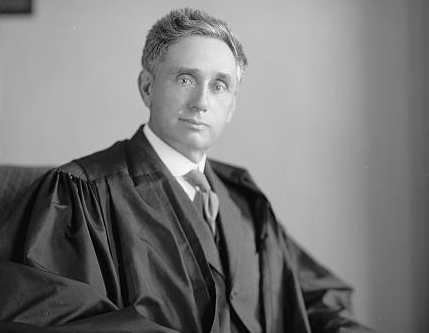
The official judicial portrait of Louis D. Brandeis taken after his appointment as Associate Judge of the Supreme Court of the United States in 1916.
During his time at the law firm, he worked on several cases, the majority of which led to successful outcomes for Brandeis and his clients. Throughout his law career in helping and assisting the everyday man, he became known as the “People’s Attorney" for his pro bono work, supporting worker’s rights, and advocating for fair wages and working hours. Brandeis's career as a lawyer was going so successfully that he was able to present and argue many cases in front of the Supreme Court.
On January 28, 1916 President Woodrow Wilson nominated Brandeis as an Associate Justice of the Supreme Court of the United States. However, Brandeis nomination was met with backlash due to his Jewish ancestry, which led to constant delays in him accepting the role. After a four-month long confirmation, Brandeis became the first Jewish Associate Justice of the Supreme Court of the United States. For 23 years he served on the Supreme Court, he continued to be a strong voice for progressivism. He retired on February 13, 1939 and for the remainder of his life he spent it quietly with his wife.
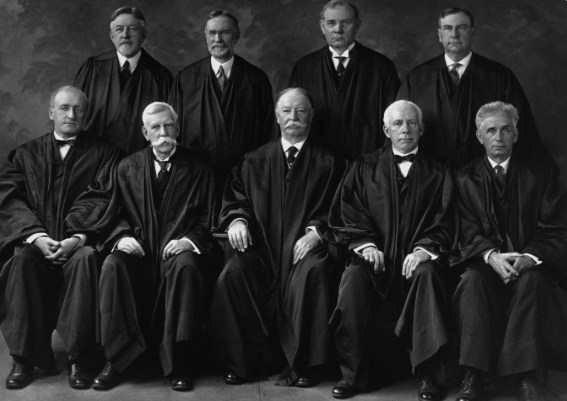
Nine members of the Supreme Court of the United States. Louis D. Brandeis is seated at the far right
Brandeis’s legacy is remembered for his strong commitment to seeking justice for worker’s rights and fairness for the underprivileged. In honor of his memory there are countless buildings named after him, the most notable being Brandeis University, The University of Louisville Louis D. Brandeis School of Law, and The Louis D. Brandeis Center for Human Rights Under Law. Louis Brandeis will always be remembered for his work and dedication to American constitutional law.
Written by Elizabeth Arebalo
Sources:
“Louis D. Brandeis: An Inspiring Life.” Robert D. Faber University Archives & Special Collections Department at Brandeis University. https://www.brandeis.edu/library/archives/exhibits/ldb-100/index.shtml.
“Our Namesake: Louis Brandeis.” Brandeis University. https://www.brandeis.edu/about/louis-brandeis.html.
“Louis Brandeis.” Wikipedia. https://en.wikipedia.org/wiki/Louis_Brandeis.
“Justice Louis Brandeis.” JUSTIA U.S. Supreme Court. https://supreme.justia.com/justices/louis-brandeis/.
“Louis D. Brandeis: Topics in Chronicling America.” Library of Congress. https://guides.loc.gov/chronicling-america-louis-brandeis.