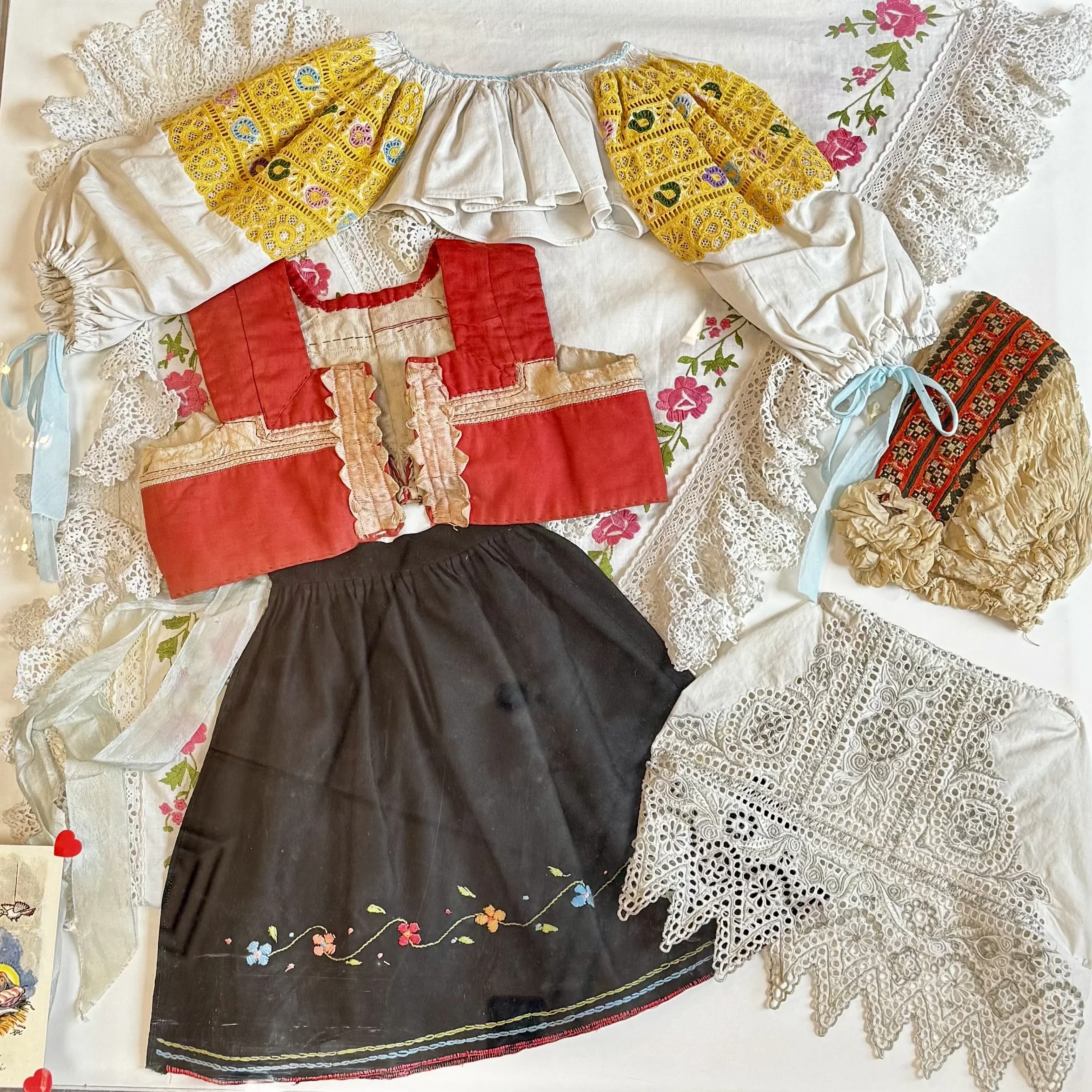
This ensemble, a child’s kroj, was owned by the Cebe-Habersky family and worn by Dagmar Cebe-Habersky. Czech children typically get their first kroj when they begin to walk and are old enough to participate in celebrations and festivals. Wearing the kroj is seen as a profound honor, symbolizing one’s connection to their region and cultural heritage.
There are 5 main components of this kroj: a skirt, apron, blouse, vest, and cap. The skirt (sukně) is decorated with red, blue, and green embroidery striped horizontally along the perimeter. Four-petal floral motifs dotted across a swirling vine with leaves add a sense of playfulness to the garment. The apron (fěrtúšek) would be worn neatly on top of the skirt, such that the skirt’s embroidery would remain visible. The apron features intricate bobbin lace with a triangular trim and small flowers to match the skirt.
The blouse (bluza) has puffy half-sleeves that tie at the elbow with a pale blue ribbon. The shoulders are decorated with yellow panels of bobbin lace that alternate with embroidered rows of colorful flowers. The vest (lajblička) is traditionally made from brocade or broadcloth to give the garment structure. Here, the bright red vest is decorated with lace trim vertically along the central opening and horizontally below the arm openings. The triangular detailing of the apron is repeated vertically, bringing continuity to the entire ensemble.
The cap (čepení) completes the look, matching the vest with its red trim, the apron with its geometric trim, and both the blouse and skirt’s floral rows.
ITEM NAME
Female child’s kroj ensemble
MATERIAL
Embroidered textile, lace, beads
DATE
unknown
CREDIT LINE
Donated by Dagmar Cebe-Habersky’s family
CURRENT LOCATION
Folklore Room (3rd Floor)
ACCESSION NUMBER
1000.58.1
PROVENANCE
Arrived in the U.S. from Czechoslovakia in 1946 and remained in the Cebe-Habersky’s possession until its donation to the CCMH by Dagmar’s daughter following her death in 2016.
Learn the story of this family by clicking below.