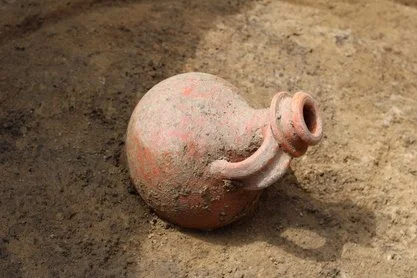
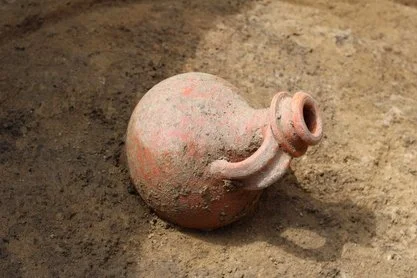
Roman ceramic vessel, possibly jug for oil or wine, 1st C - 3rd C AD, southeastern Moravia. Image via UAPP.
The Prostějov office of the Institute of Archaeological Monument Preservation Brno (UAPP) made a fascinating discovery in May 2026. The UAPP was founded on March 18, 1993, as a contributory organization of the Ministry of Culture of the Czech Republic, with the goal of carrying out rescue archaeological research. In 2007, the UAPP transitioned into a public research institution and continues to prioritize its rescue research efforts. The team recently discovered three burial pits in south-eastern Moravia, with the third pit containing a ceramic vessel found shockingly well-preserved. The discovery was made through archaeological rescue efforts ahead of a construction project linking the cycle path between Těšice and the border of the South Moravian Region near the Vyškov district.
Thought to have been created between the 1st and 3rd centuries CE, the ceramic vessel is an example of red wheel-turned pottery, a style typical of Ancient Roman provincial workshops. Researchers suggest that this vessel likely came from Pannonia or Rhineland, Roman provinces from which visually similar vessels have been found. Archaeologists found evidence of looting in the third burial pit during excavations:
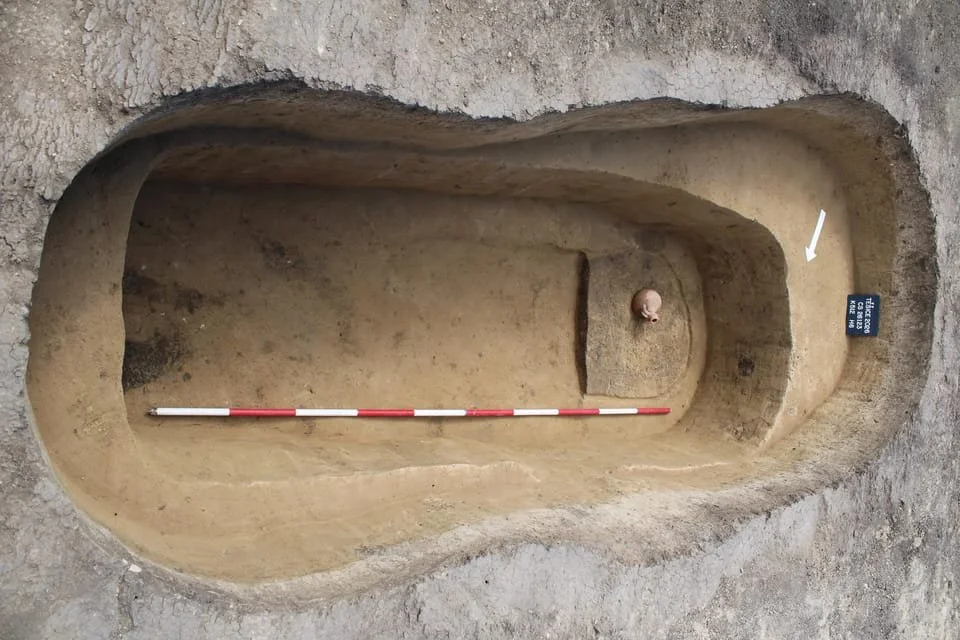
The findspot of the ceramic vessel, via UAPP.
“The grave had been reopened. The human remains were completely disturbed, broken and scattered. Nothing remained in the grave except fragments of human bones and this ceramic vessel. The robbers were probably looking for objects made of gold and silver. The pottery was of no interest to them, which is why it remained in the grave.”
- Pavel Fojtík of the Centre for Cultural Heritage Archaeology via Radio Prague.
According to the UAPP, the looting “can hypothetically be considered unusual evidence of the Celtic autumn festival of the dead (today known as "Samhain" and considered a prototype of the holiday All Saints, i.e. "All Souls"), when, among other things, graves were opened so that "the world of the living could meet the world of the dead."”
Despite this disruption to the archaeological context, the vessel itself can clarify how the Roman Empire was viewed by those living beyond its borders. Researchers suggest that Roman luxury goods - such as this ceramic jug - were prized by Germanic peoples during the Migration Period, when the grave was dug. The Migration Period spanned roughly 300 CE to 800 CE and marked a foundational shift in material culture across Europe as the ancient economy collapsed alongside the Roman Empire. The Romans had previously driven trade networks across Europe and the Mediterranean, circulating goods far and wide. As the empire sank, so too did the provincial workshops where artisans crafted goods. Without the Roman Empire, new trade routes took over as Roman provincial cities faced depopulation and turned to small-scale local economies for support.
Why would a high-quality Roman jug end up in a 5th-century burial in Moravia, far beyond the Empire’s borders? Due to the recent nature of this discovery, the full answer to this question stands to be revealed, as specialists at Palacký University in Olomouc —the oldest university in Moravia and second-oldest in the Czech Republic— continue to conduct studies on the vessel, according to Ruth Fraňková of Radio Prague.
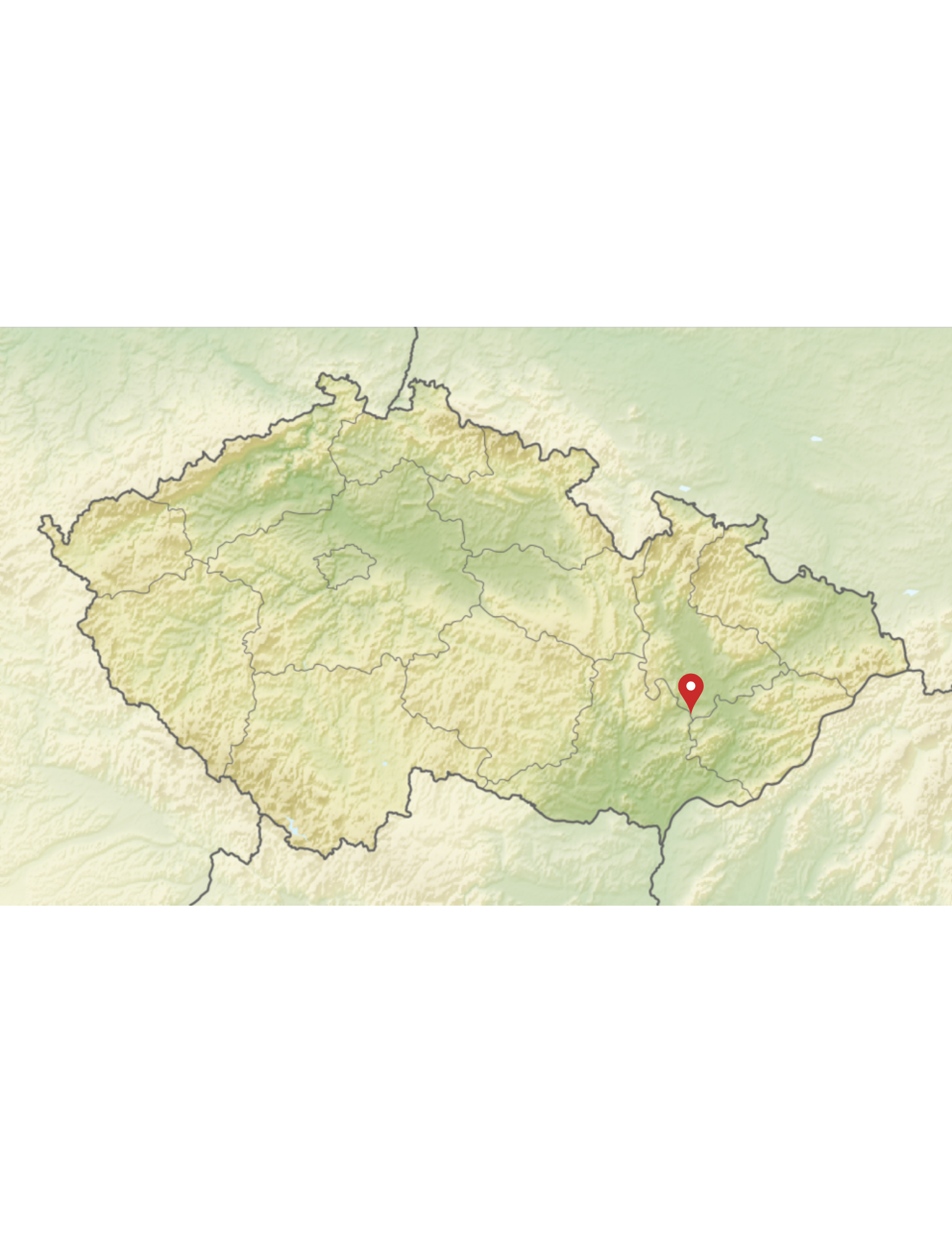
Map of the Czech Republic marking the approximate location of the archaeological site where the ceramic vessel was uncovered.
Trade routes historically facilitated far more than the movement of goods; they carried knowledge, ideas, religious beliefs, languages, technology, and culture across vast regions. Through these networks, civilizations grew within broader ecosystems of exchange and influence, ultimately shaping and absorbing power. After the fall of the Roman Empire, a quasi-power vacuum emerged, creating opportunities for new groups to rise and assert control over former imperial territories. Posessing a Roman ceramic vessel in this context would have signaled prestige, authority, and a connection to the legacy of Rome.
Given that the vessel predates the buried individual by several centuries, one may reasonably infer that it was either inherited from members of their family or cultural group, or acquired through travel or trade, perhaps even intentionally sought out for its symbolic value. Whatever its path, the vessel’s journey across Europe must have been remarkable.
And why not imagine what that story might have been? We can begin with what is known. The jug is small in size, with capacity for no more than 1 liter of liquid, which –as Pavel Fojtík notes– suggests it likely served as a container for wine or oil. Both commodities were significant exports of the Roman Empire, and owning Roman oil or wine would have marked someone as a beneficiary of cross-cultural trade, if not a direct participant. Yet the vessel’s arrival in a 5th-century grave, centuries after its manufacture, indicates that its significance extended well beyond practical use. It was an object of meaning, memory, and status.
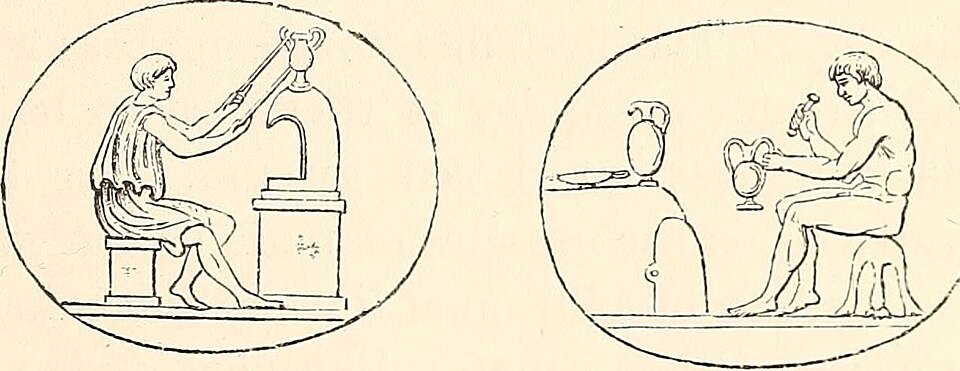
Potters working in workshops: left, picking up a freshly-glazed vessel in the kiln; right, smoothing the surface of a leather-hard vessel before firing.
Following the decline of Roman provincial workshops in Late Antiquity, everyday ceramic goods –such as a simple wine or oil jug– took on an aura of prestige. Once common household items, they became coveted, rarified objects. Being buried with such a precious object would have reflected its elevated value onto the individual, marking them as someone of distinction.
As a consequence of looting, we may never know what additional items originally accompanied the vessel, objects that might have offered futher insight into the individual’s socioeconomic standing or the broader cultural significance of the jug itself. What remains, however, points to a meaningful relationship between the deceased and the legacy of Rome.
During the excavation, the UAPP team found settlement pits from the Únětí culture of the Early Bronze Age around 2,000 BC and urn fields from the Late Bronze Age around the 13th century BC nearby. Alongside the 5th-century CE burials where the ceramic jug was uncovered, the site has peeled back layers of history to provide a peek into the region’s past. Southern Moravia is full of similar archaeological sites that witnessed occupation by Celtic, Germanic, and other tribes, not to mention Roman campaigns to conquer peoples, and later, the Slavs. These discoveries emphasize the storied nature of the land, as it saw centuries of changing societies and innovation that ultimately brought us to the present day.
Now, we look forward to the findings of the team at Palacký University in Olomouc, and celebrate this discovery that illuminates the rich history of the modern-day Moravian region in antiquity.
Written by Gabriella Carvelli
Interested in learning more? Check out our sources below!