Alphonse Mucha (1860-1939)
Biography
Alphonse Mucha was born on July 24, 1860, in Ivancice, Moravia (now the Czech Republic). Growing up he witnessed the Austrian Administration of Moravia, the Austro-Prussian Ward, and an extensive cholera epidemic in his home town, all of which made him a passionate believer in an independent Czech nation. After being expelled from school due to poor academic performance, Mucha found himself inspired by a fresco at a local church and decided to become a professional artist. After an unsuccessful application to the Prague Academy of Art in 1878, he began a scenery apprenticeship with a theater company. When the theater closed after a fire, he began a career painting portraits of local figures until he found a patron who offered to help pay for Mucha to study in Munich. In 1887, he moved to Paris to further his studies in painting and drawing. When his patron sponsorship ended, Mucha worked creating commissioned illustrations for French and Czech publishers, as well as depictions of theater costumes. Mucha accepted a last minute commission to depicting Sarah Bernhardt as Gismonda in 1894, a move that would catapult his career to make him the face of the Art Nouveau movement in Paris.
Art Nouveau-A New Style Emerges
The Art Nouveau movement, which emerged in Paris, France in the early 1900s, became a primary source of inspiration for many artists. The style represented a break from the rigid lines and sharp edges of the Industrial Revolution, instead embracing the organic forms and fluidity motivated by the organic world and femininity, featuring floral motifs and curvilinear shapes to emphasize the harmonious relationship between form and function. The “New Art” movement signified a return to nature as the primary source of inspiration.
This new style encompassed a diverse array of artistic expressions, including painting, architecture, graphic design, and decorative arts. Heavily inspired by nature and the female form, Mucha made a significant impact on the Art Nouveau with his innovative manipulation of the form and detailed incorporation of natural elements. Despite its popularity, Mucha was not pleased to be affiliated with the new style of “Art Nouveau” since he viewed it as a fleeting trend. While he became heavily involved in print making and advertising at the time, he longed to gain sponsorship to work on his oil paintings. Regardless of his initial aversion, Art Nouveau became intrinsically linked to Mucha’s name, as the movement became famously known as “Le Style Mucha” in Paris. The Art Nouveau movement played a significant role in the development and shaping of modern design and laid the groundwork for later artistic movements, such as Art Deco and Modernism.
Career
Mucha’s artistic style centered on the idealized female form going so far as to have what became known as “Mucha Women”. His works often feature graceful women in long, flowing garments, framed by intricate flowers and leafy vines. Mucha utilized gaze and positioning of the body to showcase a more powerful woman: self possessed, liberated and independent, the pinnacle of modernity. Incorporating nature as a design element and utilizing a muted color palette were also key elements of his work. After his success with the depiction of Sarah Bernhardt as Gismonda, Mucha created several series to be mass produced in order to bring fine art into the hands of the general public. These series included The Seasons, The Flowers, The Arts, The Times of the Day, The Precious Stones, and The Moon and the Stars.
Mucha spent time living in the United States with his wife Marie Chytilova, where he taught classes at the New York School of Applied Design for Women and the Chicago Art Institute. His daughter, Jaroslava was born in 1909 in New York. It was there that Mucha met Charles Richard Crane, who eventually sponsored the creation of the Slav Epic, a monumental project aimed at depicting the “joys and sorrows” of all Slavs, representing their people and history. This was an idea that Mucha had had for many years, but finally was able to begin in 1912, when he completed the first 3 canvases of the 20 canvas project. The completed Slav Epic was officially bequeathed to the City of Prague in 1928, marking the 10th anniversary of the creation of Czechoslovakia.
At the end of his life, Mucha continued to work on commissions for banks and churches, as well as planning other large scale projects that unfortunately never came into fruition. He was arrested in 1939 by the German Gestapo due to his ties to Freemasonry, and was finally released after enduring days of questioning. He passed away on July 14, 1939. As an innovator of his time and a leading figure of Art Nouveau, Mucha championed a movement that celebrated creativity and freedom inspired by the natural world.
Portrait of Mucha’s Daughter, jaroslava
Jaroslava Mucha, born in New York in 1909, often helped her father in his studio. She worked as his technical assistant, working to mix paints, and frequently modeled for Mucha in different settings. Her portrait was included on the first Czechoslovak bank notes designed by her father in 1919 and again in 1929, and she even painted the night sky in one of Mucha’s works for the legendary Slav Epic. Her early training with her father most likely inspired her to pursue a career as a conservator of fine art, with one of her biggest projects being the restoration of the Slav Epic that had been damaged by frost and water while they were hid from the Nazi Regime.
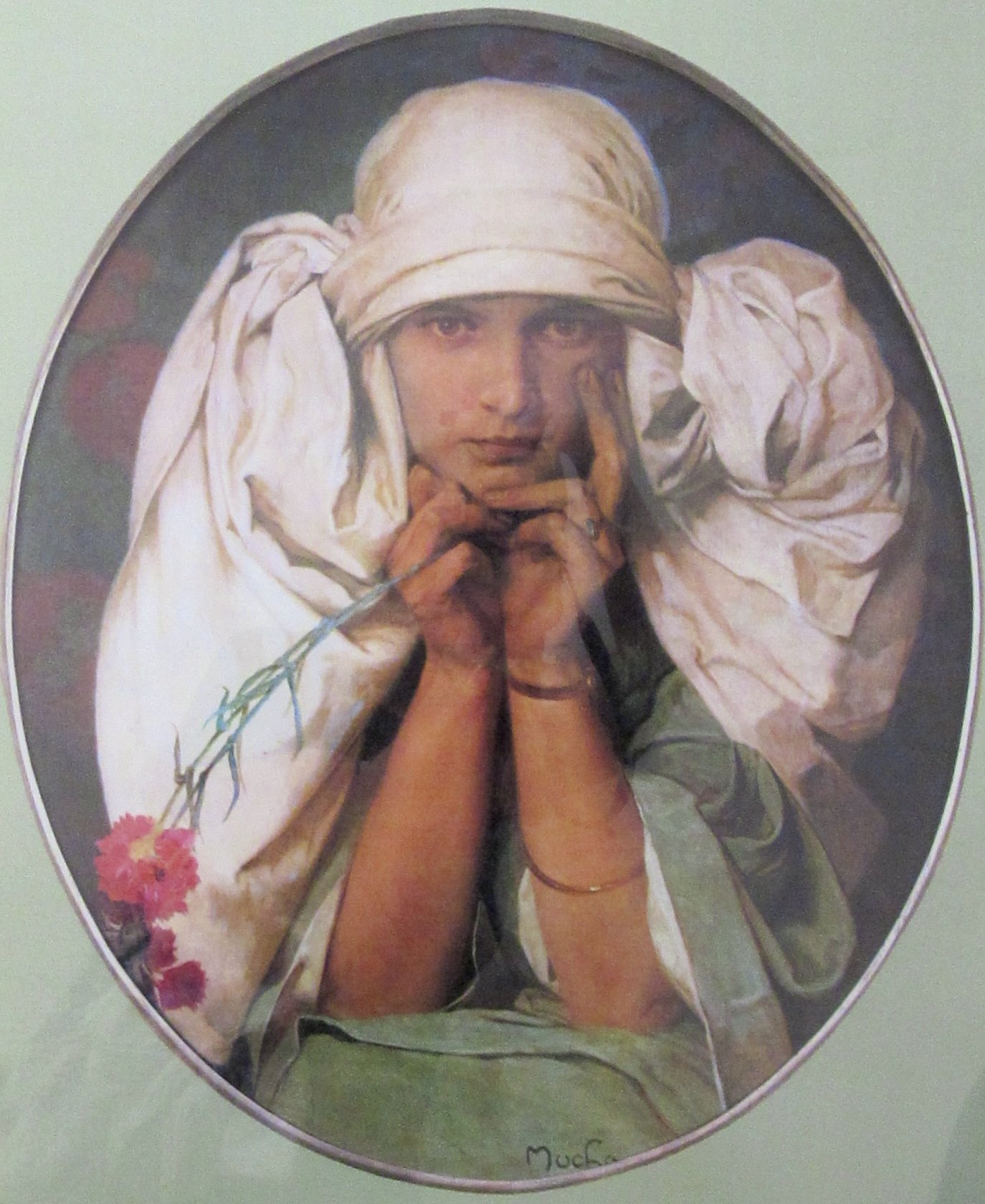
Rendered in oil, this painting represents one of many portraits of Jaroslava by her father. Mucha used classic techniques typical of the great masters of the renaissance to create a glowing, life-like representation of his daughter, wearing traditional clothing, adorned with an elaborate headscarf and bouffant sides alluding to her own Slavic ancestry. Her intense, direct gaze is characteristic of his typical female subjects.
ARTIST
Alphonse Mucha
TITLE
Portrait of Mucha’s Daughter, Jaroslava
DATE
1927-1935
MEDIUM
Print- Oil on Canvas
DIMENSIONS
Height x Width: 48.26 cm x 40.64 cm
CURRENT LOCATION
Czech Center Museum
4920 San Jacinto St.
Houston, TX 77004
CLASSIFICATION
Print
PROVENANCE
The piece was acquired through the Czech Center Museum Houston by unknown donation.
Gismonda
Alphonse Mucha created this lithograph poster for Sarah Bernhardt, the most famous actress in Paris at the time, in 1894. The Theatre de la Renaissance urgently needed a new poster for Brenhardt’s play “Gismonda” and turned to Mucha, who was the only available artist during the holiday season on such short notice. Mucha accepted the project despite never having designed a poster before, captivating the public with the resulting piece. The poster’s intricate detail and elegant design, exemplifies Mucha’s signature Art nouveau style, and became incredibly popular with the general public.
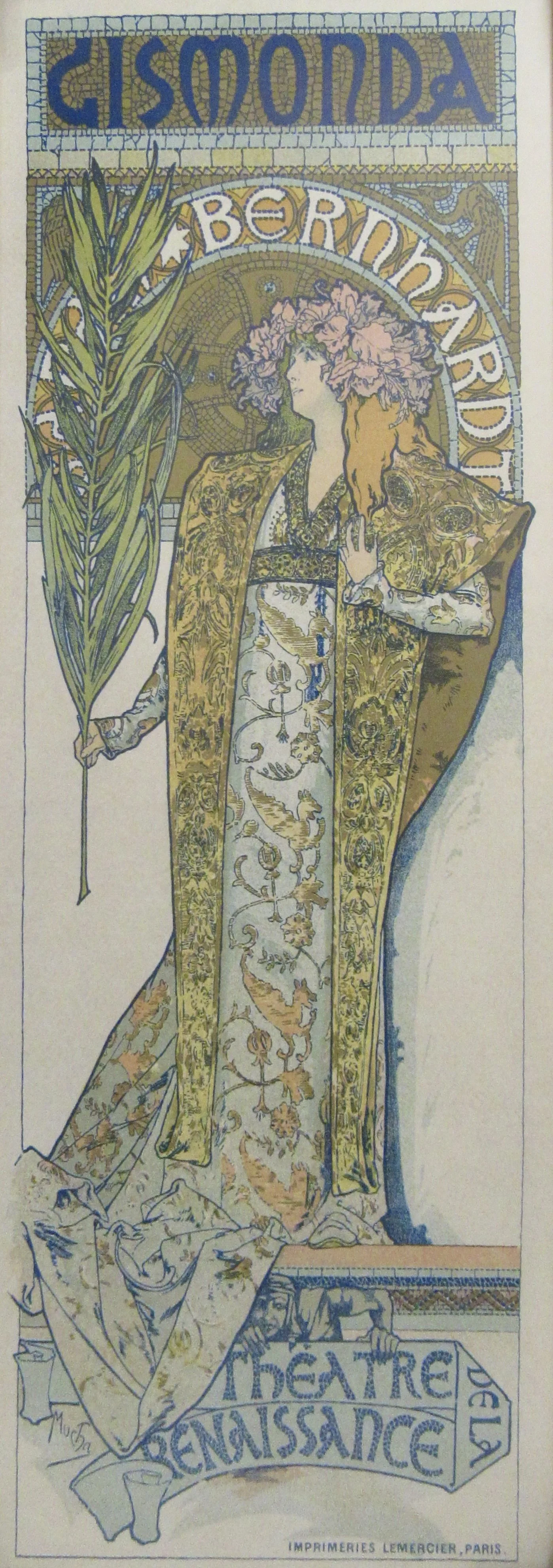
The long, narrow, near lifesized shape, pastel color palette, and statuesque pose of the figure of Sarah Bernhardt became an immediate sensation in Parisian art, catapulting Mucha to fame as collectors flocked to the theater to bribe workers to sell them the poster, or would cut them down with razors in the middle of the night. Sarah Bernhardt was so pleased with the poster that she offered Mucha a five year contract to create props, posters, and costume designs, which fostered a relationship between the two for many years. This close relationship with the famous actress also enabled him to sign a contract with the printer, Champenois, to produce commercial and decorative posters, furthering his fame in the Paris art scene. Drawing from renaissance themes and composition styles of early 20th century Japanese graphic design, Mucha’s style became intrinsically linked to the Parisian Art Nouveau movement, becoming known as “Le Style Mucha”, despite his own hesitancy to affiliate himself with the movement.
In this advertisement for Gismonda, Mucha creates a powerful and idealized interpretation of the Byzantine character. The lettering at the top of the poster calls to mind the mosaics of the Byzantine Empire filled with glistening tesserae. Sarah Bernhardt’s character takes center stage in this asymmetrical composition. The actress’s name creates a halo effect around her head, her heavily embroidered, golden robe, surrounded by native plants of the Byzantine region completes the scene. Upon viewing the piece, Bernhardt exclaimed, “Monsieur Mucha, you have made me immortal.”
ARTIST
Alphonse Mucha
TITLE
Gismonda
DATE
1894
MEDIUM
Print - Color Lithograph
DIMENSIONS
Height x Width: 120.65 cm x 41.91 cm
CURRENT LOCATION
Czech Center Museum
4920 San Jacinto St.
Houston, TX 77004
ACCESSION NUMBER
CLASSIFICATION
Print
PROVENANCE
The piece was acquired through the Czech Center Museum Houston by unknown donation.
The Times of the Day - Series
Designed as part of a commission for Champenois printer, The Times of the Day series combines elaborate yet delicate colors with intricate floral motifs. Mucha depicts each woman in the natural setting that mirrors her mood and reflects the emotion of her title. The whole is then enclosed in an elaborate ornamental frame reminiscent of a Gothic window.
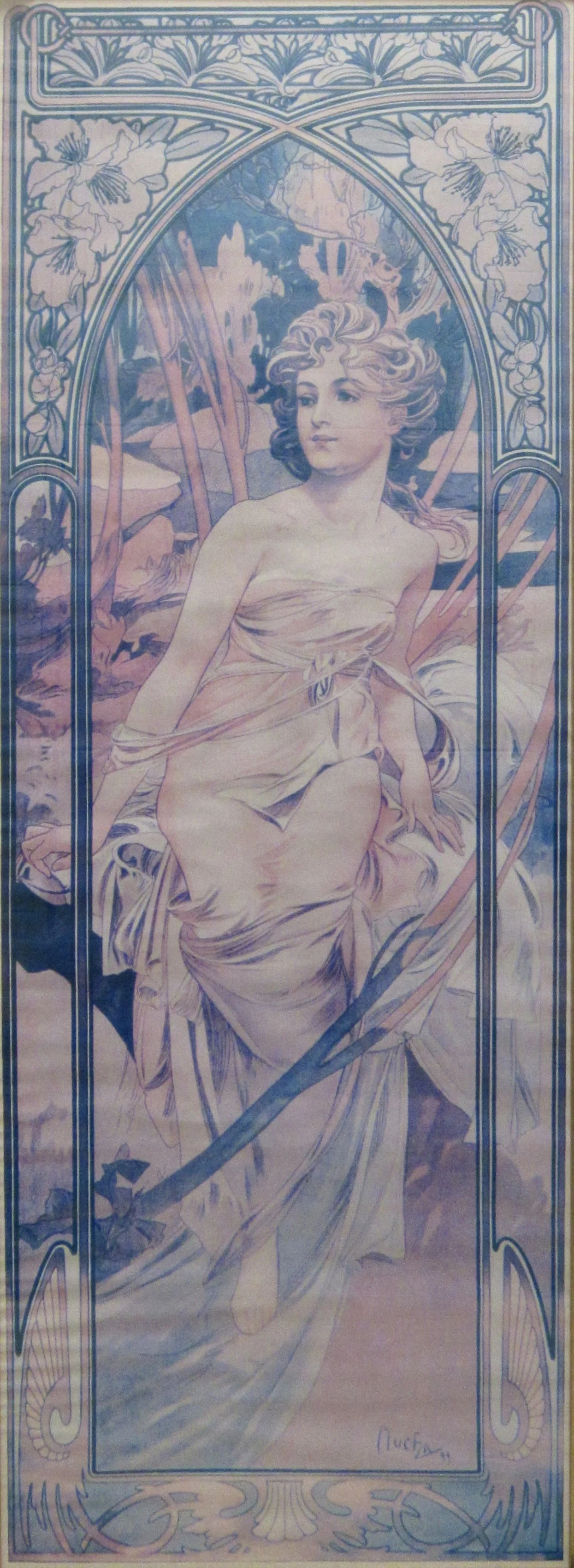
With the rise in the popularity of Mucha’s poster designs, he set out to create decorative panels for domestic use. The Times of Day was the fourth such series, which aimed to mass produce decorative art so it could be enjoyed by those of all classes. As in some of Mucha’s earlier series, he combines a fresh and delicate palette, which is enhanced by native flower motifs. The tight framing gives viewers a glimpse into an intimate space, where Mucha has personified the times of the day.
Mucha’s Morning woman is draped in a soft pink garment, accentuating the form of her body. The pink tones in her gown are complemented by the shades of green in the foreground and background and her gentle expression also correlates with the time of the day she represents.
ARTIST
Alphonse Mucha
TITLE
Times of the Day - Series
Morning Awakening
DATE
1899
MEDIUM
Print - Color Lithograph
DIMENSIONS
Height x Width: 119.38 cm x 43.18 cm
CREDIT LINE
Gift of Robert J. Dvorak
CURRENT LOCATION
Czech Center Museum
4920 San Jacinto St.
Houston, TX 77004
ACCESSION NUMBER
PDvo1
CLASSIFICATION
Print
PROVENANCE
The piece was acquired through the Czech Center Museum Houston by Robert J. Dvorak in 2003.
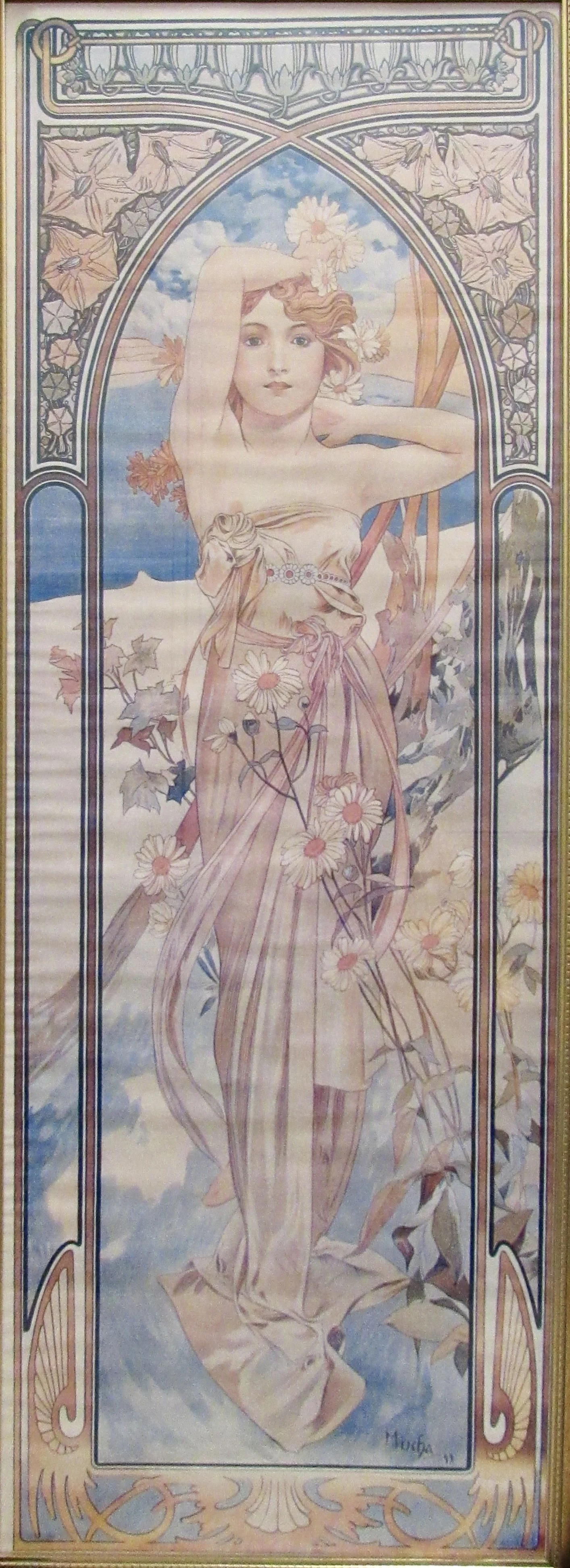
Throughout this series, and others, we see that Mucha never forgot his Czech roots. Each frame includes florals often inspired by Moravian folk art, as well as organic and geometric patterns reminiscent of what can be found in Czech Baroque church designs. The flowers within the upper part of the frame are rendered in such detail, we can identify most of the plants as native to the Czech Republic.
The mood is heightened in the Brightness of Day, where Day seems resplendent draped in marigold hues. She almost seems to float within the scene as cheery yellow Asteraceae flowers help to enhance the atmosphere. The Lady of Day’s direct gaze is a powerful reminder that Mucha women create a sense of modern sensuality and empowerment.
ARTIST
Alphonse Mucha
TITLE
Times of the Day - Series
Brightness of Day
DATE
1899
MEDIUM
Print - Color Lithograph
DIMENSIONS
Height x Width: 119.38 cm x 43.18 cm
CREDIT LINE
Gift of Robert J. Dvorak
CURRENT LOCATION
Czech Center Museum
4920 San Jacinto St.
Houston, TX 77004
ACCESSION NUMBER
PDvo2
CLASSIFICATION
Print
PROVENANCE
The piece was acquired through the Czech Center Museum Houston by Robert J. Dvorak in 2003.
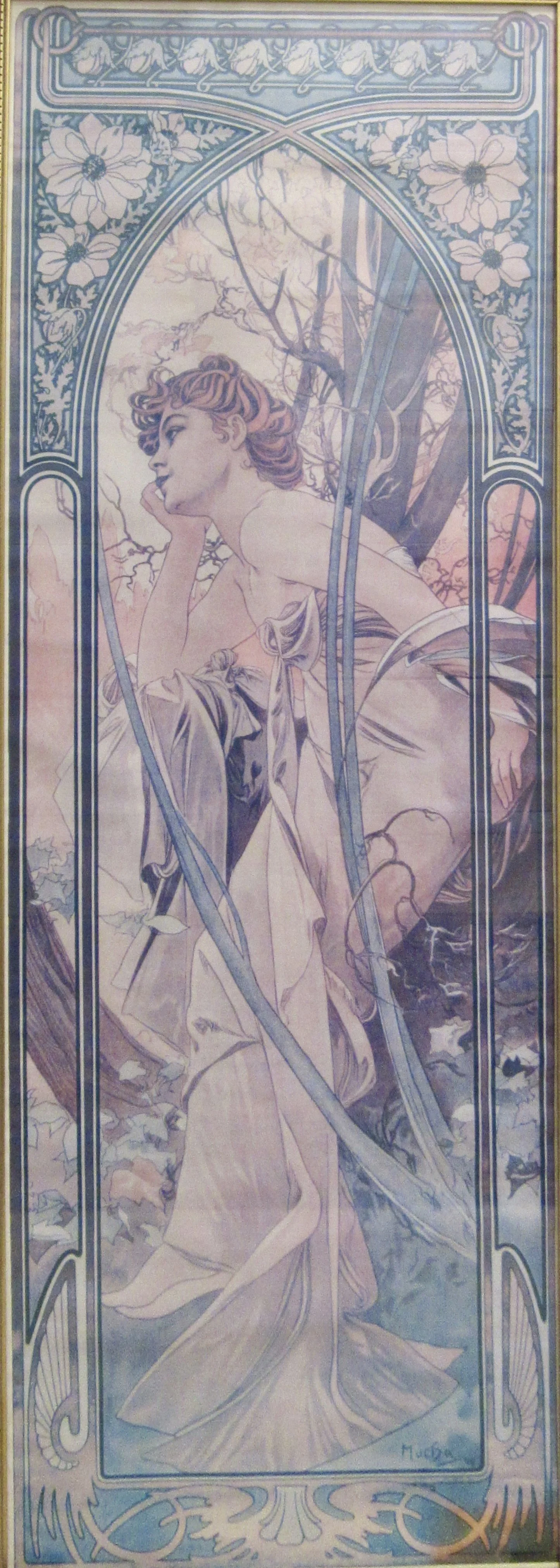
The mass production of these decorative series posters allowed those who were in awe and inspired by the Art Nouveau movement to acquire decorative prints for their homes, even when unable to afford more expensive, original Art Nouveau inspired luxuries. Art was no longer just for the elite, but for anyone who felt inspired by its beauty.
Mucha's signature delicate and muted palette is echoed throughout the series as he expertly crafts detailed white flowers along the top border of the frame. The lady lounges within her framework in evening contemplation seemingly in intimate harmony with her surroundings.
ARTIST
Alphonse Mucha
TITLE
Times of the Day - Series
Evening Contemplation
DATE
1899
MEDIUM
Print - Color Lithograph
DIMENSIONS
Height x Width: 119.38 cm x 43.18 cm
CREDIT LINE
Gift of Robert J. Dvorak
CURRENT LOCATION
Czech Center Museum
4920 San Jacinto St.
Houston, TX 77004
ACCESSION NUMBER
PDvo3
CLASSIFICATION
Print
PROVENANCE
The piece was acquired through the Czech Center Museum Houston by Robert J. Dvorak in 2003.
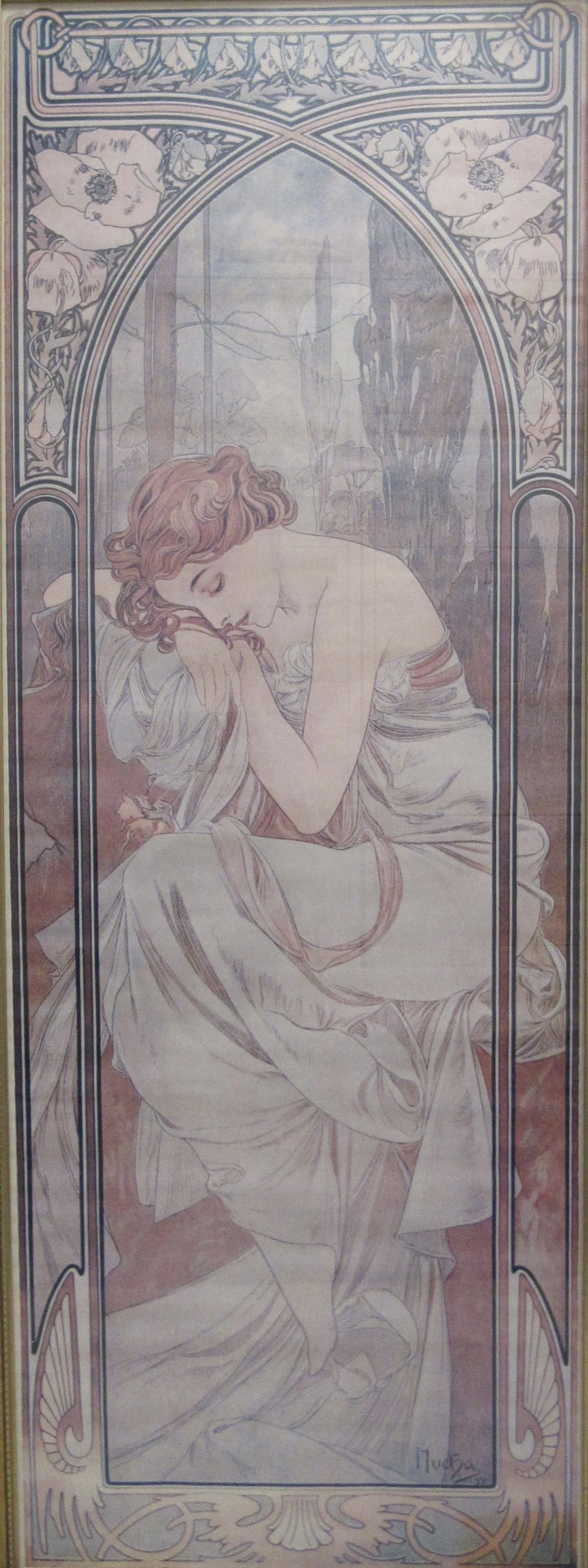
Mucha was a firm believer in the idea that beautiful works of art improved quality of life and truly believed it was his duty as an artist to promote art for ordinary people. As he once said, “I was happy to be involved in an art for the people, and not for private drawing rooms. It was inexpensive, accessible to the general public, and it found a home in poor families as well as more affluent circles.”
Once again drawing on Czech roots for floral representation, poppies, typically a symbol of rest and sleep, encompass the top frame of Night’s Rest. Her soft blue garment drapes over her like an ethereal blanket, as she rests her head on her arm in resplendent sleep.
ARTIST
Alphonse Mucha
TITLE
Times of the Day - Series
Night’s Rest
DATE
1899
MEDIUM
Print - Color Lithograph
DIMENSIONS
Height x Width: 119.38 cm x 43.18 cm
CREDIT LINE
Gift of Robert J. Dvorak
CURRENT LOCATION
Czech Center Museum
4920 San Jacinto St.
Houston, TX 77004
ACCESSION NUMBER
PDvo5
CLASSIFICATION
Print
PROVENANCE
The piece was acquired through the Czech Center Museum Houston by Robert J. Dvorak in 2003.
The Moon and Stars- Series
In The Moon and the Stars series, Mucha presents the stars as female figures, with a philosophical quality beyond mere decoration. Unlike his earlier, earthly representations, these women are depicted as divine beings, floating in a space illuminated by radiant light.
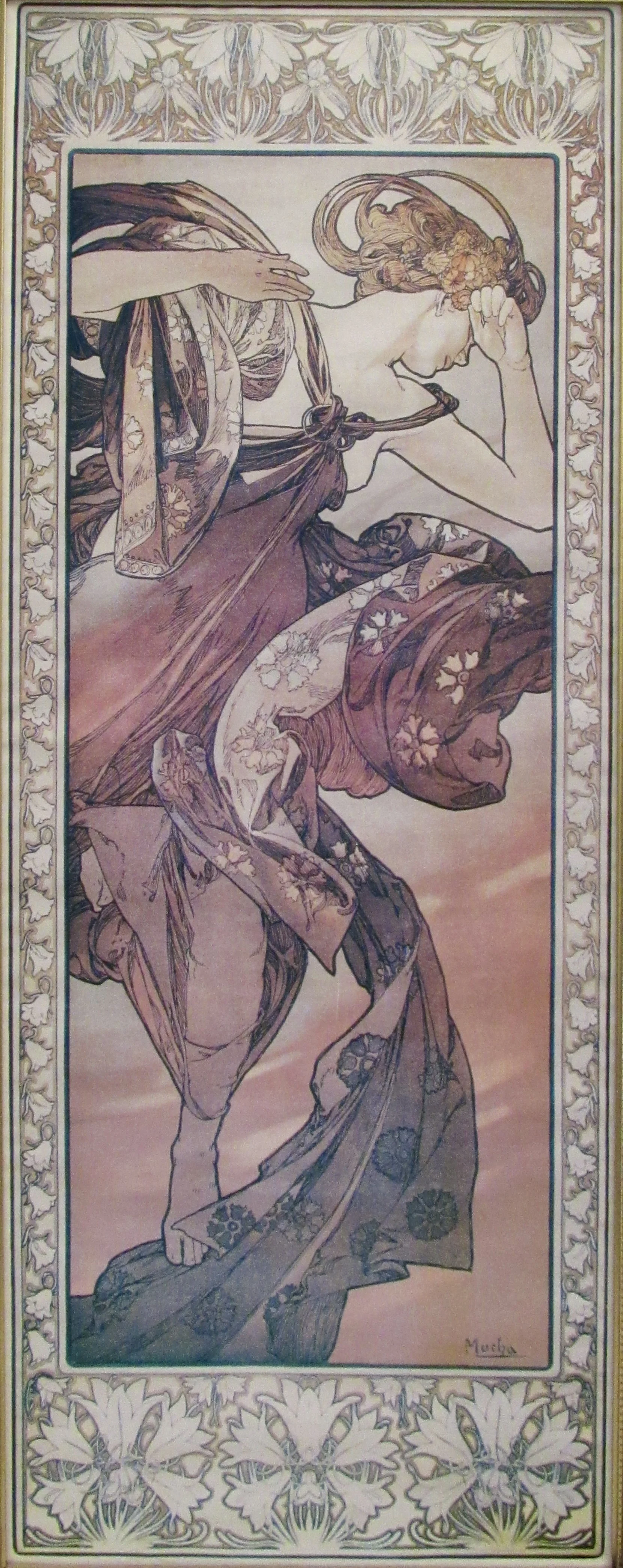
The planet Venus, often referred to as the evening star, stands out as the brightest star in the western sky as the sun sets. Its presence has been noted and tracked by ancient civilizations since the beginning of time, aiding in some of the most significant astronomical advances and discoveries throughout history. Observing the orbiting of Venus allowed early astronomers to place the Sun, rather than the Earth, as the center of the solar system.
In Mucha’s depiction of the Evening Star, her body twists within the borders of the piece, creating organic curving lines within the composition. She turns her face away from a central source of light radiating from the middle. A contrasting red-orange glow emanates from the bottom of the frame bringing to mind the colors of a sunset. Like the other women in the series, she seems to levitate within the frame, accentuating her freedom to move through space, not held captive by her frame.
ARTIST
Alphonse Mucha
TITLE
The Moon and the Stars - Series
The Evening Star
DATE
1902
MEDIUM
Print - Color Lithograph
DIMENSIONS
Height x Width: 119.38 cm x 43.18 cm
CREDIT LINE
Gift of Robert J. Dvorak
CURRENT LOCATION
Czech Center Museum
4920 San Jacinto St.
Houston, TX 77004
ACCESSION NUMBER
PDvo4
CLASSIFICATION
Print
PROVENANCE
The piece was acquired through the Czech Center Museum Houston by Robert J. Dvorak in 2003.
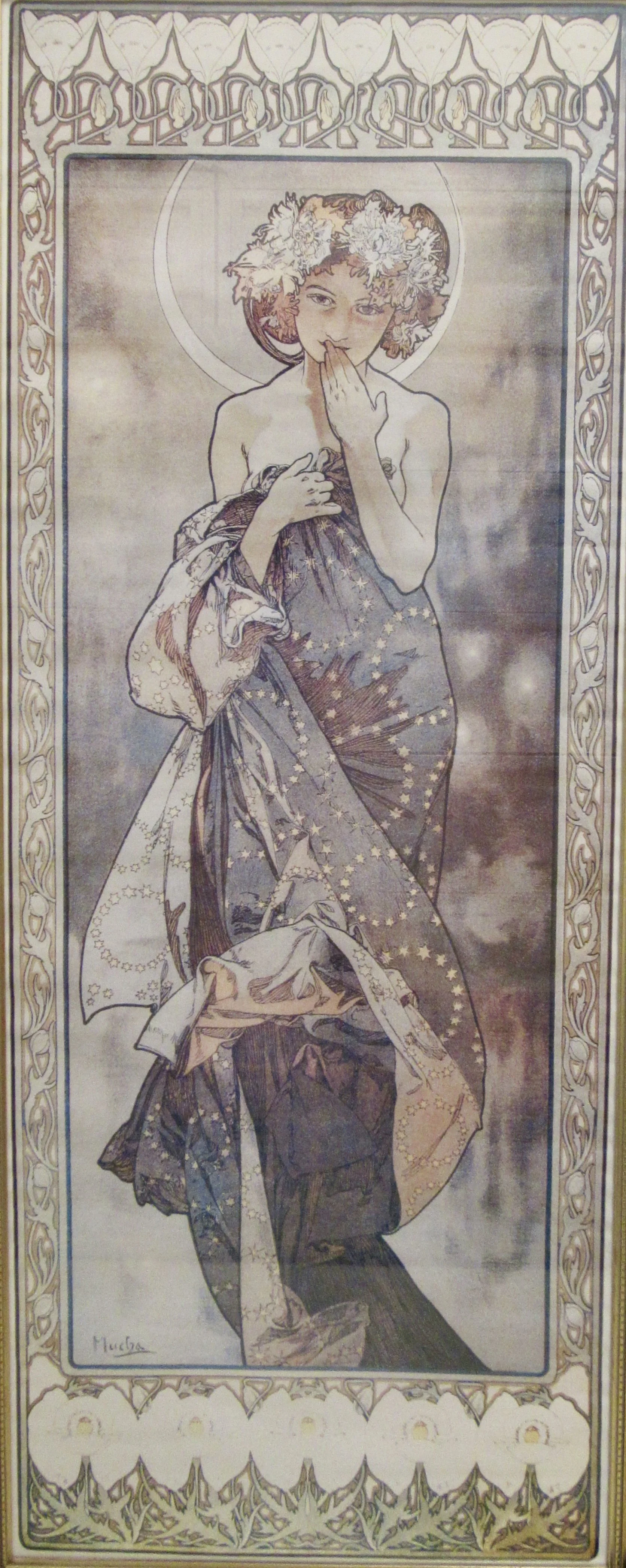
Mucha was interested in mysticism and occultism, which heavily influenced his work throughout his career. The moon has long held links to these ideas, particularly when considering the moon's historical significance as Earth’s constant companion, as well as a method of time keeping, source of mythology, and scientific advancement. Often seen as a representation of the divine feminine, the moon is not lacking in power and strength as she controls the tides and lights the night sky, remaining a guiding force and often turned to for her wisdom.
Astral bodies are personified in this captivating series ensconced in Mucha’s organic spiralling framework. Radiating with an ethereal glow, the Moon lady's light seems to come from within, emphasized by the light tone of her skin against the moody textural background. Throughout Mucha’s last decorative panel series, viewers bear witness to his masterful handling of value, texture and color within the challenging medium. As the Moon woman gathers her starry robe in her hands, the texture and drape of the garment is accentuated by the attention to detail in the robes motifs, as well as folds and Mucha’s ability to play with light and shadow. A crescent moon shines behind her head creating a nimbus effect, accentuating her as an astral body. Her hand is covering her mouth, perhaps cueing viewers to take in the scene in silence.
ARTIST
Alphonse Mucha
TITLE
The Moon and the Stars - Series
The Moon
DATE
1902
MEDIUM
Print - Color Lithograph
DIMENSIONS
Height x Width: 119.38 cm x 43.18 cm
CREDIT LINE
Gift of Robert J. Dvorak
CURRENT LOCATION
Czech Center Museum
4920 San Jacinto St.
Houston, TX 77004
ACCESSION NUMBER
PDvo8
CLASSIFICATION
Print
PROVENANCE
The piece was acquired through the Czech Center Museum Houston by Robert J. Dvorak in 2003.
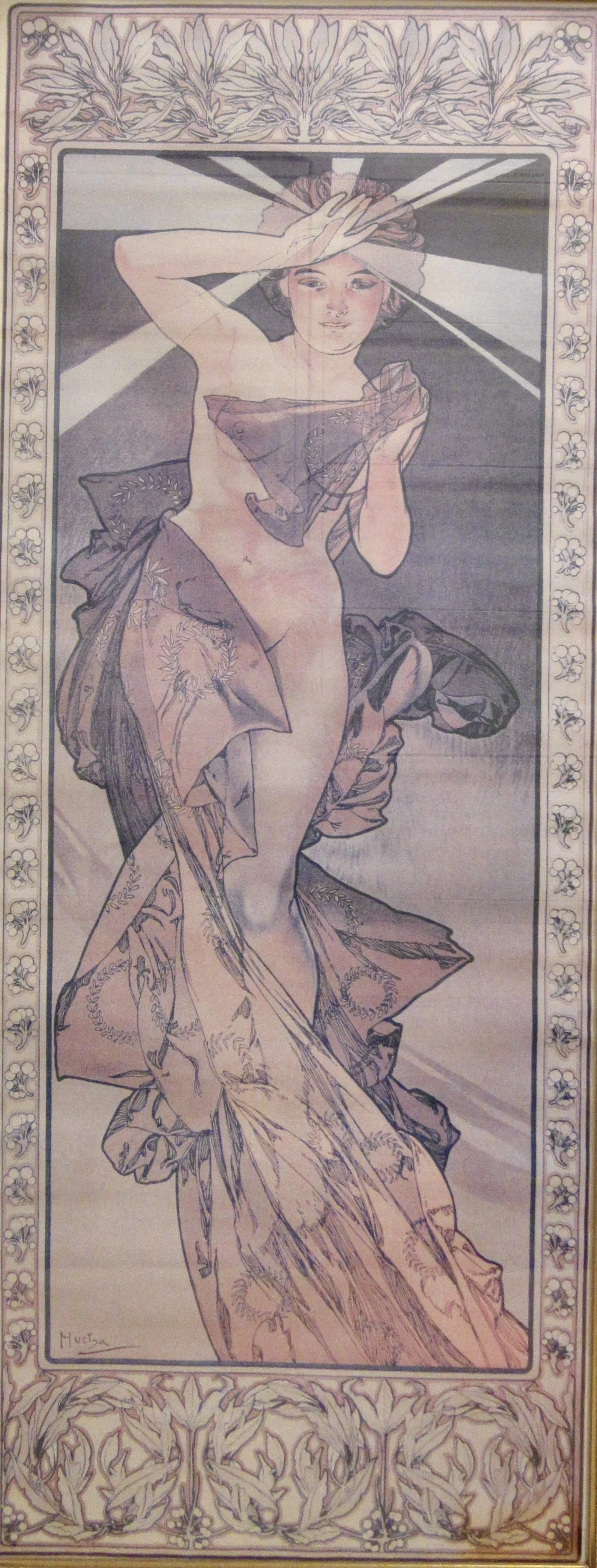
The ancients’ often referred to Venus as the Morning Star or the Evening Star. Although it took a period of approximately 584 days to complete this cyclical transition; they did not realize that both astral bodies were indeed one. A planetary twin to Earth, Venus shines so brightly that it is often mistaken for a star and can be seen, from November through Summer, shining brightly as the sun begins to rise in the eastern sky. Its dual identity as both morning and evening star could explain why Mucha had these stars flank the moon in the series, reflecting Venus’ nightly journey across the sky.
In this image of the Morning Star, light radiates from her hand over her brow; she grasps the edge of the fabric in her left hand. While her posturing is front-facing, her downward gaze suggests a hint of mystery, avoiding the intimacy of direct eye contact. Through her frontal stance, Mucha helps to draw attention to the power of her femininity. As with the other forms in this series, Mucha endeavors to explore the intensely philosophical meaning behind his subjects.
ARTIST
Alphonse Mucha
TITLE
The Moon and the Stars - Series
The Morning Star
DATE
1902
MEDIUM
Print - Color Lithograph
DIMENSIONS
Height x Width: 119.38 cm x 43.18 cm
CREDIT LINE
Gift of Robert J. Dvorak
CURRENT LOCATION
Czech Center Museum
4920 San Jacinto St.
Houston, TX 77004
ACCESSION NUMBER
PDvo6
CLASSIFICATION
Print
PROVENANCE
The piece was acquired through the Czech Center Museum Houston by Robert J. Dvorak in 2003.
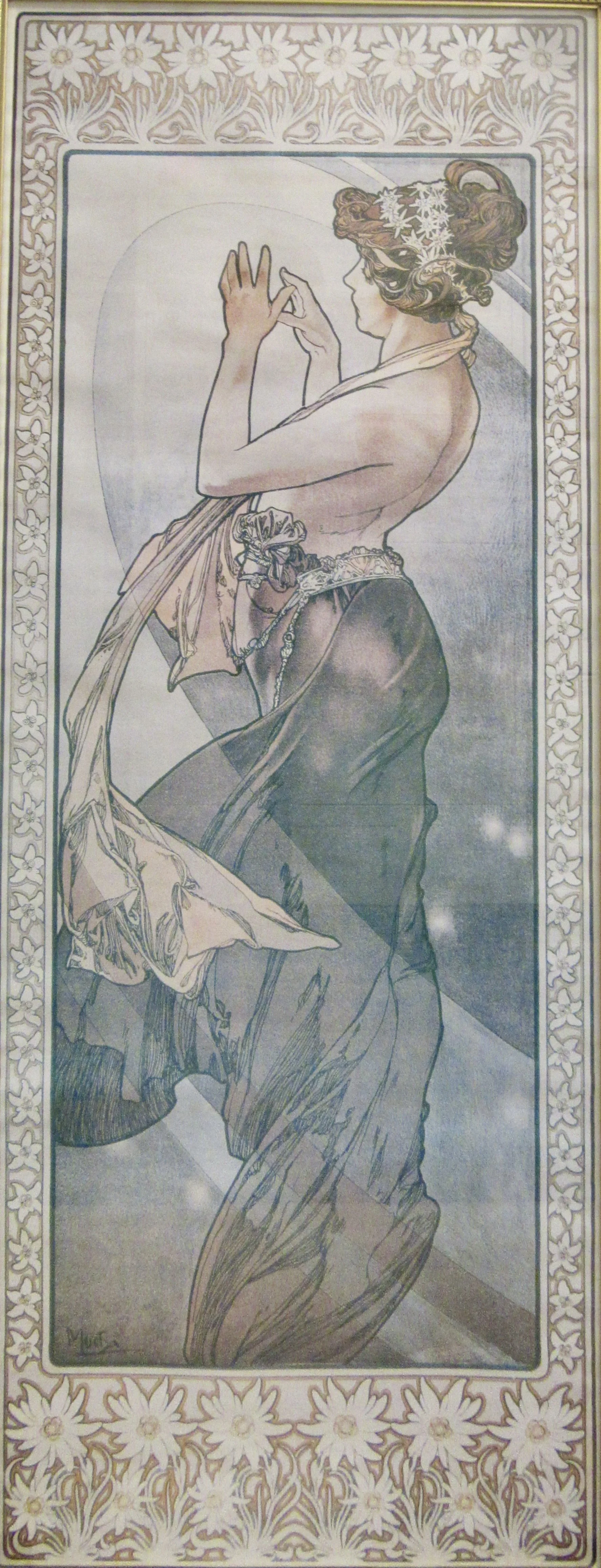
Otherwise known as the North Star, the Pole Star remains steady in the sky, guiding those in need; unlike Venus whose position changes throughout the year. Though not as bright as the morning and evening star, its consistent location in the sky allowed it to be used as a navigational tool, stationary and immovable, often symbolizing guidance and direction for a weary traveler.
Mucha’s Pole Star woman floats in the firmament, her eyes fixed on a source of light she guards with her hands. Her soft and graceful posturing embodies the idealized version of a “Mucha Woman”. A watery color scheme runs throughout the series linking all four of the works in a harmonious fashion. Mucha’s masterful handling of chromolithography can be fully appreciated here in his final series, where a clear display of his honed skills in rendering shadow and texture can be appreciated.
ARTIST
Alphonse Mucha
TITLE
The Moon and the Stars - Series
The Pole Star
DATE
1902
MEDIUM
Print - Color Lithograph
DIMENSIONS
Height x Width: 119.38 cm x 43.18 cm
CREDIT LINE
Gift of Robert J. Dvorak
CURRENT LOCATION
Czech Center Museum
4920 San Jacinto St.
Houston, TX 77004
ACCESSION NUMBER
PDvo7
CLASSIFICATION
Print
PROVENANCE
The piece was acquired through the Czech Center Museum Houston by Robert J. Dvorak in 2003.
“The purpose of my work was never to destroy but always to create, to construct bridges, because we must live in the hope that humankind will draw together and that the better we understand each other, the easier this will become” - Alphonse Mucha
Written by Erin Marashi and Tria Van Horn